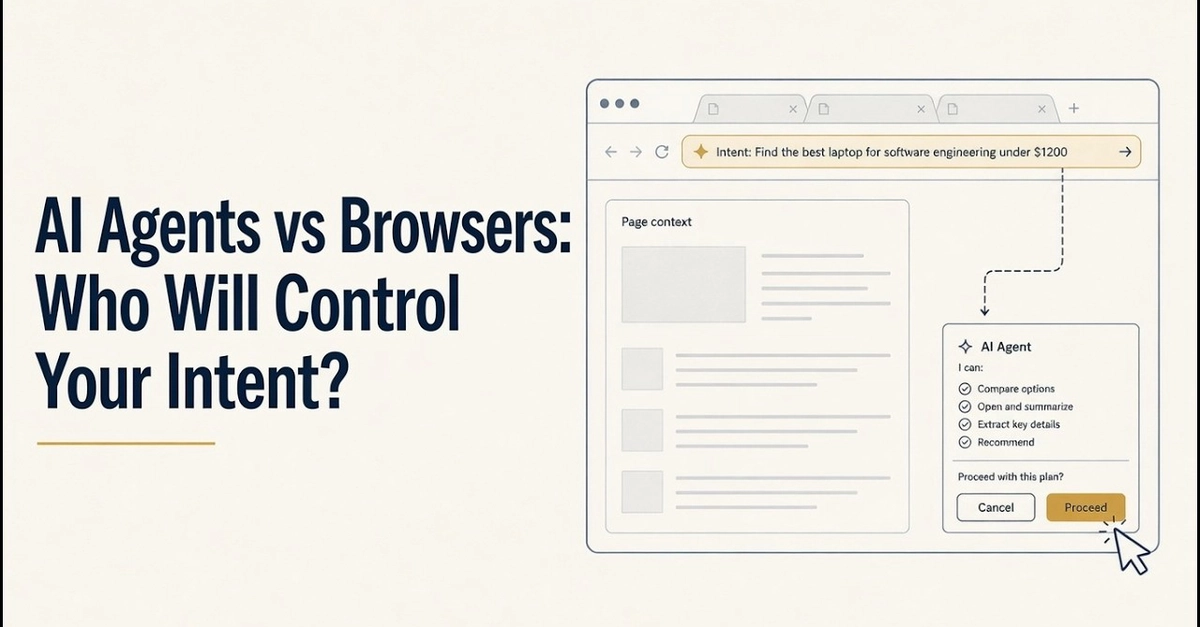
Mazy Dar is CEO and Founder of here.io, an AI-first enterprise browser and workspace platform.gettyRemember the browser wars? The 20-year fight for market dominance, waged under the premise that whoever controls the browser controls the internet?In the first browser war, which ran from around 1995 to 2001, Microsoft beat Netscape’s Navigator by making Internet Explorer the default option on all Windows machines. In the second browser war, which ran from 2004 to 2017 or so, Google Chrome’s rapid feature releases dethroned Internet Explorer. Chrome has commanded a 60% or higher market share ever since, and its dominance has seemed as permanent as its hold over internet search.Now, AI has sparked a new round of competition. Tech companies are racing to add generative and agentic capabilities to web search. Google recently added AI capabilities to Chrome. OpenAI, Perplexity and The Browser Company have launched AI-centric browsers in the past year. Even Opera is back in the mix. Enterprises are being left behind in this competition. The browsers of yesteryear targeted consumers to secure mass adoption. For all the proof you need that the new AI ones aren’t being designed for businesses, look at the launch categories Google chose for its AI capabilities: shopping, wellness and personal productivity. The stakes are different this time around. The consumer AI browsers built today come from companies with a strong commercial interest in distributing the AI stack underneath it. Google's browser pushes you to Gemini, Atlas pushes you to ChatGPT and Comet pushes you to Perplexity. All of these players want their AI to reign supreme, and the ones with popular browsers will attract the most users.The browser is a natural on-ramp, but what the consumer companies are dealing in won’t drive enterprise adoption. AI has to fold into the work their people are already doing, securely and compliantly.Consumer browsers were never made for work.When SaaS replaced on-prem software, enterprise work migrated to the browser. But the browsers in place at most enterprises today were designed for consumers to shop and search the internet. Banking, healthcare, insurance, government and other highly regulated sectors in particular have to abide by productivity, security and compliance requirements consumer browsers simply haven’t accommodated. Enterprise employees spend significant time context-switching and searching for information across systems. To cross-reference a customer record against a policy document, for example, the user has to be able to easily access information from multiple sources at a glance. They might have to dig through apps because data sets are siloed and they don’t know exactly what they’re looking for. The information they need is usually locked behind authenticated apps and websites, while consumer browsers only let them search the public internet. Consumer browsers don’t natively secure these workflows, either. In financial services, for example, the browser should enforce screenshot control. In healthcare, it should provide protected health information handling. That involves features like enterprise-grade authentication, reliable last-mile data loss prevention (DLP) controls and audit trails.Some enterprises have made do by augmenting their existing browsers (like Chrome Enterprise or Edge for Business) with security extensions. While these offer some policy management and administrative controls, I've found that the extension approach limits operating-system-level defenses, like reliably preventing screenshots and local file exfiltration. When the browser functions as the workspace, the most reliable place to govern data use is inside of it. There, users can populate fields, copy and paste, print and download files. Consumer browsers aren’t designed to comprehensively enforce security on all the actions a user might take. AI only widens the gap between consumer and enterprise-grade browsers.If enterprises thought it was dangerous before to use consumer browsers at work, throwing AI into the mix can send the risk off the charts.Compliance risks used to move at human speed. Now, AI can violate your rules a thousand times a minute. Combine an unreliable actor (an AI agent) with execution at machine speed and often limited supervision, and you’ve got a recipe for compliance disaster. I've seen many AI firms develop agents that have evolved from single-application assistants into orchestrators that touch CRM, ticketing and back-office systems. But these agents still need to be pointed at a consistent surface. The enterprise browser is the logical destination, as it can apply zero-trust policy, DLP rules and telemetry across human and agentic actions. Enterprises can use AI in the browser safely and productively as long as it comes with certain features. To start, they need audit trails structured well enough to hold up to regulatory scrutiny and enforceable in-session rules on what data can be entered into a prompt and where the output can go. Think about a telecom representative using a consumer AI browser to resolve a customer ticket. That’s an exponentially higher-risk workflow than a person using the same browser to plan a vacation. Enterprises must consider questions like the following: Which models can be used? How are sensitive inputs handled before they leave the session? How does AI-generated output flow into downstream systems? With proper enterprise browser controls, user actions can be permitted, masked, watermarked or blocked based on identity, application type and data classification—with policy messages appearing right in the tab. Without capabilities like these, you can’t fully ensure compliance.The leaders I talk to at major financial and healthcare institutions aren’t debating which AI model to use. They’re assessing whether their people can use AI at all without creating regulatory risk. The companies that crack enterprise adoption could win the browser war.Highly regulated industries like healthcare, financial services and the public sector account for a not-insignificant portion of the U.S. labor force. They represent a substantial share of the enterprise AI market. The consumer browser companies know how to launch AI tools for the mass market and other tech companies, but I don't believe they have demonstrated they can build for a claims adjuster or a healthcare administrator. The third browser war will be decided in the enterprise. The companies that figure out how to bring AI-enabled workspaces to businesses will capture a market that the current wave of AI companies has left wide open. Forbes Technology Council is an invitation-only community for world-class CIOs, CTOs and technology executives. Do I qualify?
The Browser Wars Are Back, And Businesses Are Losing
The browser is a natural on-ramp, but what the consumer companies are dealing in won’t drive enterprise adoption.
1,027 words~5 min read