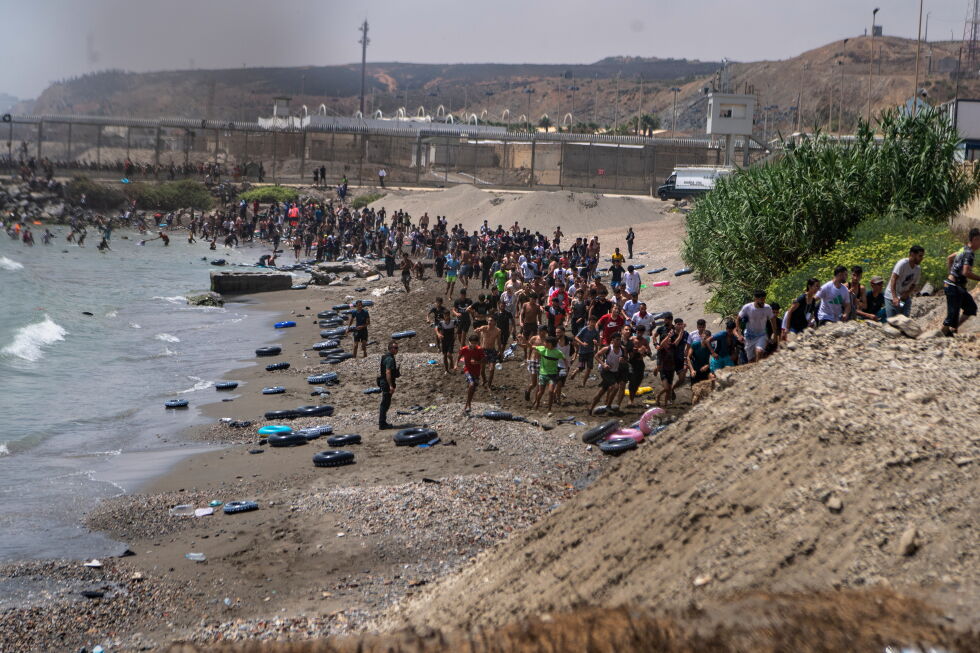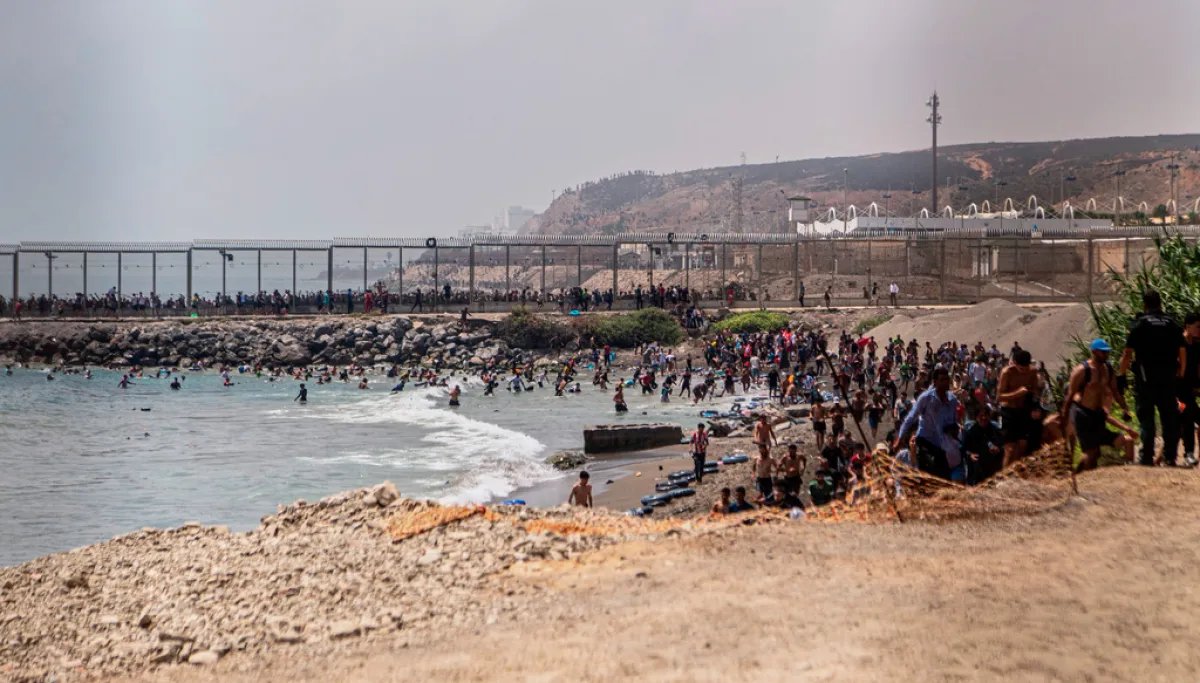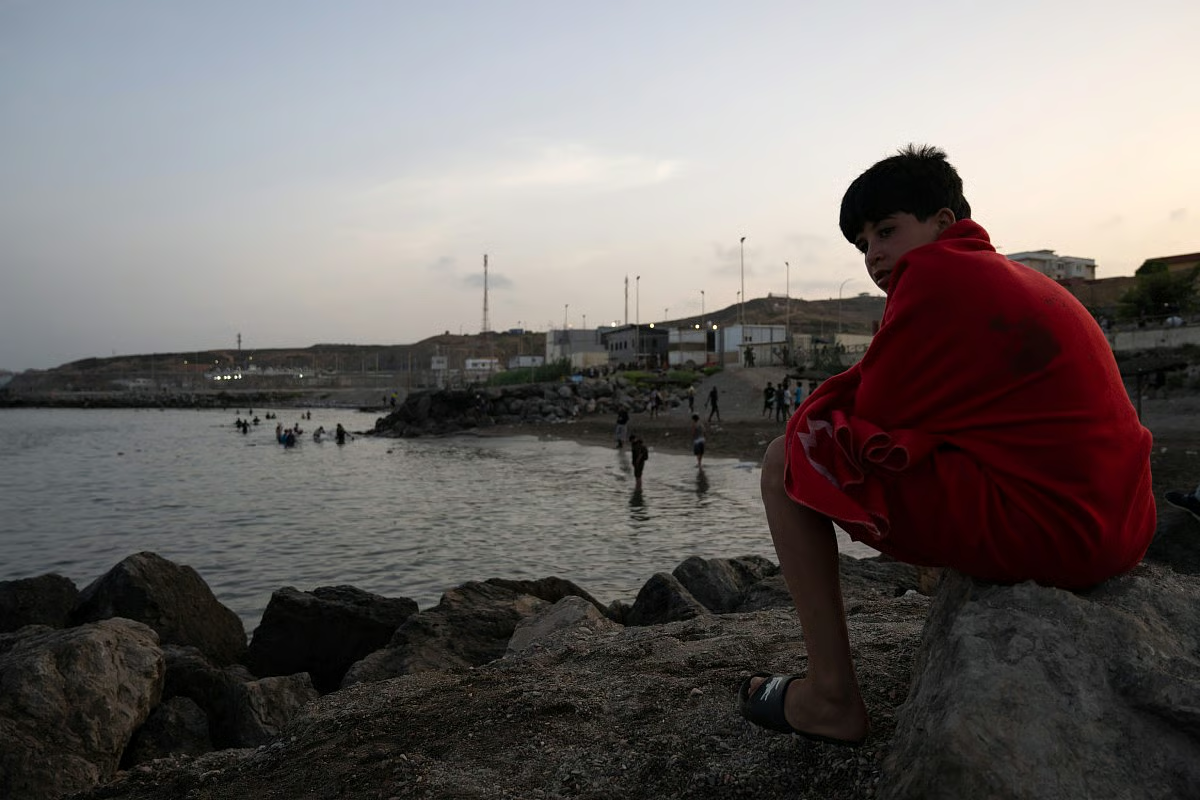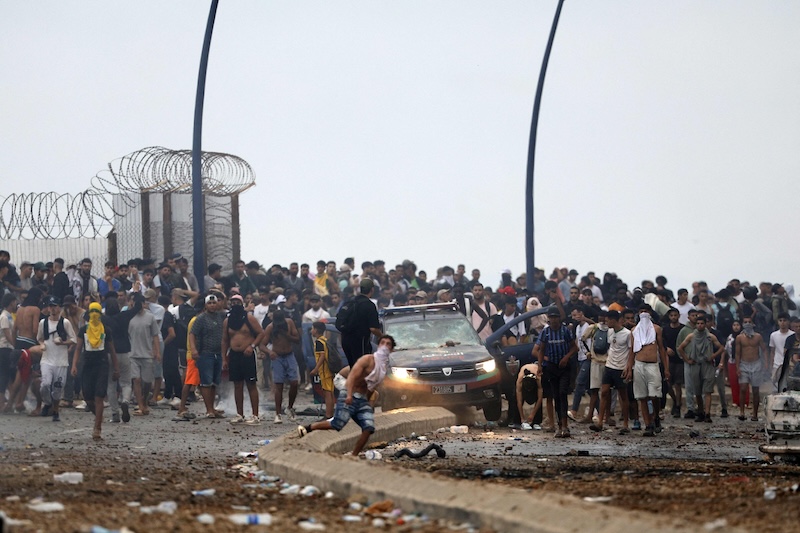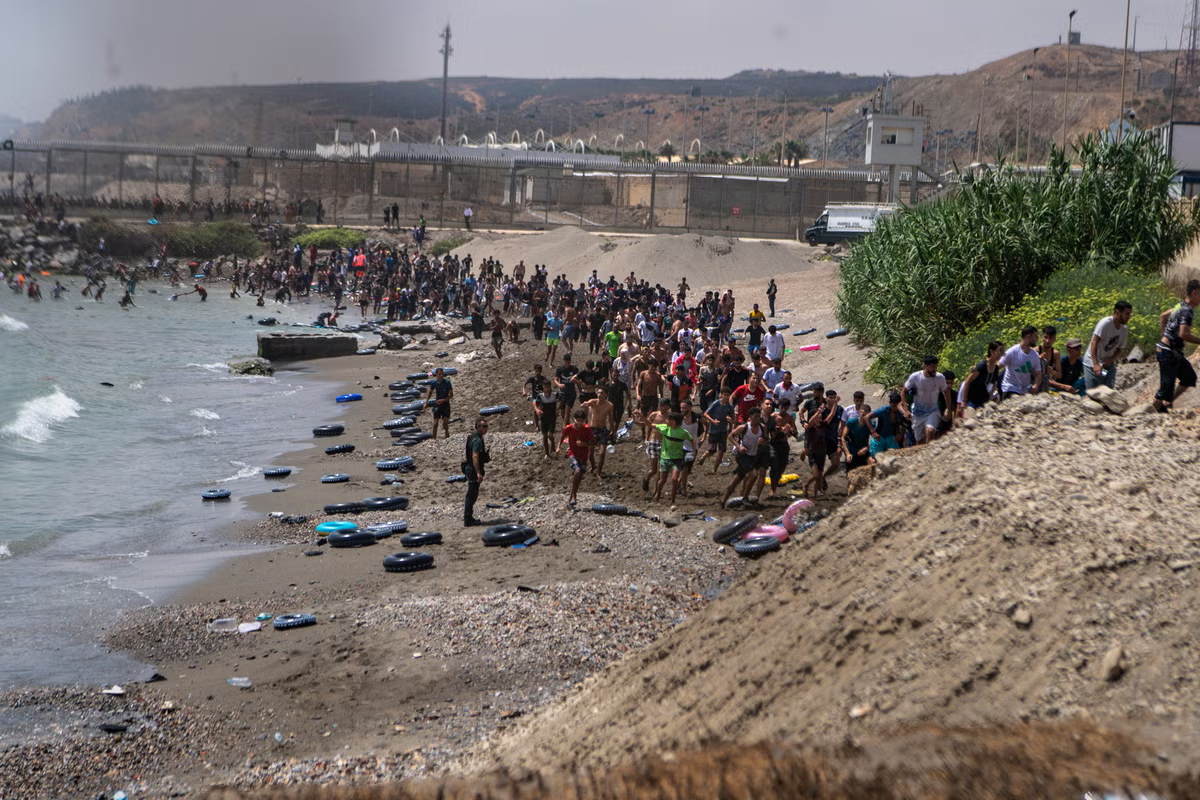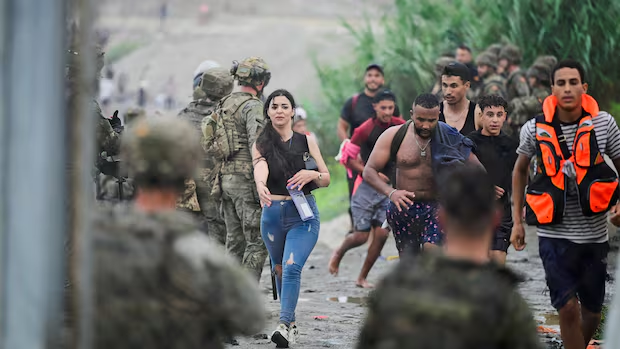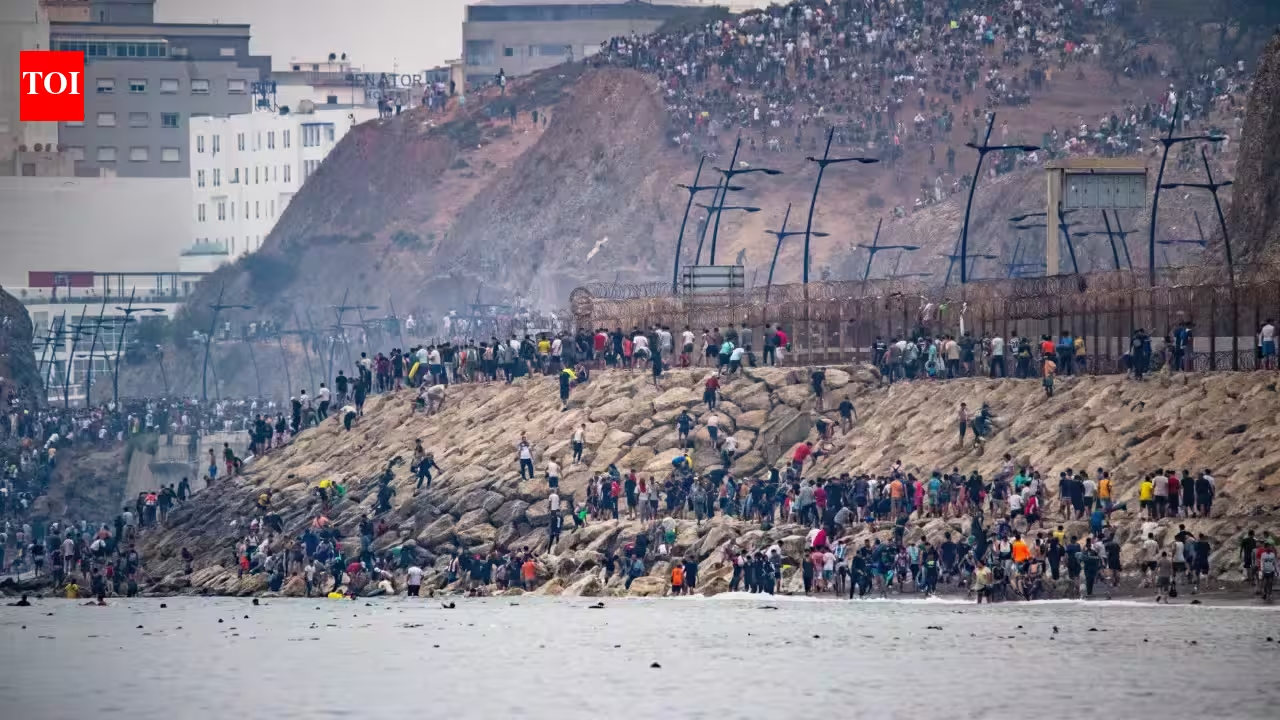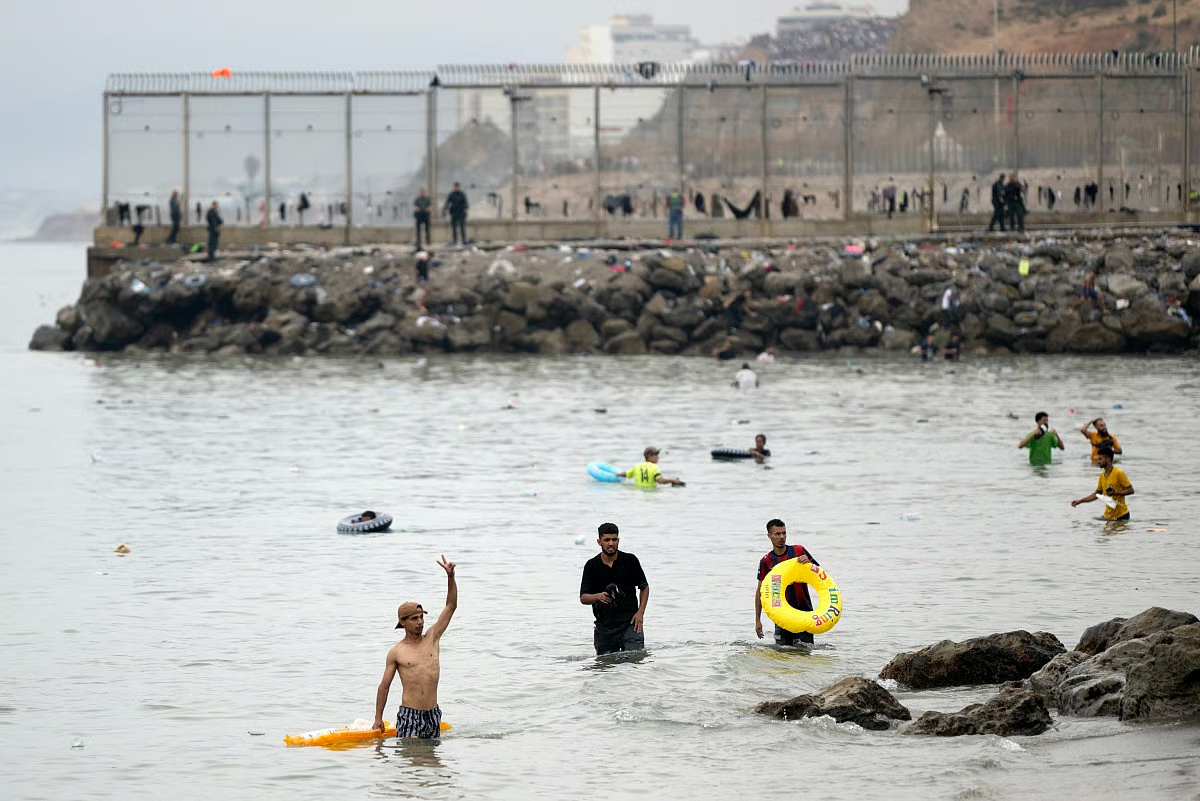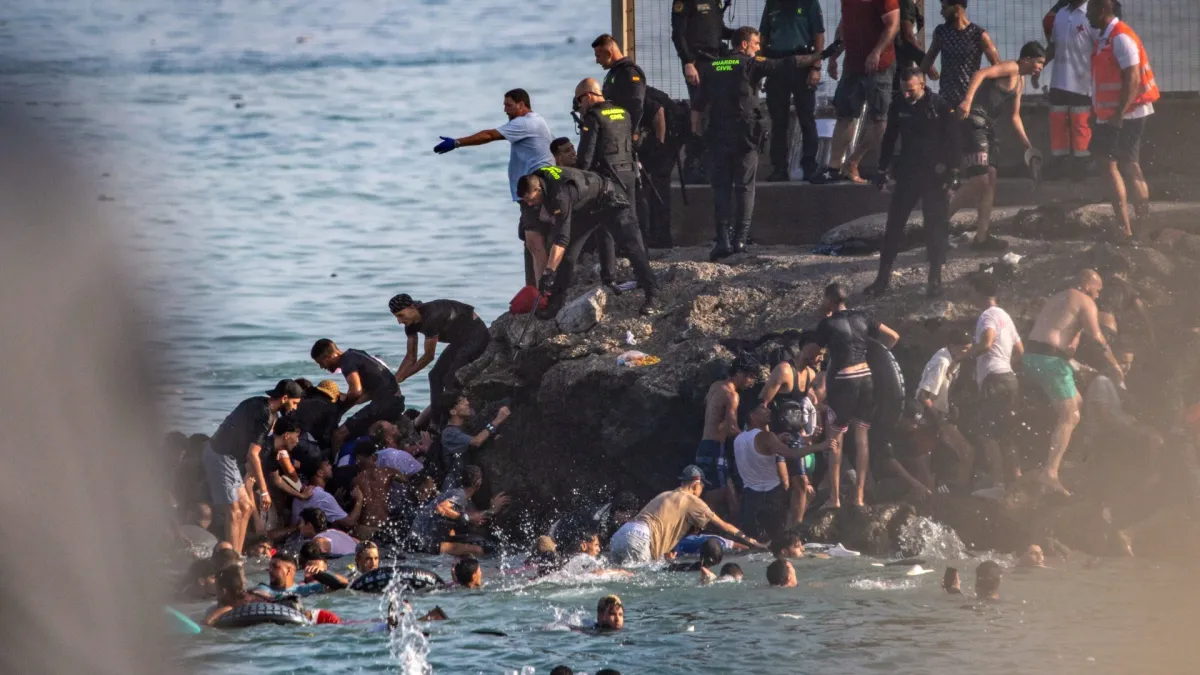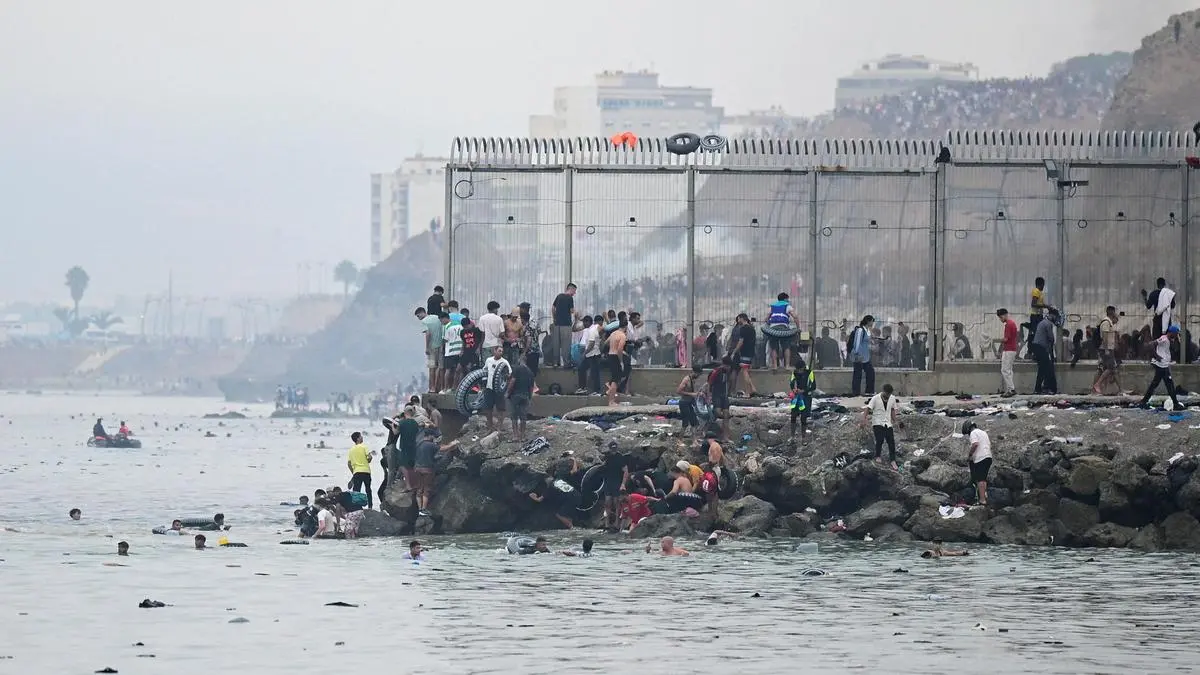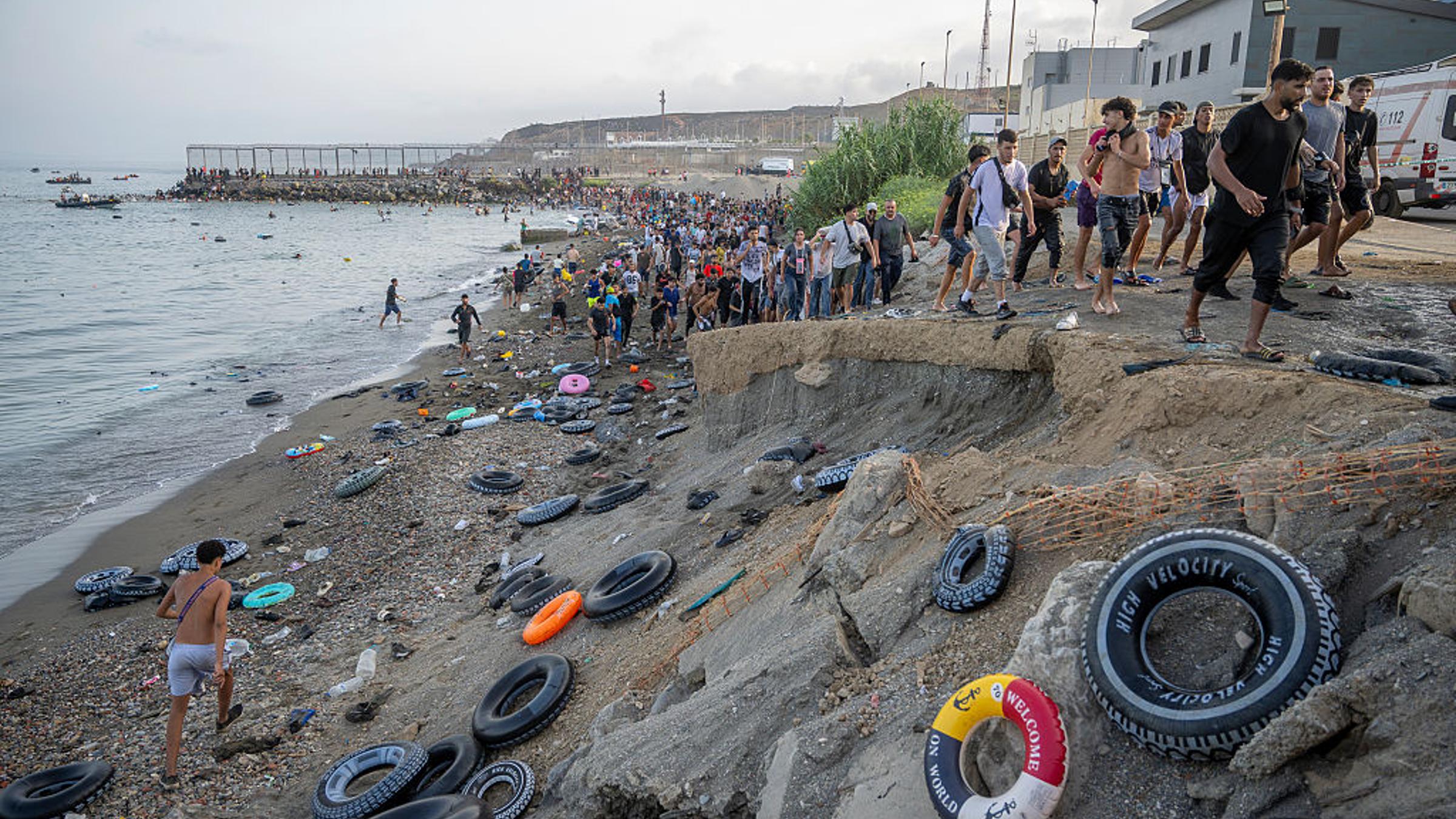
A Spanish territory in northern Africa is experiencing a humanitarian and security crisis after thousands of migrants continue to swim across the border from Morocco, with at least 24 dying in the chaos.Footage and images show scores of people, many of whom appear to be young men, bypassing the Tarajal border fence between Morocco and the Spanish exclave of Ceuta. Ceuta has long been considered a gateway for migrants seeking better lives in Europe, and the city has progressively fortified its border in response to perennial illegal border crossings. But Thursday saw a yet-to-be-explained surge: come Friday morning, Spain’s interior ministry estimated that some 49,000 migrants rushed into Ceuta in the previous 24 hours, though the government statement was later removed without explanation. Centers that receive migrants have been overwhelmed, while parks and streets were crowded with people from across the border.Juan Jesús Vivas, Ceuta’s President, called the crisis “a situation of absolute humanitarian and social emergency” on radio station Cadena SER on Thursday and asked that Ceuta be placed under a “national emergency.”The Moroccan government is asking its citizens who have crossed the border to return home. Morocco’s ambassador to Spain, Karima Benyaich, said at an embassy event Thursday that the situation in Ceuta was “not wanted by the Kingdom of Morocco,” adding that it would “prefer legal, orderly, and safe immigration for everyone.”Spain has called in its military to assist law enforcement in Ceuta, Agencia EFE reported. Prime Minister Pedro Sánchez, in a social media post, said he has spoken to Vivas and added that his government is working with Moroccan and international authorities “to restore normalcy as soon as possible” in Ceuta. Sánchez traveled to the exclave on Friday.Here’s what to know.What is Ceuta?The city of Ceuta, a peninsular region covering 19.9 sq. km (7.7 sq. mi) on Africa’s northern coast, is one of two Spanish exclaves on the continent, along with Melilla, which is about 220 km (140 mi) southeast. The two Spanish autonomous cities represent the European Union’s only land borders with Africa. Spain has possessed Ceuta, which is separated from mainland Spain by the Strait of Gibraltar, since 1580.Ceuta has a population of more than 83,000, a mix of Christians and Muslims, including residents and day workers from Morocco and Spain. Ceuta’s population has generally lived harmoniously.But Morocco, which largely surrounds the two exclaves, still treats them as occupied lands and challenges Spain’s sovereignty, citing history dating back to the Islamic conquests during the 8th century.Over the years, Rabat, the political seat of the African nation, has triggered diplomatic incidents as part of the dispute. In 2002, Morocco and Spain had a standoff after both sent forces to a small uninhabited island off Ceuta. And in May 2021, amid a deepening diplomatic spat over the disputed Western Sahara region, the Moroccan government loosened its border controls, resulting in nearly 8,000 people from Morocco and sub-Saharan countries pouring into Ceuta in just two days. Some of the migrants eventually returned, but the diplomatic rupture was only repaired when Spain backed Morocco’s autonomy plan for Western Sahara in 2022. What are authorities saying about the spike in migrant crossings?Thursday’s events did not begin without warning. Vivas, speaking to Cadena SER, said arrivals from across Morocco have overwhelmed the city’s social services and security apparatuses over the past few days, with more than 300 people per day. “To give you an idea of the scale, for the rest of Spain, this is equivalent to 2% of Ceuta’s entire population. It’s like a million people entering Spain irregularly,” Vivas told the broadcaster.The crisis in Ceuta bucks the trend for the rest of Spain, where irregular arrivals fell from 17,990 in the first six months of 2025 to 12,138 in the same period in 2026, according to Interior Ministry statistics. For Ceuta, there were 2,582 land arrivals, compared with 978 during the same period of 2025—an increase of 164%.While surges in illegal crossings have happened before in Ceuta, it’s unclear what caused the recent one.Spain’s interior ministry references an earlier court ruling behind the latest influx, arguing in a statement that it “believes that human trafficking networks are exploiting a court ruling to encourage the flow of undocumented migrants, mostly young people.” A June 29 ruling by the Spanish Supreme Court stopped authorities from summarily returning migrants who arrive in Ceuta and Melilla by sea, at least not without due process. While it did not legalize irregular entry or guarantee that those swimmers could remain in Spain, Spanish broadcaster RTVE reported on Thursday that the ruling spread on Moroccan social media, reportedly prompting people to try to enter Spain by swimming to Ceuta.There also are likely economic migrants among the latest surge. According to official statistics, while the Moroccan nationwide unemployment rate fell from 13.3% in 2024 to 13% in 2025, it remains high among Moroccan youth aged 15 to 24 (from 36.7% to 37.2%) and women (from 19.4% to 20.5%).RTVE also reported that the Spanish foreign ministry rejected insinuations that the crisis was Morocco’s retaliation for Spain reinforcing diplomatic ties with Algeria—Morocco’s regional rival. Sources from within the ministry said that Spain’s relationship with Morocco “is excellent and is in no way affected by the good relations with Algeria.”What has the response been?Ceuta’s crisis has become an opportunity for Spain’s right wing to attack Prime Minister Sánchez’s leftist, pro-migrant government. In defiance of a trend across European governments that have shifted to the right, Sánchez has planned to give 500,000 undocumented migrants in Spain a path to legal status. More than a million have applied to that program.“Pedro Sánchez, with his mass regularization, has provoked an invasion of our border, which is being experienced first and foremost by the Spaniards of Ceuta,” said Santiago Abascal, who leads the far-right party Vox. Alberto Núñez Feijóo, the leader of the conservative Popular Party, said in a video on X that Sánchez’s government “refuses to acknowledge that we are facing a serious national security problem.”The crisis in Ceuta has also prompted a flurry of reactions on social media from other parts of the world.Italy’s right-leaning Prime Minister Giorgia Meloni used the incident in Ceuta to support her anti-migrant agenda, threatening to try to suspend the Schengen agreement and remove Spain from the free-travel zone across Europe “to defend our borders and ensure the safety of our citizens.” Spain’s foreign minister summoned Italy’s ambassador over the statement.France, which shares a border with Spain, said that border control measures would be reinforced. “In response to the situation observed in the Ceuta enclave, I gave instructions as of last night to immediately strengthen the controls at the Spanish border,” Interior Minister Laurent Nuñez said on social media.Speaking to conservative media outlet the Daily Wire, White House spokesperson Anna Kelly said: “President Trump has long warned Europe what would happen if they continue to implement far-left, globalist policies—including enabling mass migration. Spain and other countries who have adopted this destructive philosophy should immediately reverse course or risk their own demise.”
Why Thousands of Moroccan Migrants Crossed Into the Spanish Exclave Ceuta
More than a dozen have died as thousands of migrants entered a small Spanish territory in Northern Africa. Here’s what to know.
1,165 words~5 min read