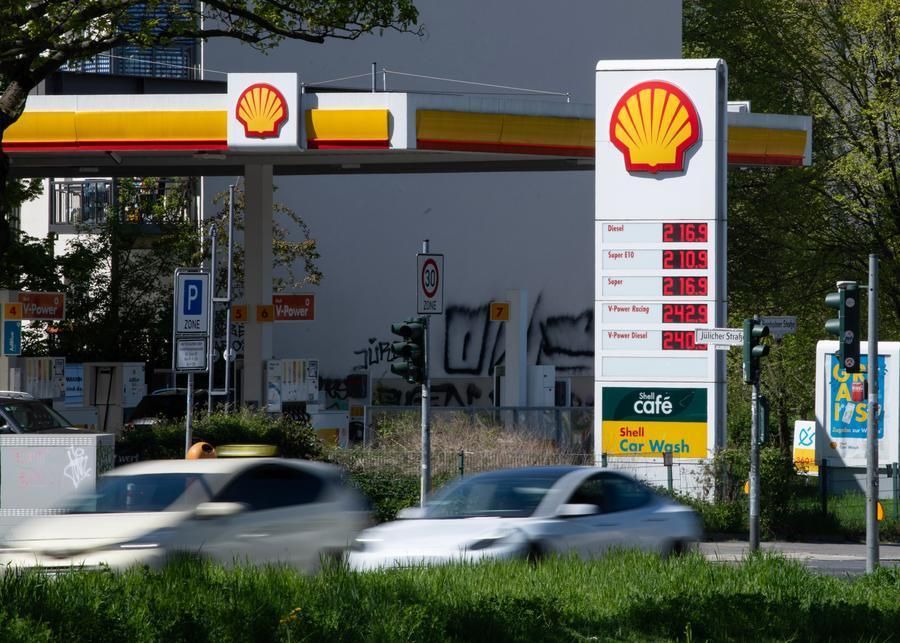
Vehicles run past a gas station in Gesundbrunnen of Berlin, Germany.
Shell posted profits of $9.84 billion for the second quarter of 2026, more than double the $4.26 billion it reported for the same period last year. It is the oil major's strongest quarterly result since 2022, and it comes at a moment when war in the Middle East has thrown global energy markets into some of their most volatile conditions in years.
The headline number tells only part of the story. Shell's own account of the quarter describes a business pulled in two directions at once: soaring prices lifting revenue on one side, and serious operational disruption cutting into production on the other.
Revenue for the quarter rose 45% year-on-year to $96.4 billion, driven largely by higher oil and gas prices. Cash flow from operations reached $21.4 billion, helped by a $3.4 billion working-capital inflow. The company also confirmed a further $3 billion share buyback and left its 2026 capital spending guidance unchanged, at $24–26 billion.
Set against that, Shell's gas production nearly halved within the space of a single quarter, falling to 631,000 barrels of oil equivalent per day, down from 909,000 in the first three months of the year. The cause was direct: the war has disrupted operations in Qatar, home to some of Shell's key liquefied natural gas (LNG) infrastructure. Its Pearl gas-to-liquids facility was struck by a missile in March and is not expected to be fully repaired for around a year, while wider outages hit the Ras Laffan LNG hub, one of the largest in the world. Across the first half of 2026, Shell's total oil and gas production was down 16% compared with the same period in 2025, only partly offset by new output from Brazil and the Gulf of America.