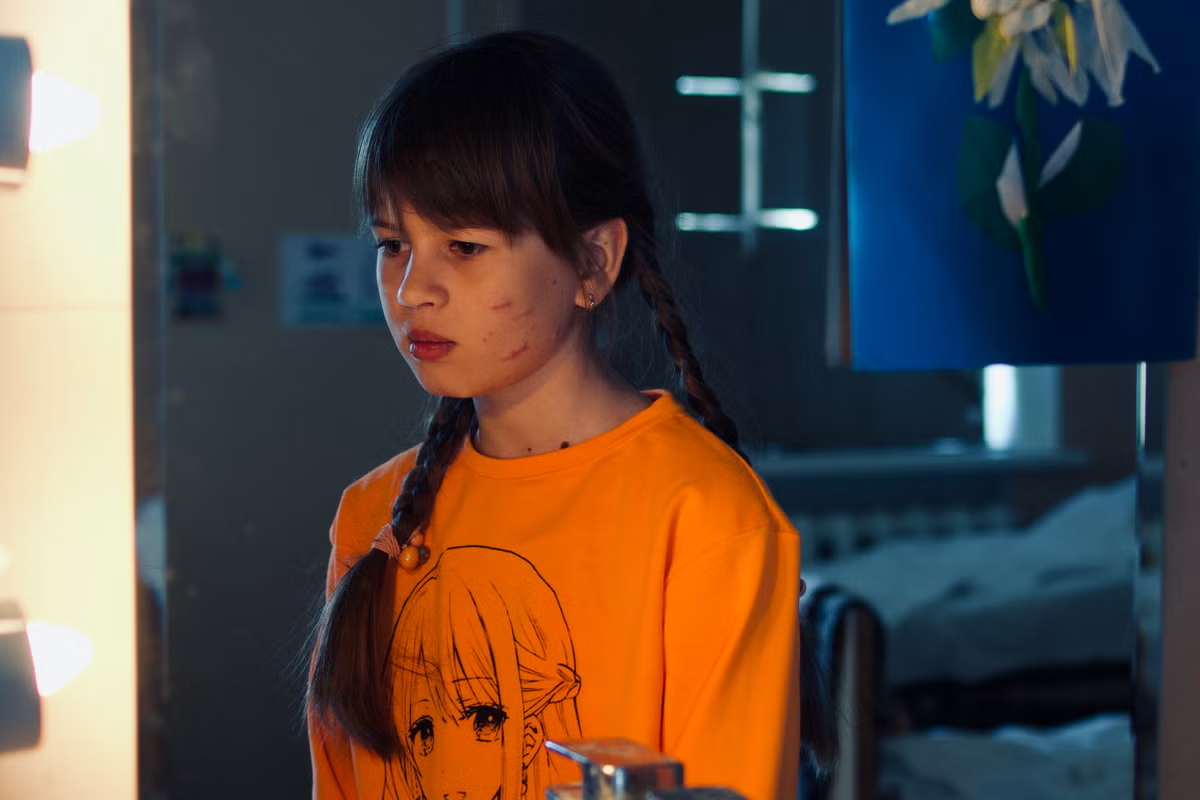
Sofia is an 11-year-old Ukrainian girl with scars on her face and light brown hair in a ponytail. She recalls vividly what happened when Russian troops entered her village.“They took the 16-year-old girls to their place,” she recounts tearfully. “When the girls came back, their clothes were torn. Everything was torn. The Russians behaved badly with those girls.“Everyone was panicking. We didn’t know what to do, where to go. The Russians came to my house. They checked my toys, my hairpins, and my clothes… They threatened my parents. They had weapons. If you say anything, they might kill you.”Sofia: ‘When the girls came back, their clothes were torn ... If you said anything, they might kill you’ (Cinessaince)The alleged sexual assaults of young girls are one of the shocking accounts in an extraordinary new documentary called Can I Go Home Now? about the experiences of Ukrainian children during the five-year-long Russian invasion. Viewed by The Independent on an exclusive basis, the film contains interviews with Ukrainian boys and girls; no adult voices are present. Produced and directed by Pritan Ambroase, a 35-year-old philanthropist and former owner of the Hollywood Insider, the film was made with help from humanitarian charities who gave access to 500 children. Having previously made a documentary focusing on private prisons in the US, Ambroase made multiple perilous visits to Ukraine by flying to Poland and then travelling by car to Lviv, and train to Kyiv, to document their harrowing stories from a war where it is estimated Ukraine has endured between 525,000 and 625,000 casualties, including 125,000 and 150,000 fatalities. Millions of Ukrainian children have fled their homes since Russia’s full-scale invasion began in 2022. In 2025, Ukrainian authorities said more than 19,500 people have been unlawfully deported or forcibly transferred to Russia or Russian-occupied territory, with only a fraction returned to their families.We were promised we were going to a camp like the Bahamas. My Mum came to pick me up, but she was late. The gates were closed ... we were put on a shipVitaly, 16-year old UkrainianDuring his visits, Ambroase heard heartbreaking testimonies to a relentless soundtrack of explosions, missiles and buildings collapsing daily. Determined that the youngsters’ stories should be heard, he battled fears for his own safety and chose 15 youngsters to tell their stories on camera to Ukrainian journalist Tetiana Popova, who had done much vital reporting on the deportation of Ukrainian children. “My biggest concern was for the children who had been rescued from Russia and were being filmed a week after arriving in Ukraine,” he says. “It was all very fresh and raw. And so I had this dilemma: am I doing the right thing by making children speak about what they went through? I spoke to multiple therapists who all said it was better for them to talk than keep it inside.” Pritan Ambroase chose 15 children to recount their own horrific stories (Cinessaince)One child is filmed performing as a ballerina, and another girl stares down the barrel of a tank’s gun, handing a flower to a soldier. Six-year-old Sasha’s dreams of being a gymnast were shattered when a missile exploded in her house. She was hit directly; a slab of concrete fell on her left leg and taken to hospital. She woke up from a coma to discover she had lost a leg, an arm and the hearing in one ear. “The doctors tried to save my leg, but it didn’t work, and so they had to cut it off,” she recalls. “When the doctors changed the bandages, it was very painful. There was a shrapnel wound. I was very scared and crying. I wouldn’t be able to live like normal people, to walk and practice gymnastics.”Sasha’s parents wept on seeing her amputated leg, but she remains defiant. “When I grow up, I want to be a gymnastics coach and go to the Olympic Games,” she said. “I would say to the terrorists [Russians], stop shooting. We didn’t do anything bad to you, but you waged a war on us.”Focusing on the voices of the children brings its own power. As does the silence of the voices that we are still waiting to hear from. Only 2,000 of forcibly taken children have been reunited with their families; thousands of others have been placed in camps in Russia where they undergo military-style training and are indoctrinated with propaganda about the war. You could hear five-year-old kids constantly crying, begging to go home. I tried to hide my tears. I thought I would never go back homeVitalyHorrifically, some children have been coerced into adoption with new Russian families. There is credible evidence from the UN and other sources that Russian authorities have issued Russian birth certificates and citizenship documents in occupied Ukrainian territories, with some deported Ukrainian children given new identities, including Russian names, as part of adoption or foster placement. Charities deploy specialised teams to travel to Russia at great personal risk to retrieve and escort children back to their desperate families. One 16-year-old boy, Vitaly, recalls what happened when his family tried to leave their city in eastern Ukraine. “The Russians told us if we drove through their checkpoint, they would shoot us,” he recalled. “Some people tried to go through it and were shot on the spot.”Vitaly was taken after his mother signed papers under duress by Russian soldiers for her son to attend a “summer camp”. “I ended up in Russia,” he said. “We were promised we were going to a camp like the Bahamas. My Mum came to pick me up, but she was late. The gates were closed. They told her the children were taken to Svatovo. She screamed and yelled, but we were put on a ship.“For three days the ships carried children there. One ship could carry 1,000 people. As we entered the port, we saw barbed wire on the fence. The Russians said everything would be perfect. But as you enter the camp, it’s the polar opposite. “There was no fire, the electricity did not work, no hot water, virtually no heating. Everything was dirty, soiled and black. We slept on mattresses on the floor. There was one shower and two toilets,” Vitaly explains.Thousands of children like Artem, 16, have been forcibly taken to Russia or its territory – the documentary seeks to tell their story (Cinessaince)“There were about 500 children at the camp between the ages of five and 18. They made us work. We got sick many times, but there was no medical care. “I was worried I would never go home again. The Russians yelled at us all the time, calling us ‘hohol’ and ‘ukrop’ [abusive language] and said we were mentally ill. They forced us to learn and sing the Russian national anthem, but we refused. It was all Russian propaganda. When we said, ‘Crimea is Ukraine’, they put us in solitary confinement in the basement. They treated us like animals. They did not consider us humans.”One of Vitaly’s fellow inmates, Olya, was assaulted in the basement by a Russian teacher for shouting “Glory to Ukraine”.“He beat her with a metal rod, swearing at her, saying he will slaughter her,” Vitaly recalls. “She showed me her blue bruises on her back. We were distressed. You could hear five-year-old kids constantly crying, begging to go home. I tried to hide my tears. I thought I would never go back home.”After seven months at the camp, he was released by the Russians. “When I saw my mother, I almost broke the gates and I started crying,” he said.Back in Ukraine, the children have also suffered directly from the bombing of their homes. “We were all thrown back by the blast wave,” recalled Sofia, who was bombed throughout 2022 in her hometown. Buried dreams: one child tells the story of her gymnastic aspirations crushed under the weight of rubble from a missile strike (Cinessaince)“I woke up in a pit. I couldn’t move at all as I was under the concrete slabs. I didn’t have enough air. I was covered with rubble. I was scared and I thought I would die and no one would rescue me. I swallowed the soil and half of my hair was left in there. “The police dug me out and transferred me to the emergency hospital. I had swallowed shrapnel in my stomach and so they put me in intensive care where they did surgery. The missile left three scars on my cheek, behind my ear and on my back... I always put on a mask when I go outside. I am not beautiful with these scars.”I woke up in a pit. I couldn’t move at all as I was under the concrete slabsSofia, 11She remains in her hometown, but her grandmother has since died, and her mother has spent much of the war in hospital. It is heartbreaking to bear witness to so many shattering losses of war. Yuriy, 16, and his father were travelling on their bikes to Bucha to deliver food for old people when a Russian soldier stopped them. “He asked us where we were going. I told him we were delivering food. My father walked towards me and then shots rang out. My father fell and the soldier aimed at me. He shot my hand twice and I fell too. I turned on my stomach. I then heard two more shots as I lay down. I felt one and the other hit my father. (Cinessaince)“I turned my head and saw my father lying in a pool of blood. I reached out to his body but I was shot again. The Russians thought I was dead and told my mother what happened.“The next day my grandma arrived with a wheelbarrow and Ukrainian soldiers helped her take my father’s body and we buried him in the yard. My clothes were soaked with blood. I told my Mum not to go there because it was too dangerous. But she went there anyway.”What Ambroase had not anticipated was the emotional impact after filming for 30 days of filming and travelling 1,000km in 10 different cities. “During the interviews, I took off my headphones and left the room. It was too much,” he said, adding that he was diagnosed and treated with post-traumatic stress after returning to the US. Reflecting on so many childhoods stolen, he said. “I cannot forgive crimes against children. This film is a revolution against war and hatred.” ‘Can I Go Home Now?’ is produced by Cinessaince Motion Pictures Inc and the Humans of our World Foundation
‘Can I go home now?’: The heartbreaking voices of Ukraine’s stolen children
Exclusive: An extraordinary new documentary gives Ukrainian children the chance to tell their own stories of war, forced deportation from their homes and survival. Their testimony lays bare the devastating human cost of Russia’s invasion, reports Mark Hollingsworth
1,758 words~8 min read