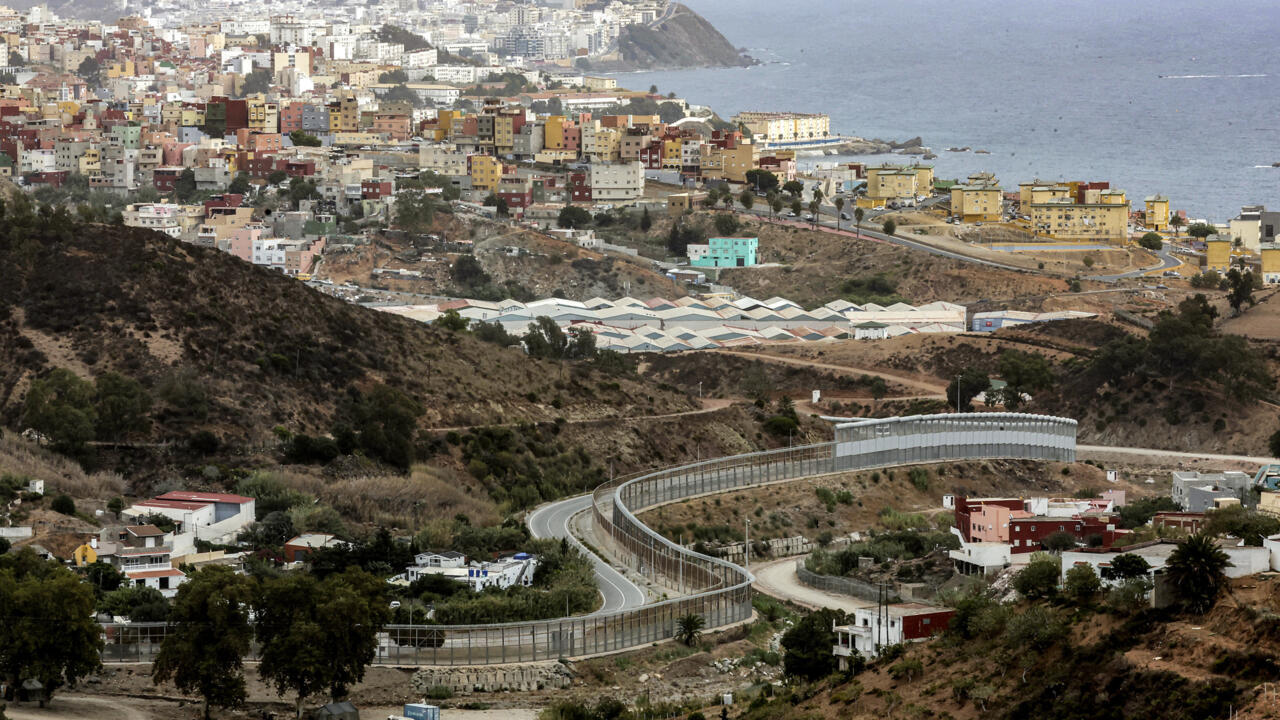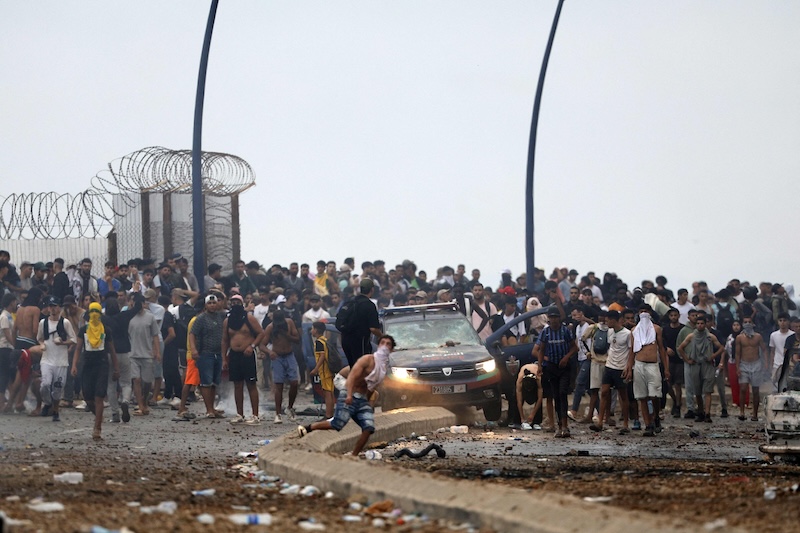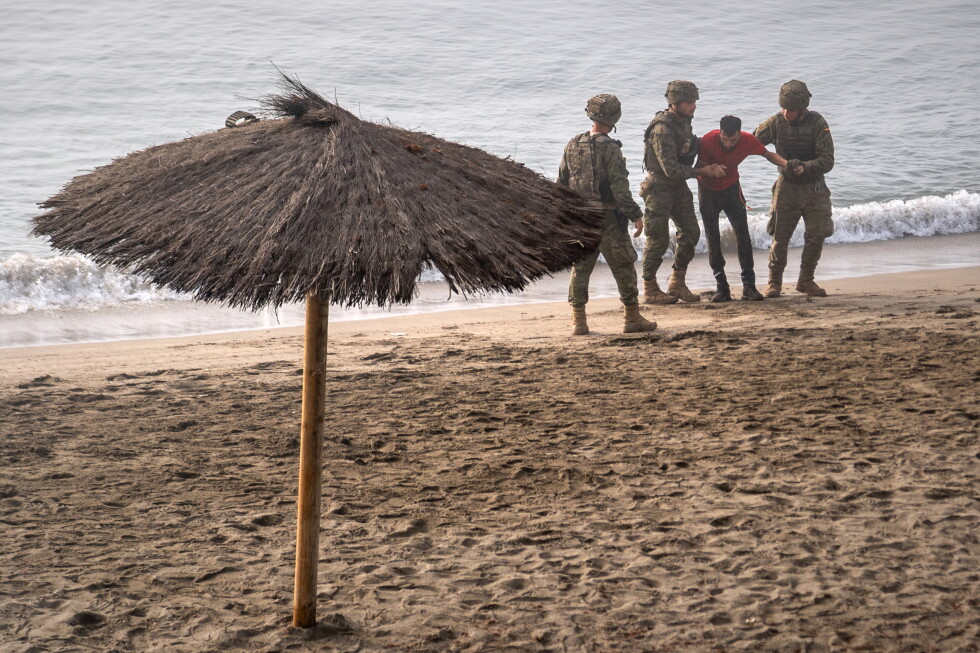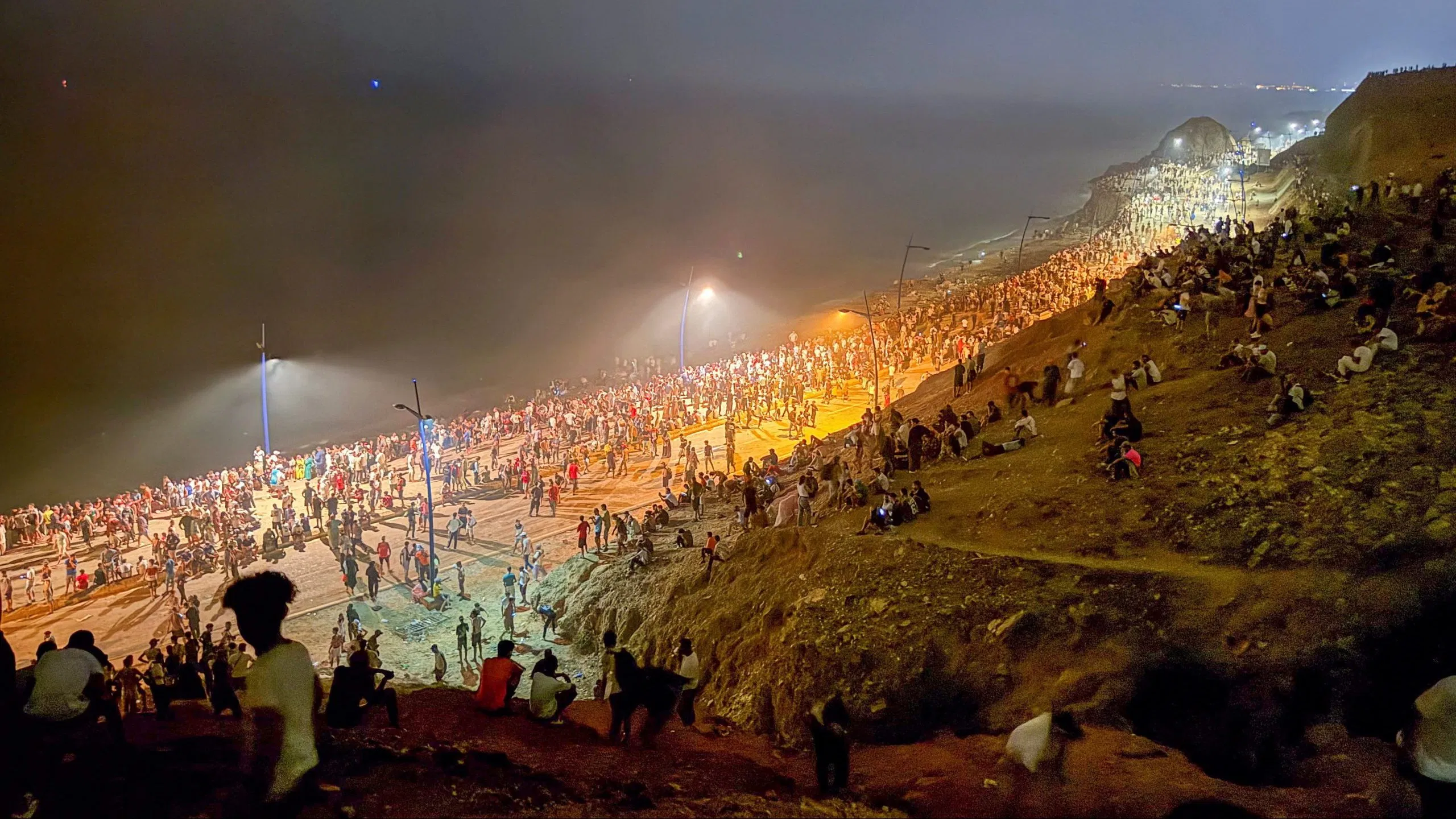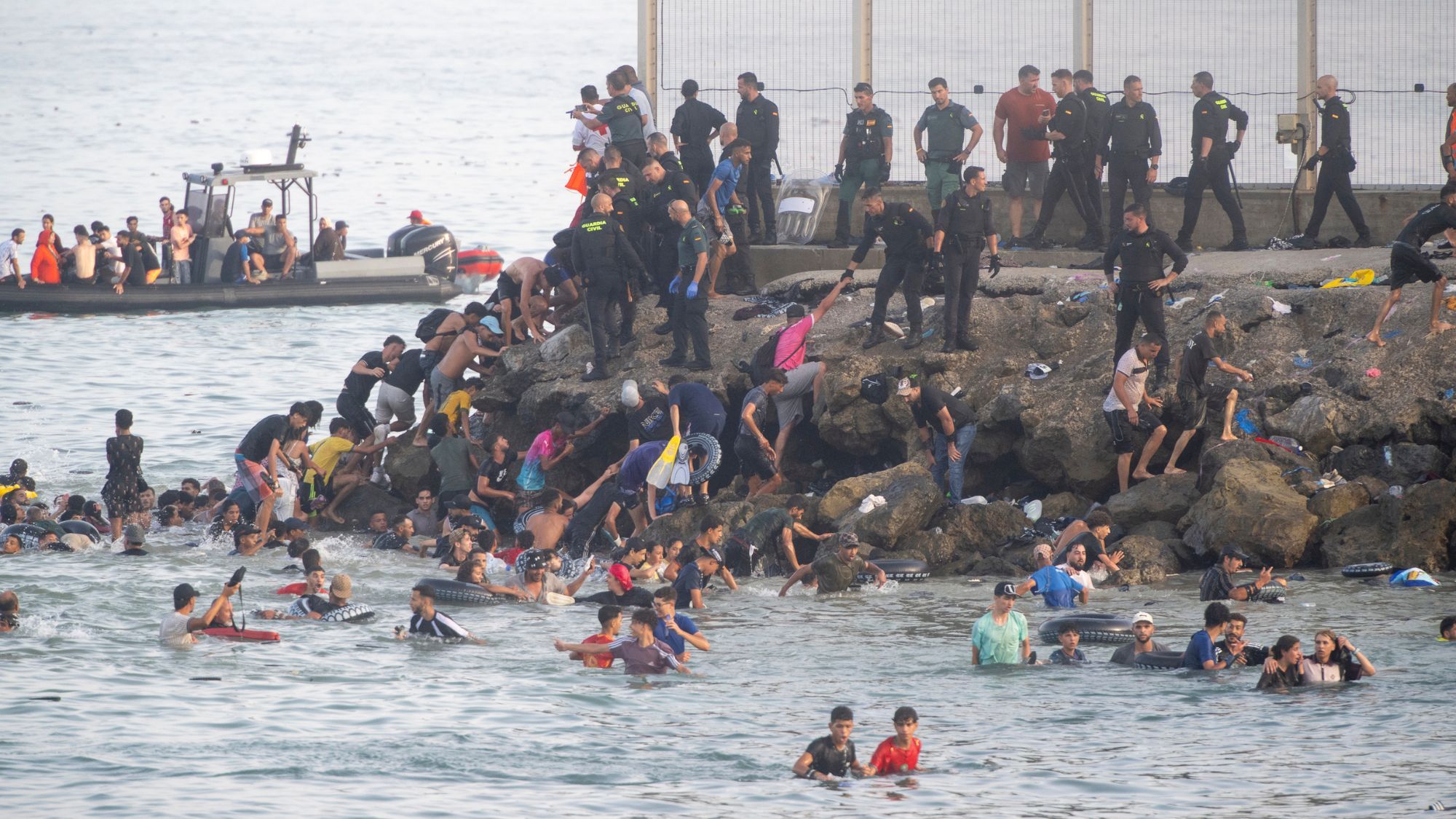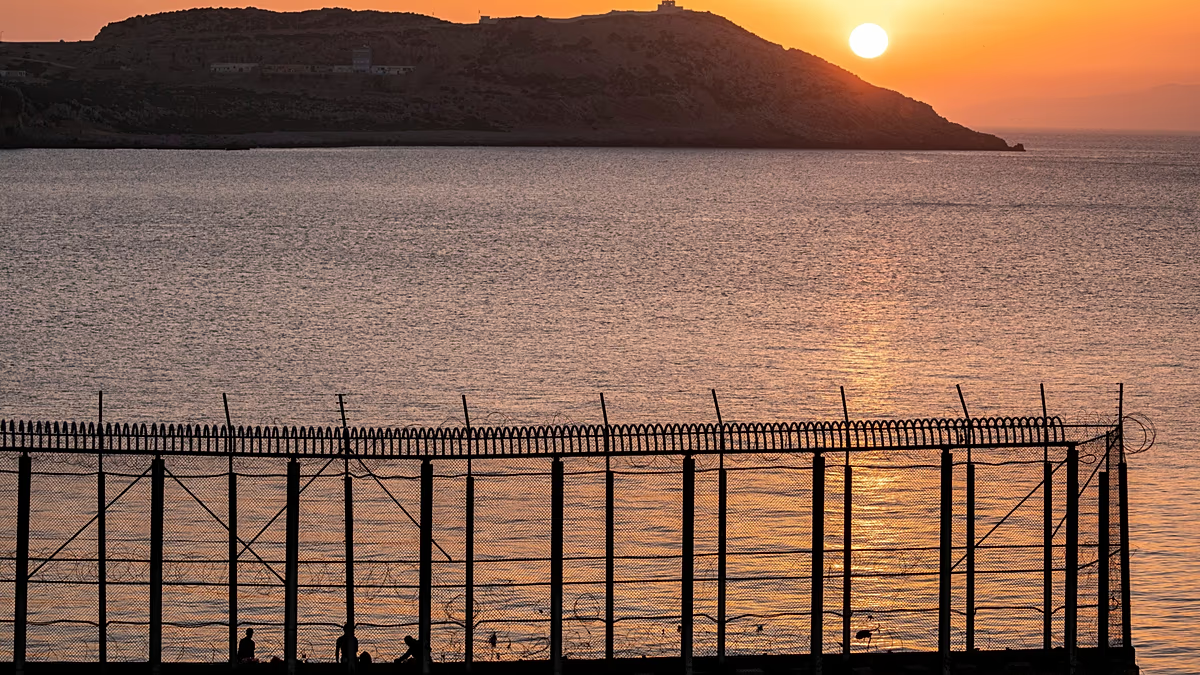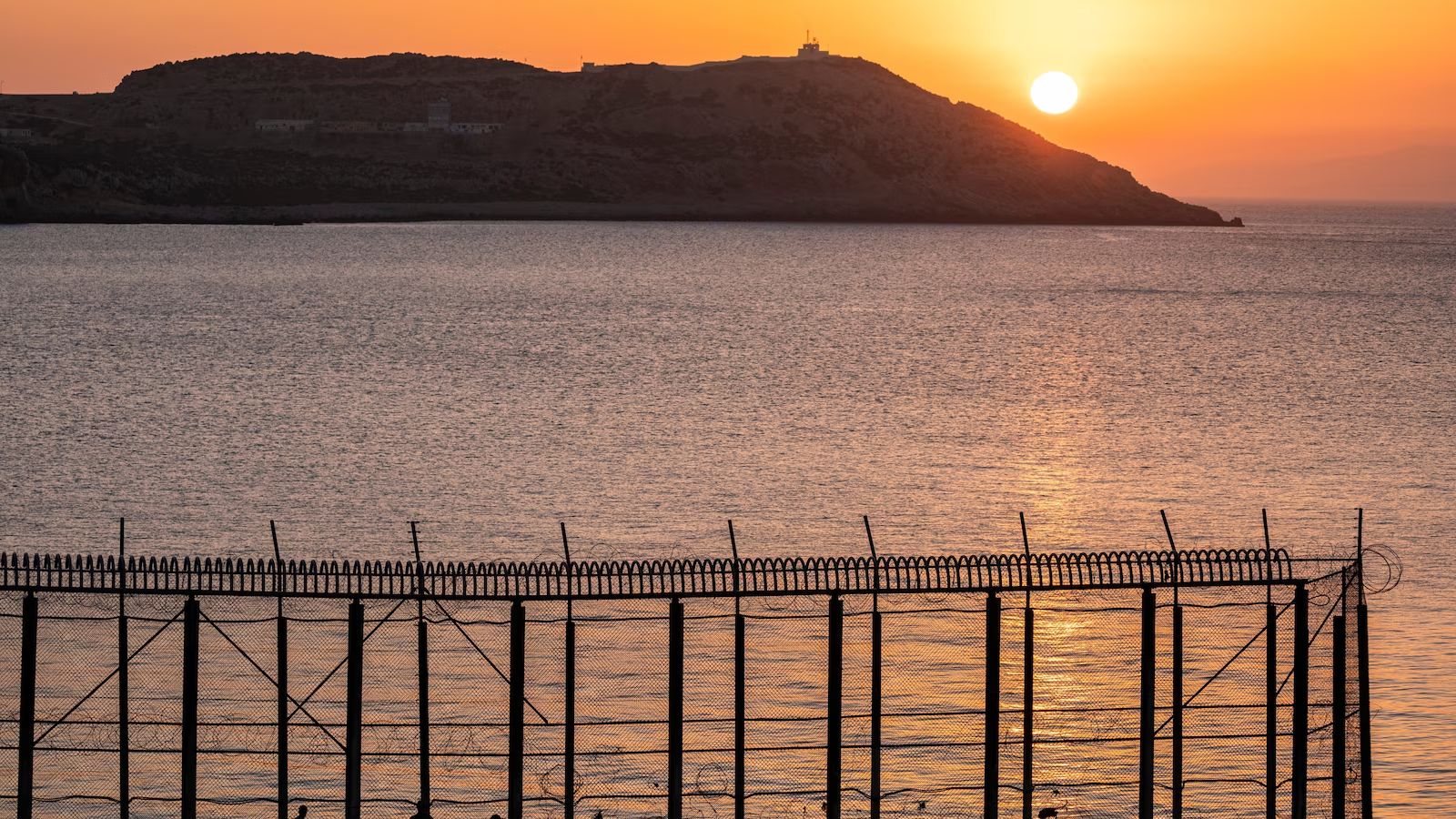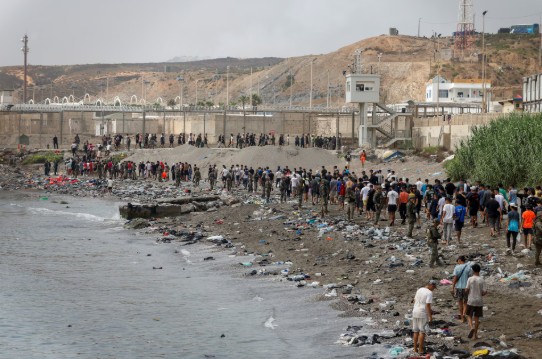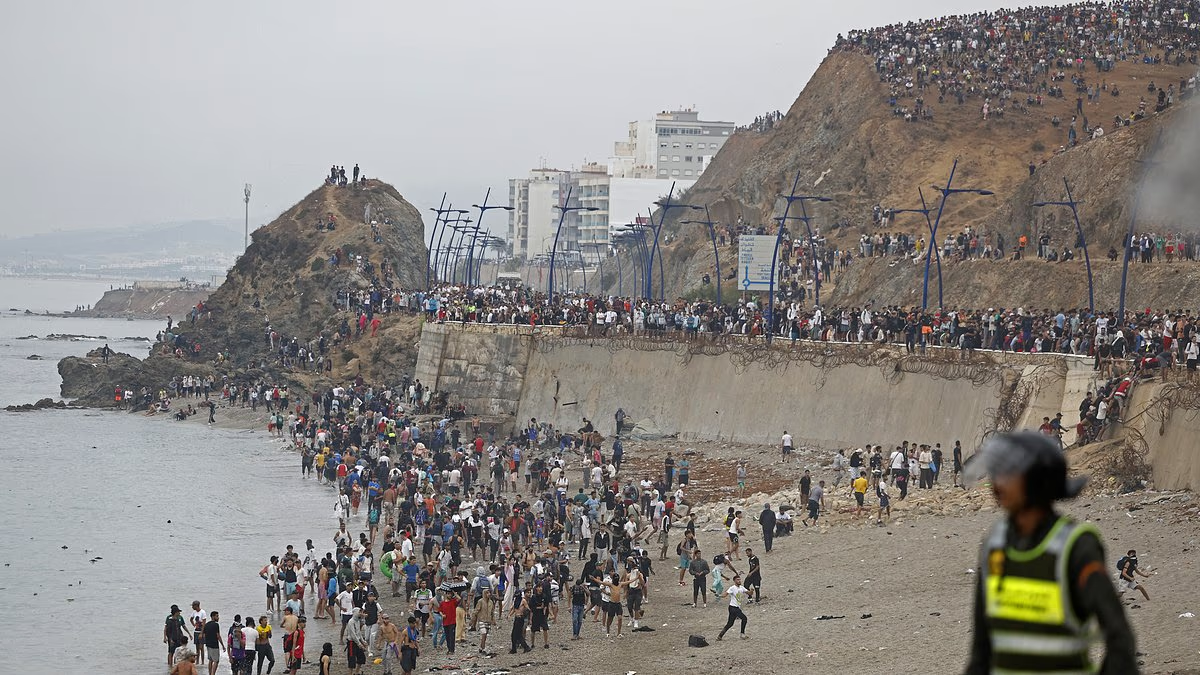
Thousands of migrants who flooded a Spanish enclave may be protected by a new loophole created by the country's Supreme Court. Officials estimated that 20,000 migrants were able to bypass a long border fence between Morocco and the Spanish territory of Ceuta on Thursday. The crowd, largely made up of people from Morocco and Algeria, were seen swimming far out to sea on the Moroccan side, before swimming back on the Spanish side and rushing through. Many were seen celebrating, with some shouting: 'Long live Spain!' Shockingly, upon their arrival, the migrants were seen apparently trying to break into homes across the city late at night, with local media reporting that a Moroccan couple carrying a baby used a ladder to climb up to a first-floor window, break a window, and climb in. The rush started on Thursday afternoon, and carried on well into the night, even after Spanish military units were deployed to the enclave from the mainland. Even after the crossing was closed off following the surge of people, hundreds of people were seen at the border in the Moroccan town of Fnideq. Police unions said following the influx of migrants that they were emboldened by a decision in the country's Supreme Court earlier this month that created a 'pull factor' for them to rush through. Migrants were seen apparently trying to break into homes across the Ceuta after invating the Spanish territory on Thursday Terrifying footage showed scores of people seemingly breaking into homes across the city late at night Migrants try to cross from Morocco into the Spanish enclave of Ceuta, Thursday, July 30, 2026 Spanish army soldiers travel in military vehicles after being deployed to the Spanish enclave of Ceuta, Thursday, July 30, 2026The powerful judicial body ruled that migrants intercepted at sea while attempting to reach Ceuta or Melilla – another Spanish enclave further along the Moroccan coast – cannot be summarily returned under the enclaves' special border-rejection regime.The ruling established that migrants who arrive by sea cannot be immediately pushed back across the border without due process, unlike those who cross into Spain by land – by physically climbing over the border fence, for example. Police unions said this Supreme Court decision created a 'pull factor' for migrants. The Unified Police Union said the surge came 'after the Supreme Court rejected border rejections, complicating deportations'.It added: 'We demand the Government immediately reinforce the National Police and Civil Guard personnel at the border with Morocco.' Some activists, including Omar Naji, president of the Moroccan Association of Human Rights in Eastern Morocco, expressed doubt that the Supreme Court ruling was behind the surge. Most Moroccans would have been unaware of such legal decisions, he said.Upon their arrival, the migrants, largely made up of people from Morocco and Algeria, went into the city of around 84,000. Migrants cross from Morocco into the Spanish enclave of Ceuta, Thursday, July 30, 2026 Officials estimated that 20,000 migrants were able to bypass a long border fence between Morocco and the Spanish territory of Ceuta on Thursday Migrants cheer after they cross into Spain from MoroccoIn response, enraged Spanish citizens were seen taking to the streets to push them back. Many were seen waving Spanish flags and screaming at them. As a group of migrants were seen running away, a loud police siren was heard in the background. Terrifying footage showed scores of people seemingly breaking into homes across the city late at night. One clip appeared to show a man on top of a ladder, hitting a first-floor window with a object. Another clip showed dozens of people rushing into a single door, as the person filming cowers on their balcony. A man was heard letting off a sharp whistle, apparently telling others that there was somewhere to rest. As some people were able to make their way inside, scores of more migrants were seen running up to the open door, desperate to find a place to rest. After migrants flooded into the city, many local shops chose to close early. Enrique Serrano, who runs a women's clothing store in central Ceuta, told Reuters business owners were organising self-defence because they believed police resources would be insufficient. People stand next to barbed wires during an attempted crossing from the Moroccan northern town of Fnideq to the Spanish enclave of Ceuta, Thursday, July 30, 2026 Security forces stand guard as people attempt to cross from the Moroccan northern town of Fnideq to the Spanish enclave of Ceuta, Thursday, July 30, 2026 The rush started on Thursday afternoon, and carried on well into the night Security forces stand guard as people attempt to cross from the northern Moroccan town of Fnideq to the Spanish enclave of Ceuta, Thursday, July 30, 2026 Upon their arrival, the migrants, largely made up of people from Morocco and Algeria, went into the city of around 84,000'I'm not opening this afternoon because the situation is extremely tense ... The first thing I have to do is protect my business and my family,' he said, adding that when the fence was breached after midnight, hundreds of migrants rushed through in a matter of minutes. Even before Thursday's mass influx of people, local officials said that around 1,500 migrants managed to get into Ceuta by sea in recent days. The president of the territory, Juan Jesus Vivas, said: 'The reception centres are saturated - there is no more room for anyone in them and according to yesterday's figures the number of people entering is more than 200 a day.'He added that facilities for unaccompanied minors were operating at 2,400 per cent of capacity.Mr Vivas also pointed to the human cost of the crossings, saying 60 bodies had been recovered at sea in recent months, and argued that stronger migration controls would help prevent further deaths.Spain's Interior Ministry, which tracks irregular migration, would not confirm the number of migrants who had made it to Ceuta in the last few days but said it would publish its next migration report on August 3. As of July 15, well before the latest rush, nearly 3,000 migrants had entered Ceuta by land or sea since the start of the year, according to ministry figures. Mr Vivas declared a 'total humanitarian and social emergency', with at least 60 migrants washing up dead in the last few months and camps completely overwhelmed. Spain's government said that 18 people died while trying to reach Ceuta on Thursday alone. Officials in Ceuta begged the national government in Madrid to declare a national emergency, which was rebuffed. Security forces stand guard as people attempt to cross from the Moroccan northern town of Fnideq to the Spanish enclave of Ceuta, Thursday, July 30, 2026 Migrants from Morocco react as they crossed into Ceuta by sea, at the border between the Spanish enclave of Ceuta and Morocco, as seen from Ceuta, Spain, July 30, 2026 Enraged Spanish citizens took to the streets to push migrants back. Many were seen waving flags and screaming As a group of people were seen running away, a loud police siren was heard in the background Crowds of migrants gather on the beach of Ceuta People reach Spanish territory after swimming from Morocco to CeutaCentral government officials claimed that migration crises were not a good enough reason to call a national emergency but promised additional resources after police unions decried the lack of personnel and equipment in Ceuta. Following the request from local authorities, Madrid sent in the army to help deal with the crisis. The government added that 200 specialised police officers and 60 troops had arrived from the Spanish mainland to reinforce the enclave's regular forces.If official estimates of the number of people who illegally entered are confirmed, the migratory incident will be the largest irregular entry of people into Spain in its history. The surge of people has already begun to affect Spain's relationship with its neighbours. Italy's prime minister, Giorgia Meloni, said in a post to X that she was going to push for 'the suspension of the Schengen Area with Spain'.She wrote: ' The images coming from Ceuta are striking and demonstrate, once again, that uncontrolled illegal immigration poses a concrete threat to the security of Europe's borders. 'I have spoken with Interior Minister Matteo Piantedosi. Italy will not stand by and watch. 'We are convening the relevant bodies, and following these meetings, we are prepared to intervene with extraordinary measures to defend the borders and the safety of citizens, including the suspension of the Schengen Area with Spain. 'On illegal immigration, we will not yield an inch: defending the borders, stopping human traffickers, and ensuring effective repatriations will continue to be the line of this Government.' Spanish military stands guard at the border between the Spanish enclave of Ceuta and Morocco, after thousands of migrants crossed into Ceuta by sea, as seen from Ceuta, Spain, July 30, 2026 Migrants from Morocco react as they crossed into Ceuta by sea, at the border between the Spanish enclave of Ceuta and Morocco, as seen from Ceuta, Spain, July 30, 2026 A view of the border between the Spanish enclave of Ceuta and Morocco, as Spanish military stands guard, after thousands of migrants crossed into Ceuta by sea, as seen from Ceuta, Spain, July 30, 2026This sentiment was echoed by her foreign minister, Antonio Tajani, who said he was 'in favour' of closing the free travel zone with Spain. He wrote in a post to X: 'The images coming out of Ceuta show that the Madrid government’s decision to grant Spanish – and therefore European – citizenship to over 500,000 irregular migrants is profoundly misguided and encourages human trafficking.'And Brussels has been forced to intervene, offering operational and financial reinforcements to Spain, including the deployment of Frontex – the EU's border force. Despite the chaotic scene, UN Secretary-General António Guterres called on authorities to 'ensure that the rights and dignity of all people arriving in Ceuta are respected'.It comes after the country's socialist government approved plans to give around 500,000 undocumented migrants legal status earlier this year. Spain's foreign ministry on Thursday night denied that the deluge of people had nothing to do with the regularisation efforts. A source told Spanish newspaper ABC: 'It is false that anyone who has crossed the border in recent days can benefit from this process, as it requires very specific conditions, such as proving residency in Spain before January 1, 2026, and having resided in Spain for five consecutive months at the time of submitting the application.'According to EFE, hundreds of youths could be seen scaling the security fencing – which was not being guarded by police at the time – and entered Ceuta, while members of the Moroccan auxiliary force responsible for security on the ground withdrew as the young people passed. Spain's interior ministry said in a statement that several ministries were 'acting in coordination to respond with the utmost speed and efficiency to the situation in Ceuta'.Several of the country's largest police unions blasted the government for not giving local cops enough resources to deal with the influx. Jupol, which represents the National Police in Spain, said: 'The National Police officers stationed in Ceuta continue to work at the limit of their capabilities, with a clear lack of personnel and material resources to cope with a situation of this magnitude.' Migrants from Morocco cross into Ceuta by sea and gather near the border fence between the Spanish enclave of Ceuta and Morocco, as seen from Ceuta, Spain, July 30, 2026 Thousands of migrants pictured on the beach of CeutaMigrants reach Spanish territory after swimming from Morocco to Ceuta A young man kisses the ground as migrants arrive in Ceuta
How 20,000 migrants SWAM into Spanish enclave
Officials estimated that 20,000 migrants were able to bypass a long border fence between Morocco and the Spanish territory of Ceuta on Thursday.
3,066 words~14 min read