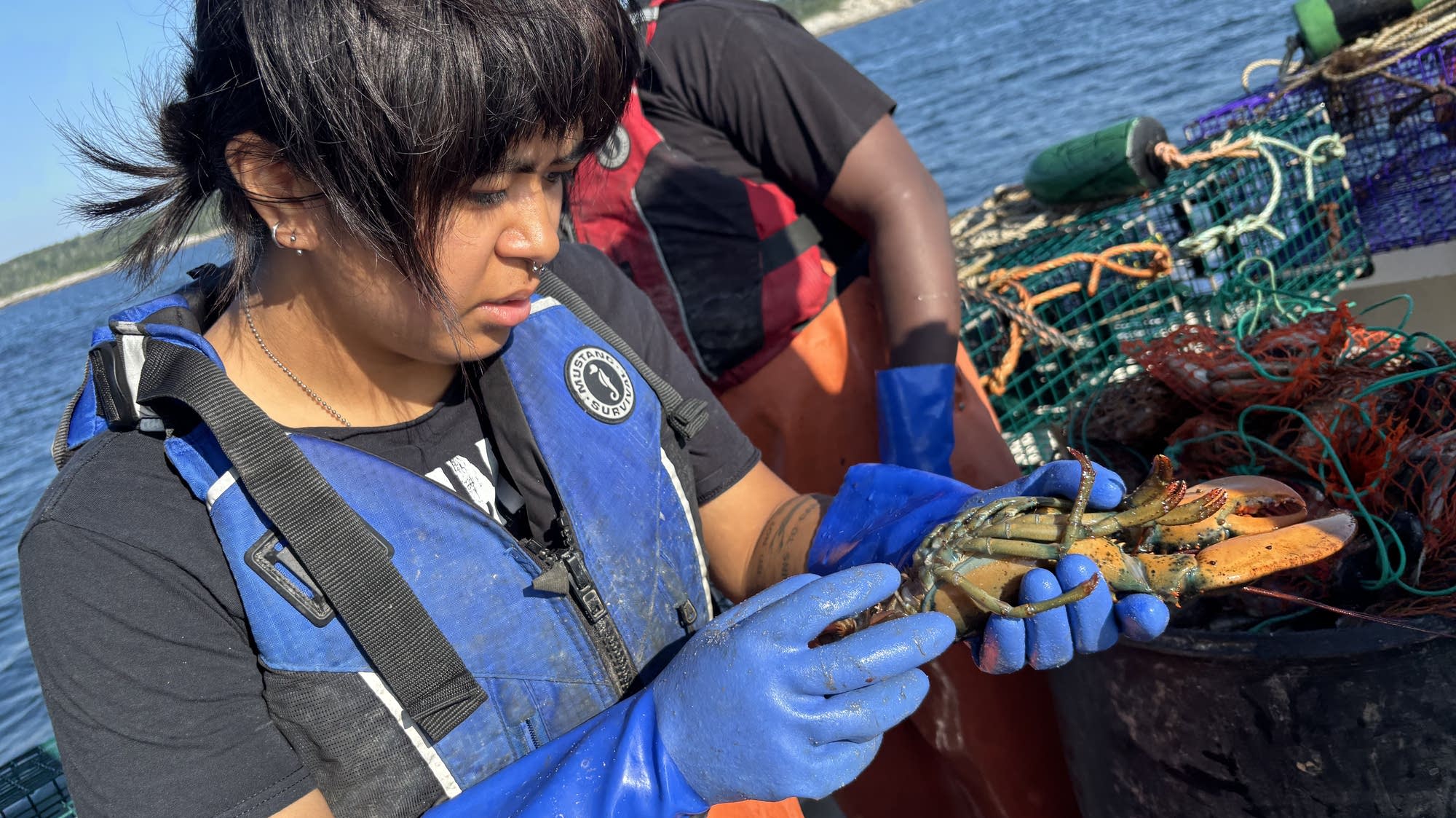
It is early on one of those summer days so perfect you think, “I should probably move to Maine.” Sunny and 70s, low humidity, almost no clouds in the sky. Out among the rocky islands of Casco Bay, just off Portland, the water is calm. Janelle Anastacio, 18, is standing on the deck of the Sea Smoke, dressed in orange waders, tall rubber boots, a blue life jacket, and thick blue gloves, holding a lobster. “Nice keeper!” She snaps a thick, green rubber band around each claw and then grabs a metal gauge to double-check that the lobster is big enough. “So first you have to put the gauge from the eye socket to the back of the carapace body,” she said, lining it up. “Below 3 ¼ inches, not a keeper, that’s a baby.”Students typically spend one day a week out on the water, learning all the basics of working on a lobster boat, including how to bait and haul traps and band and measure lobsters.Samantha Fields/MarketplaceThis one is, as she suspected, a keeper. She tosses it into a blue barrel full of seawater off to her left and grabs another lobster from the blue milk crate near her feet. If you had told Anastacio a few years ago what she would be doing today, she would not have believed you. “Oh, my God! Not at all, no!” she said with a laugh. “I literally did not know what lobstering was at all. Never would have expected to be here.”Growing up in Maine, all Anastacio knew about lobster was that she loved to eat it. Now, she’s in her second summer on the Sea Smoke. Her senior year of high school, a teacher came up to her and some of her friends and asked them if they had any connections to the lobstering industry (they did not), and if they might want to learn how to lobster (they did. Well, kind of). “We sort of signed up as, like, a joke,” she said. “We were like, ‘We don’t know what this could possibly be, but why not?’ And I never expected to grow so passionate about it.”At the end of each day, students unload and sell their catch at the dock.Samantha Fields/MarketplaceAnastasio is one of 32 high school and college students learning to lobster through the nonprofit Lift All Boats, a program designed to introduce young people who don’t already have connections to the lobster industry. The program gets them out on a boat, teaches them the basics, and helps them navigate the complex student licensing process.“That's the only realistic way to launch a career in the lobster industry,” said Ben Conniff, founder and executive director of the five-year-old program, and co-founder of the seafood business Luke’s Lobster. “The Maine lobster industry is a closed fishery, so that means no new licenses are issued generally until fishermen give up their licenses.”Because of that, the waitlist for a new commercial lobster license in the state can be up to 15 years long, depending on which zone you want to fish. There is one way to skip that waitlist, but you have to start young: get a student license before you turn 18 and apprentice with a licensed lobsterman for 1,000 hours before you turn 20 if you don’t go to college, or before you turn 23 if you do.“So the only way typically that someone even knows about that student program or has the opportunity and the connections to do it is if they're the kid of a current lobsterman,” Conniff said. Lobstering in Maine has always kind of been like this. “There's a lot of family tradition, no question,” said Roger Woodman, 72, who has been lobstering in Casco Bay for most of his life. “A lot of guys I know, fifth generation or more.”Unlike many of those guys, Woodman did not come from a family of lobstermen, but he did have a lot of friends in the industry, growing up in Falmouth, Maine in the ‘60s. Back then, it was easy to get a license. “You could just apply,” he said. “There was no apprenticeship, there was no limit, there was nothing. You wrote into the state, paid your fee, and got your lobster license.”He got his license when he was 14, and he’s been lobstering on and off ever since. Today, though, he said, “the barriers to entry have increased so much, anywhere from licenses to boats to gear. That didn't exist when our cohort was growing up in the ‘60s, ‘70s, ‘80s.”And if you don’t grow up around lobstermen, like Woodman did, the barrier is even higher. All of this has contributed to fewer young people going into the industry.Maine Lobstering5 of 5Lift All Boats is designed to teach young people who don’t already have connections to the industry all about lobstering — by getting them out on a boat, teaching them the basics, and helping them navigate the complex student licensing process.Samantha Fields/Marketplace1 of 5Lift All Boats is designed to teach young people who don’t already have connections to the industry all about lobstering — by getting them out on a boat, teaching them the basics, and helping them navigate the complex student licensing process.Samantha Fields/Marketplace2 of 5Lift All Boats is designed to teach young people who don’t already have connections to the industry all about lobstering — by getting them out on a boat, teaching them the basics, and helping them navigate the complex student licensing process.Samantha Fields/Marketplace“As a co-founder of Luke's Lobster, we buy lobster directly from fishermen,” Conniff said. “We talk to fishermen up and down the coast of Maine all the time, and we were consistently hearing from people who couldn't find the folks that work the junior jobs on their boat called sternman.”So, he figured, maybe there should be a program to introduce more young people to lobstering, people who might not ever consider it otherwise. People like Janelle Anastacio and Sunila Deloacth. Deloacth, 18, is in her third summer with Lift All Boats. Before she started, she didn’t think she had any interest in physical labor. “But I've grown to learn that I do like it a lot. I like actually working outside, and I love being on the boat first of all,” she said. “I like dealing with the live animals, I love kind of, like, battling with the lobsters, trying to get them out of the cages.” She also likes the fast pace, that you always need to be paying attention, that there’s always something to do. “At the end of last summer, I realized I actually want to do this long-term. I want to get my license,” Deloacth said. “It makes me feel badass,” Anastacio said. “Cause I don't know many other Filipino women on the water.”Samantha Fields/MarketplaceThe friends she’d first signed up with had all left the program; she decided it was time to get more serious. She’s starting college in the fall, studying to become a teacher, but she’s also going to keep lobstering as much as she can.“Really anytime I have any downtime or any time off, I'm just gonna plan to try to get on the boat,” she said. “Like weekends, my Fridays, vacation times, like just really dedicating my time to getting those hours.”Deloacth is determined to get the 1,000 hours she needs by the time she’s 23 so she can get her commercial license. After graduation, her goal is to teach during the school year and spend her summers on the water. “I just have the desire to just be out there longer, have more traps, and really take the label as a lobsterman,” she said. Janelle Anastacio isn’t sure yet how lobstering will fit into her life long-term. She could see one day maybe being the captain of her own boat. She could also see doing it more casually, going out with other people as a sternman on their boats. The one thing she can’t imagine is not being on the water. “It makes me feel badass. Cause I don't know many other Filipino women on the water,” she said. “I really just want to open up more pathways for women like me.”
"Never would have expected to be here": Young Mainers consider the lobster
A program in Maine is teaching young people with no previous connections to the lobster business how to get into an industry where the barriers to entry have historically been high.
1,364 words~6 min read