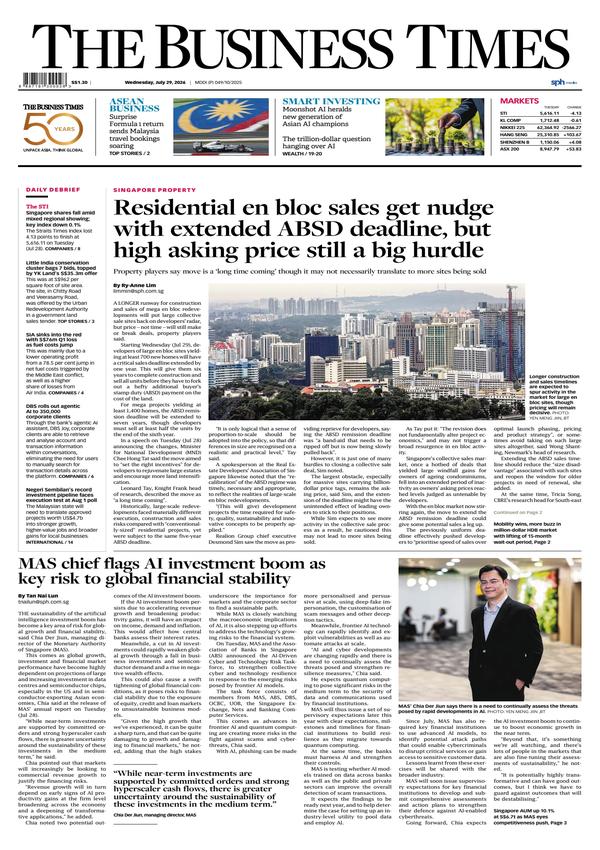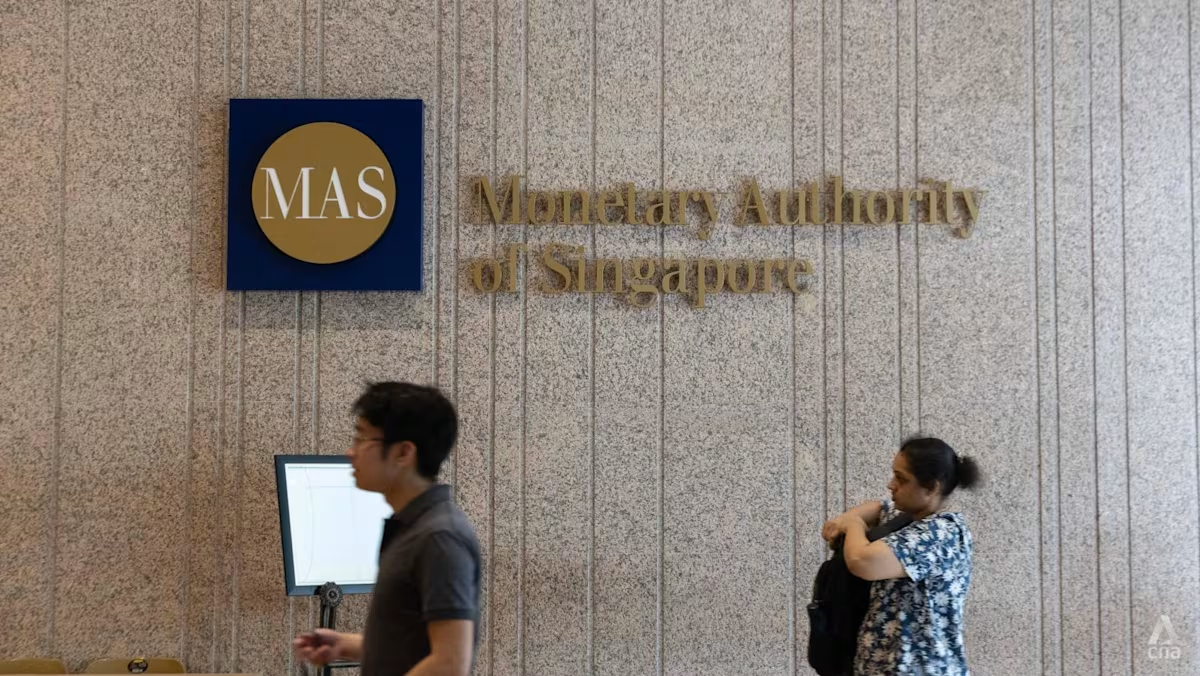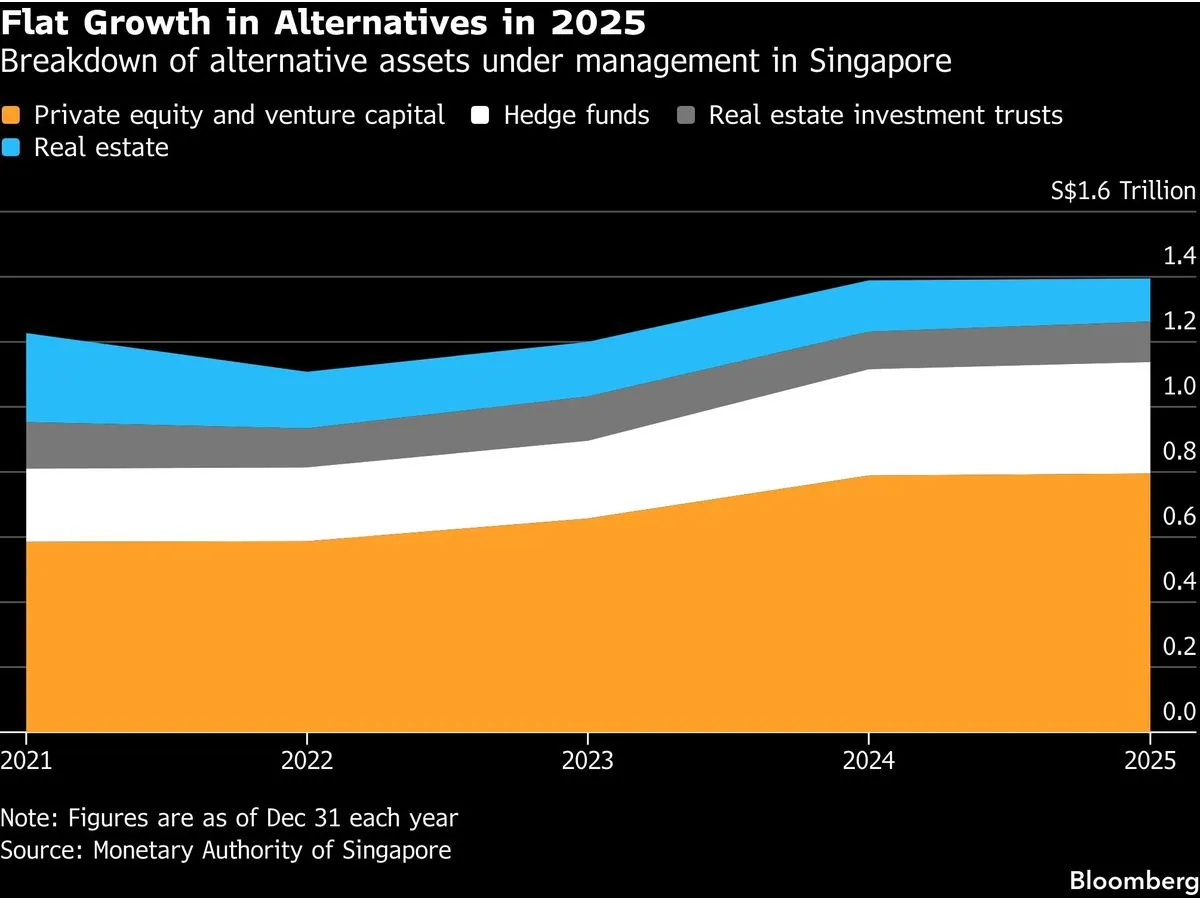
Skip to Content News Archives Economy Energy Oil & Gas Renewables Electric Vehicles Mining Commodities Agriculture Real Estate Mortgages Mortgage Rates Finance Banking Insurance Fintech Cryptocurrency Work Wealth Smart Money Wealth Management Investor Personal Finance Family Finance Retirement Taxes High Net Worth FP Comment Executive Women Puzzmo Newsletters Financial Times Business Essentials More Innovation Information Technology FP500 Podcasts Small Business Lives Told Tails Told Shopping Financial Post Store Obituaries Place a Notice Advertising Advertising With Us Advertising Solutions Postmedia Ad Manager Sponsorship Requests Classifieds Place a Classifieds ad Working Profile Settings My Subscriptions Saved Articles My Offers Newsletters Customer Service FAQ News Economy Energy Mining Real Estate Finance Work Wealth Investor FP Comment Executive Women Puzzmo Newsletters Financial Times Business Essentials HomePMN BusinessSingapore's MAS Flags AI Pullback as Threat to Global MarketsSingapore’s central bank warned that uncertainty over sustaining massive AI investments is a key risk for global growth and financial markets, citing this along with the threat of a prolonged re-escalation of the war in the Middle East.Author of the article: You can save this article by registering for free here. Or sign-in if you have an account.itdlmigo)[vur97][db2e(ap_media_dl_1.png Monetary Authority of Singapore(Bloomberg) — Singapore’s central bank warned that uncertainty over sustaining massive AI investments is a key risk for global growth and financial markets, citing this along with the threat of a prolonged re-escalation of the war in the Middle East.Subscribe now to read the latest news in your city and across Canada.Exclusive articles from Barbara Shecter, Joe O'Connor, Gabriel Friedman, and others.Daily content from Financial Times, the world's leading global business publication.Unlimited online access to read articles from Financial Post, National Post and 15 news sites across Canada with one account.National Post ePaper, an electronic replica of the print edition to view on any device, share and comment on.Daily puzzles, including the New York Times Crossword.Subscribe now to read the latest news in your city and across Canada.Exclusive articles from Barbara Shecter, Joe O'Connor, Gabriel Friedman and others.Daily content from Financial Times, the world's leading global business publication.Unlimited online access to read articles from Financial Post, National Post and 15 news sites across Canada with one account.National Post ePaper, an electronic replica of the print edition to view on any device, share and comment on.Daily puzzles, including the New York Times Crossword.Create an account or sign in to continue with your reading experience.Access articles from across Canada with one account.Share your thoughts and join the conversation in the comments.Enjoy additional articles per month.Get email updates from your favourite authors.Create an account or sign in to continue with your reading experience.Access articles from across Canada with one accountShare your thoughts and join the conversation in the commentsEnjoy additional articles per monthGet email updates from your favourite authorsSign In or Create an AccountorA surge in investment in data centers, chips and computing infrastructure and semiconductor capacity has boosted global economic growth, which has stayed resilient despite repeated shocks from higher tariffs to the war, said Chia Der Jiun, managing director of the Monetary Authority of Singapore. There are significant implications whether the AI boom continues or if there is a major curtailment in funding in this area, Chia said in remarks that accompanied the MAS’ release of its annual report. A big pullback is likely to sharply weaken economic expansion around the world, Chia said. Financial stability risks could also come about through the equity, credit and loan markets’ exposure to unsustainable business models with deteriorating cashflows and weak credit terms in complex financing structures, he added. Conversely, a long AI boom will affect income, demand and inflation, he said. Get the latest headlines, breaking news and columns.By signing up you consent to receive the above newsletter from Postmedia Network Inc.A welcome email is on its way. If you don't see it, please check your junk folder.The next issue of Top Stories will soon be in your inbox.We encountered an issue signing you up. Please try again“Global growth, investment and financial market performance have become highly dependent on projections of large and increasing investment in data centers and semiconductor chips continuing well into the future,” Chia said, pointing out this is particularly so in the US capital markets and semiconductor-exporting Asian economies. Singapore’s central bank joins authorities around the world who are increasingly alert to the risks posed by the rush to AI. Bank of England Governor Andrew Bailey warned the fallout from an AI stocks bubble bursting would reach the UK economy and could prompt a response in interest rates. The Bank for International Settlements, an umbrella group for the world’s central banks, cautioned that the AI investment race could turn a debt-fueled boom to bust. Still, Federal Reserve Chairman Kevin Warsh has pushed back on commentary that surging investment into AI is stoking inflation, saying the boom won’t necessarily lead to persistent price pressures. Meanwhile, stocks tumbled this week on investor worries over crowded equity positioning, lofty valuations and rising corporate debt levels in the AI sector, underscoring how quickly sentiment can turn for the worse. Financial markets will be focusing on commercial revenue growth to justify financing risks, MAS’ Chia said in his remarks. He cited the escalating costs of energy and chips, supply bottlenecks of raw materials, regulatory uncertainty, intense competition among model providers, including from lower-cost open-weight models, as well as how widely shared the benefits of productivity gains are as “clear risks” for AI investment monetization. Markets have been working relatively well in pricing some of the credit risks, though more transparency would be “very helpful,” Chia said at a briefing in response to a query about potential systemic risks that could happen if the AI boom fizzles out. “It’s probably premature to conclude that the extension of financing is going to result in a huge financial stability event,” he said. “If it continues for a few more years and there is more financing flowing into opaque and less well-structured vehicles, then I think that the risk increases by the day.”Chia also addressed the city-state’s efforts to boost its competitiveness as a financial center, as Hong Kong and other rival jurisdictions seek to attract more fund managers with tax breaks and other incentives.Singapore Mulls Lower Taxes, Easier Talent Entry for Hedge FundsMAS has had consultations with the industry and has received some good feedback and ideas, and is reviewing various measures “to sharpen our competitiveness,” according to Chia. He didn’t provide any details, but said its review will be completed soon and more information would be provided then.Total assets under management in Singapore grew 10% last year to S$6.68 trillion ($5.2 trillion), driven by increased net inflows and higher asset values, according to a report released on Tuesday. Alternatives — a category that includes hedge funds, private equity and real estate — turned in flat growth of just 0.4% in 2025 from the previous year. The entry of several new managers more than offset the downsizing of one large manager, the report stated. There were 1,320 asset managers in the country as of December last year, a net increase of 22 new firms. —With assistance from Rthvika Suvarna, David Ramli, Nurin Sofia and Rieka Rahadiana. Join the Conversation This website uses cookies to personalize your content (including ads), and allows us to analyze our traffic. Read more about cookies here. By continuing to use our site, you agree to our Terms of Use and Privacy Policy.
Singapore's MAS Flags AI Pullback as Threat to Global Markets
Singapore’s central bank warned that uncertainty over sustaining massive AI investments is a key risk for global growth and financial markets, citing this along wit…
1,232 words~6 min read