Ask Codex, Claude or Cursor to wire a workflow library into a .NET service and you usually get code that looks right and calls a method that doesn't exist. Say the agent gets past that. It then hits the line "obtain a license key from the vendor" and stops, because that step was built for a human with a browser and an email inbox.
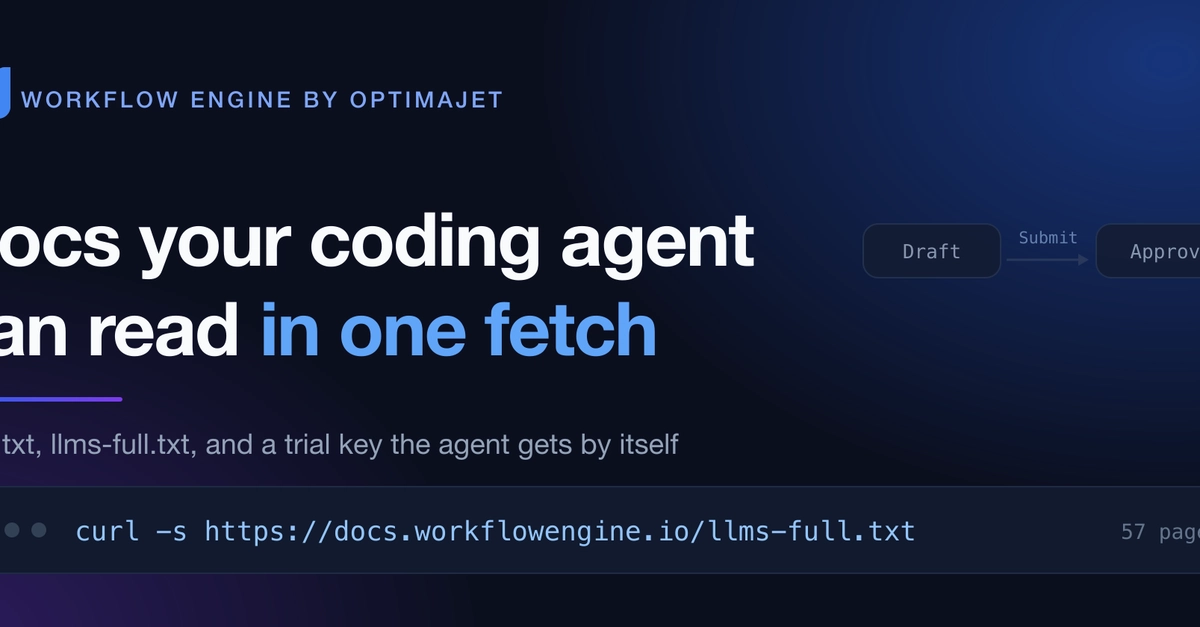
I work on Workflow Engine at Optimajet, and we've recently rebuilt our documentation. The new primary documentation is available at docs.workflowengine.io. It is gradually replacing the legacy documentation at workflowengine.io/documentation. It publishes its full text as a single file so an agent reads the whole thing in one request instead of guessing, and a trial key can now be obtained by an agent, without a human clicking through a form.
The rest is for humans: 57 pages, four sections, 24 feature pages, 17 pages that each define exactly one concept, plus the generated C# API reference on its own host, api.workflowengine.io, 1256 pages across 20 packages.
If you've never touched the product: Workflow Engine by Optimajet is an embeddable .NET library for workflow automation. You add a NuGet package to your app, point it at the database you already have, and it handles process state, transitions, timers, rules and actions in-process. Nothing extra to deploy, no separate workflow server to babysit. It works on .NET Framework 4.6.2 and up as well as modern .NET and ASP.NET Core, and it persists to SQL Server (2017+), PostgreSQL, MySQL, Oracle, SQLite or MongoDB, whichever provider package you install.