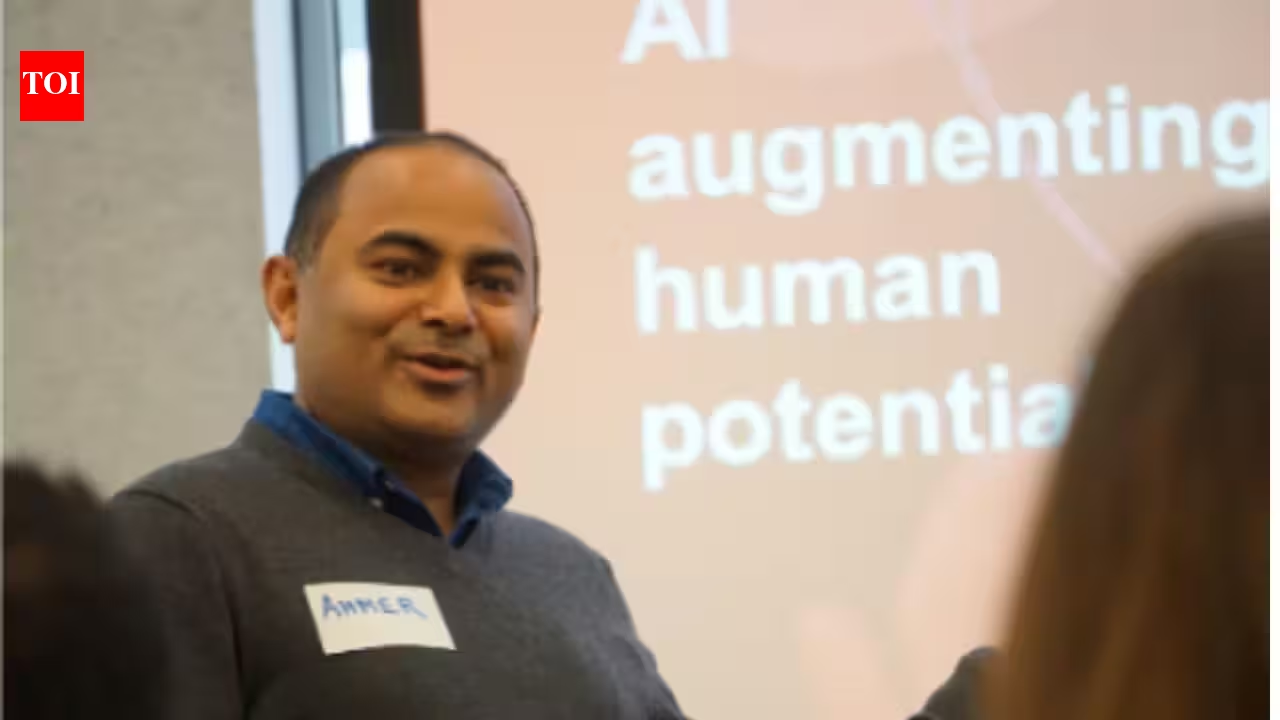
Everyone in Silicon Valley is racing to build machines that replace human expertise. Ahmer Inam, a schoolteacher's son from Delhi, is building machines that inherit it.When Ahmer Inam appeared on Fox & Friends in June, his mother watched the segment without following much of it. Her English is limited. There was her son on the famous curved couch of American morning television, fielding questions about artificial intelligence, and she understood almost none of the words. She wept anyway. Some distances need no translation, and the one between a schoolteacher's household in Delhi and a Manhattan television studio is legible in any language.Had she followed the argument, it might have surprised her less than it surprised the audience. Because what Inam was defending, underneath the vocabulary of frontier AI, is approximately the oldest idea in civilisation — the one his father practised for a living: that knowledge survives only when one generation troubles to hand it to the next.Inam has spent twenty-five years building artificial intelligence — long enough to remember when it meant symbolic logic in the late nineties, and senior enough to have run AI and data for Fortune 500 companies, Nike and Wells Fargo among them, back when "chief AI officer" was still an exotic title. He is not, in other words, a critic sniping from the cheap seats. Which makes the thesis of Cognisee, the research lab he founded and leads, sound almost seditious in today's Silicon Valley: "We're not trying to replace the worker," he says. "We're trying to make the worker irreplaceable."The problem he is aiming at usually gets filed under the bland heading of "labour shortage." By one estimate, more than two million skilled-trade jobs in the United States could sit unfilled by 2030 — electricians, welders, machinists, the hands America needs if it is serious about building factories, chip plants and grid capacity again. But Inam's diagnosis is sharper than a headcount. "America does not have a work shortage," he likes to say. "It has an expertise shortage."Consider what actually leaves the building when a master electrician retires at sixty-eight. Not the manual — the manual stays. What leaves is the ear that catches a motor running slightly wrong two weeks before it fails; the instinct that connects a faint vibration to a pattern in old maintenance logs; forty years of judgment that was never written down because it could not be. The philosopher Michael Polanyi had a name for this — tacit knowledge, the things we know but cannot tell — and Cognisee is, at bottom, a bet that the most valuable training data on earth is tacit.The company's method has a fable-like symmetry. Its AI begins as an apprentice: it works alongside experienced people and learns what they notice, what they ask, how they make judgment calls. Then it turns around and becomes a coach, carrying that accumulated judgment to the newcomer. "First it's an apprentice," Inam says. "Then it becomes a coach." Picture a 22-year-old on his first aircraft-maintenance job, hearing a sound he has never heard before, with the distilled instincts of the country's best technicians beside him in real time. "He's not being replaced by a machine," Inam says. "He's being mentored by one."The repository where all this lives is called, a little grandly, a Wisdom Vault — a secure library of hard-won know-how from doctors, nurses, electricians, factory workers, farmers, small-business owners. Grand or not, the name gives away the emotional register Inam is working in. This is not pitched as workforce optimisation. It is pitched as inheritance.He is careful — insistent, actually — about the question that framing invites: who owns it? In Cognisee's design, the expert decides what to preserve, what to share, and with whom; the contributor is recognised and rewarded; the knowledge belongs to the person who earned it, not to the machine that absorbed it. "There is a big difference," Inam says, "between being monitored and being mentored." The company is incorporated as a public benefit corporation, which he describes as a legal commitment to the worker rather than a marketing pledge.That ownership principle is also where his quarrel with the reigning AI paradigm becomes explicit. The frontier labs, Inam argues, got intelligent by swallowing the written internet — and the written internet is now substantially swallowed, which is why the industry's plan increasingly amounts to bigger data centres and more electricity, even as some of the field's own pioneers warn of a wall ahead. His contrarian wager is that the next leap will come not from more compute but from the knowledge that never made it onto the internet in the first place — and that it can be gathered by consent rather than by crawler.For an Indian reader, the resonance is hard to miss. This is a country that has watched its weaves, its remedies and its craft knowledge catalogued, carried off and sold back to it before. It is also a country whose deepest teaching traditions were never textual at all, but moved from person to person — the guru-shishya parampara, the ustad and the shagird. Inam has spoken about Wisdom Vaults for indigenous and medicinal knowledge, with communities retaining ownership of what they contribute. One way to describe Cognisee is as an attempt to give the world's oral inheritances an infrastructure layer — sovereignty included.The idea is attracting converts from unexpected quarters. Cognisee's co-founder, Alex Giannou, spent nearly two decades on Wall Street financing precisely the data centres and power deals behind the AI boom; he crossed over, in Inam's telling, because the right bet and the smart bet turned out to be the same one. Among the company's early backers is a senior Google executive who helped invent federated learning, one of the foundational privacy-preserving techniques of modern machine learning. And last year the XPRIZE Foundation, where Inam serves as a Visionary, recognised his work with its Global Visioneering Award.None of which quite explains the conviction. For that you have to go back to Delhi. Inam grew up in a low-income household, the son of a teacher — a man who spent his working life on the least scalable expertise-transfer technology ever devised: one adult, one room, one generation at a time. The son's journey to America was not gilded; there were stretches, early on, when he could not always afford to eat. It takes a particular kind of person to emerge from that and conclude that a nation's most undervalued asset sits not in its server farms but in the heads of its retiring machinists and nurses."Every generation should start where the last one left off," Inam says. It sounds like a product principle. It is closer to a family creed — the thing his father practised without ever calling it a thesis, the thing his mother recognised on a television screen in a language she does not speak. Some knowledge, it turns out, transfers just fine.
Before the knowledge walks out the door
Everyone in Silicon Valley is racing to build machines that replace human expertise. Ahmer Inam, a schoolteacher's son from Delhi, is building machines that inherit it.
TL;DRAI
Cognisee trains AI to apprentice under skilled workers, learning their tacit expertise (40 years of unmapped judgment), then deploy as coaching agents to new technicians—tackling 2M unfilled US skilled trades by 2030. The shift: knowledge ownership stays with the human expert, and the next AI frontier is inherited wisdom, not compute-scale.
1,151 words~5 min read