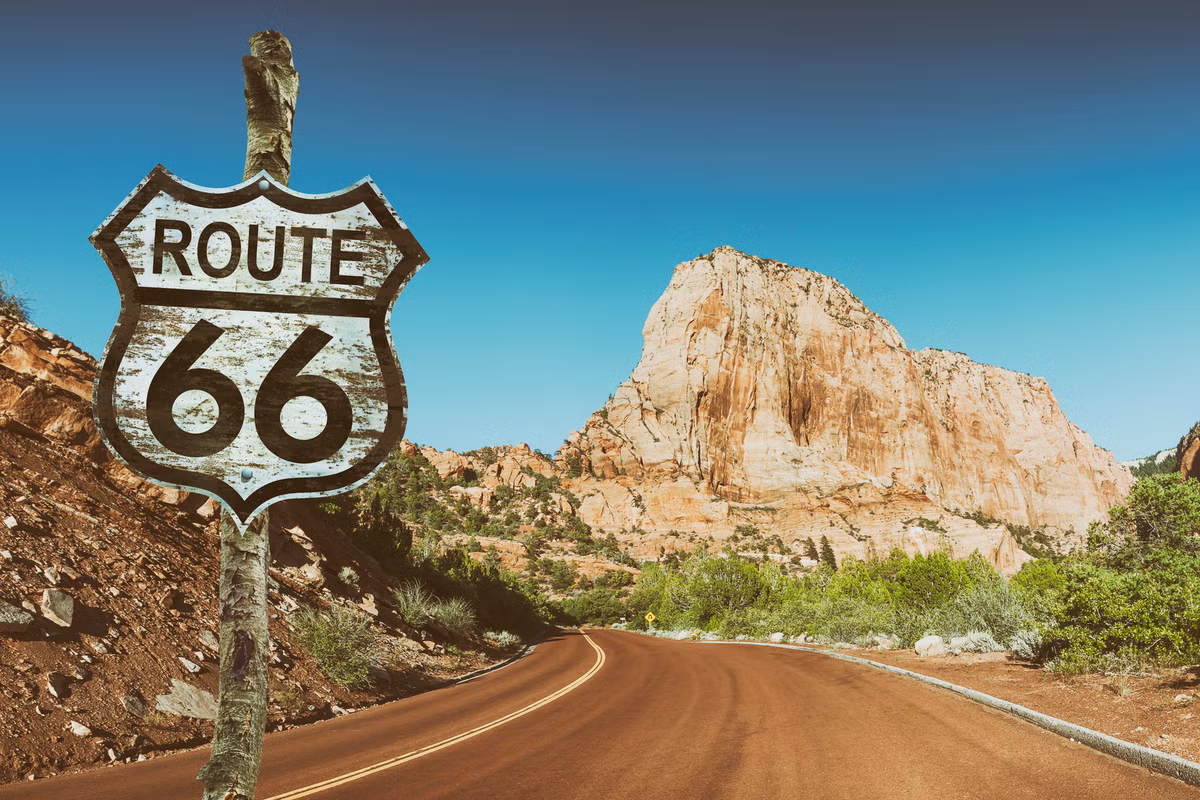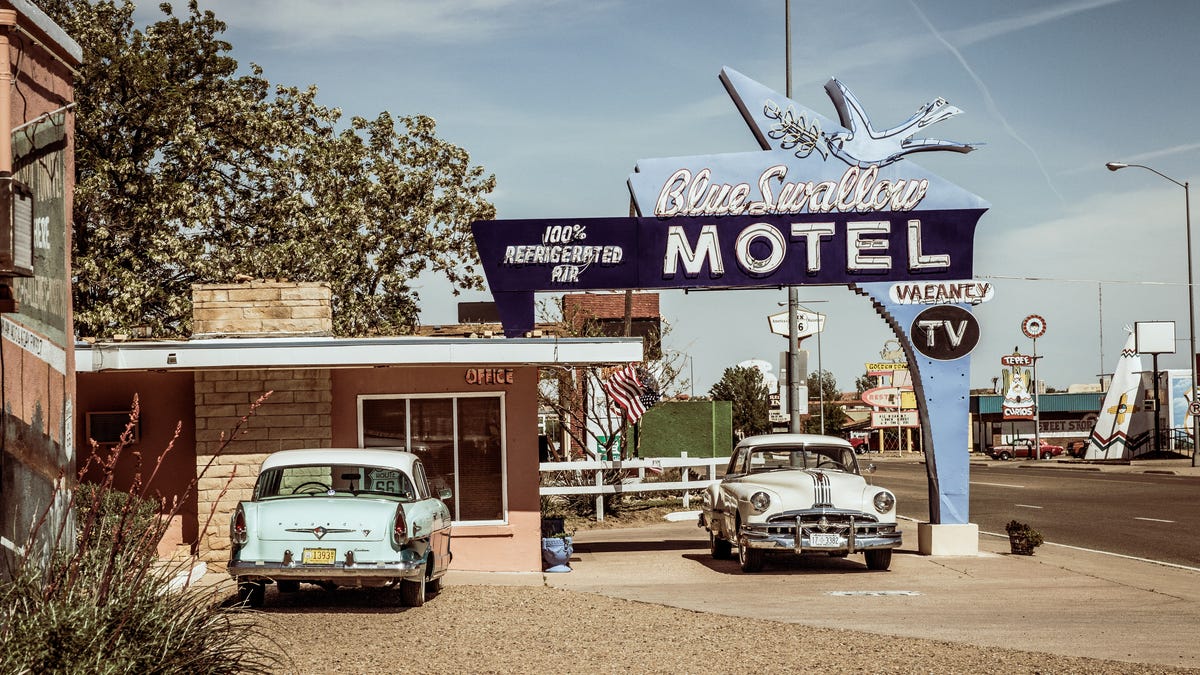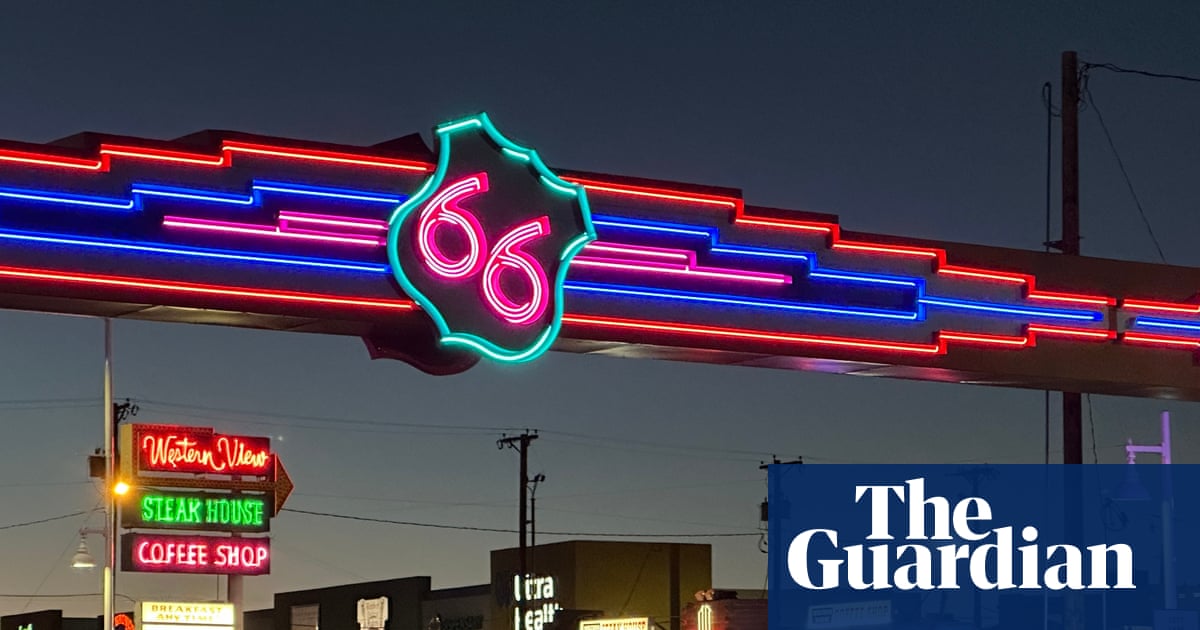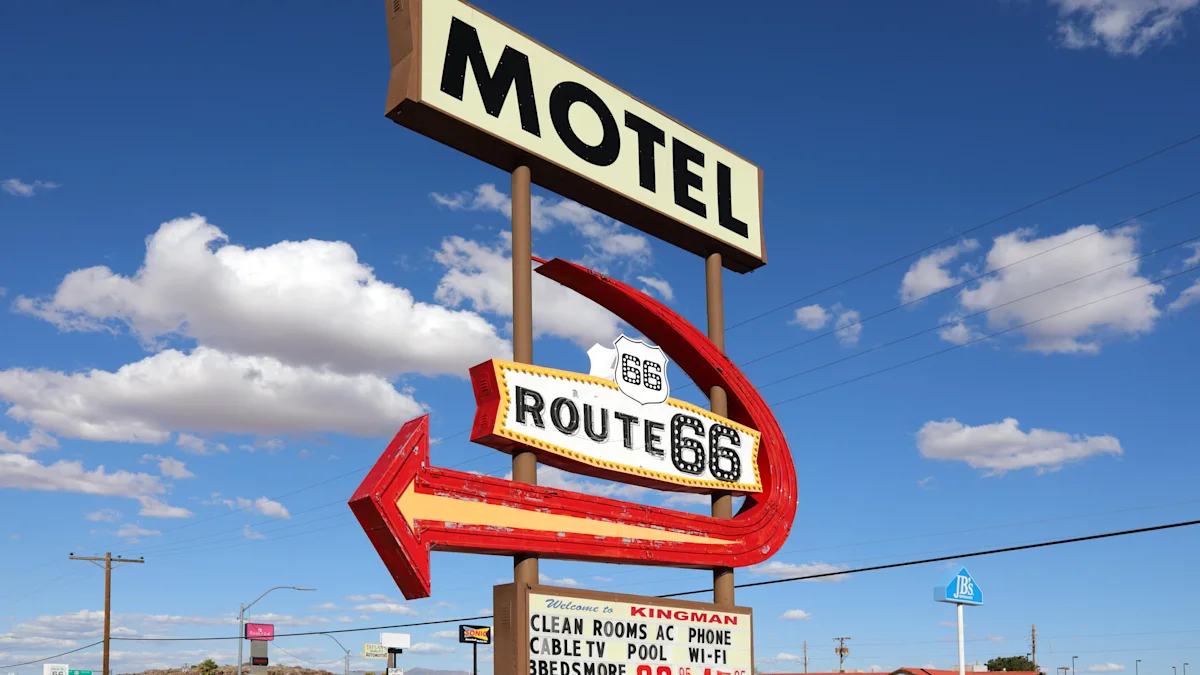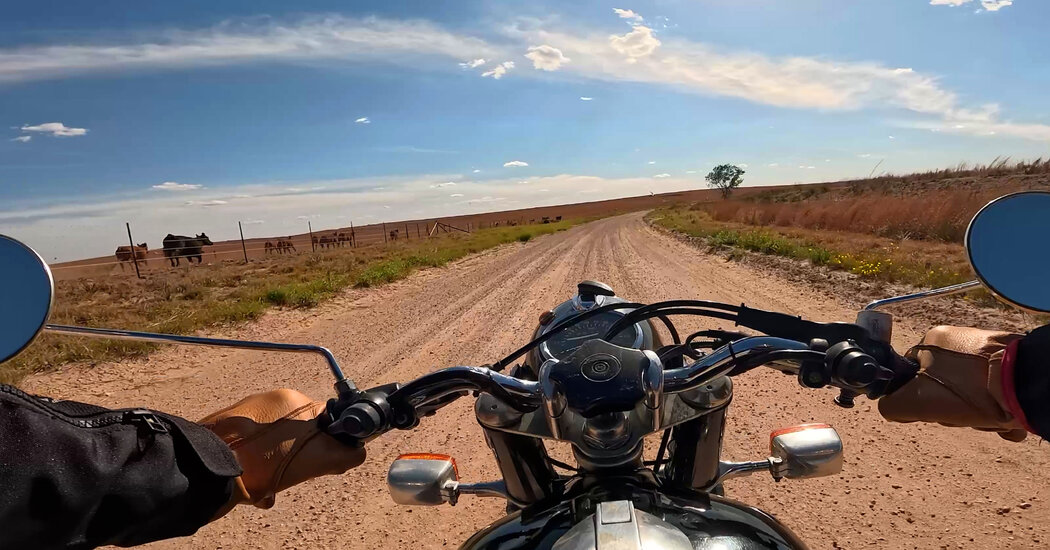
It’s a common refrain that Route 66 no longer exists. And it’s true, in a way. The 100-year-old road that stretches from Chicago to Santa Monica was decommissioned in 1985. You won’t find it listed on modern maps as a contiguous highway.And yet the 2,448-mile road — at first largely unpaved, then over time populated with so many motels and diners and outlandish attractions that it became central to the American experience, only later to be bypassed, forgotten, left to crumble — somehow endures.Earlier this year, in celebration of the road’s 100th birthday, I spent 14 days tracing the original path of Route 66 as best I could from Illinois to California — across fresh pavement, old concrete, weathered bricks and even isolated patches of dirt.Prepared for lonely stretches of empty highway, I frequently found myself in the company of joyful travelers. Expecting decay, I instead discovered renewal — often in the form of hobbyist-historians who pour their passions into preserving and conveying eccentric works of American folk art.I made the trip on my vintage motorcycle, a BMW from the early 1970s that I’d last taken on a long ride some 10 years earlier.An old motorcycle, in the end, is a lot like an old road: Neither promises an efficient journey. Each will test your patience. But they’ll both leave you with a string of good stories.Day 1 An Inauspicious StartLike many memorable adventures, this one had an inauspicious start: It rained from dawn to dusk.About 15 minutes in, still in Chicago, I made my first stop at Lulu’s Hot Dogs. When I mentioned my plans to Don Grieco, one of the owners, he told me about a similar trip he’d taken to drop his daughter off at college in Flagstaff, Ariz. — “mostly on 66,” he said. He wished me luck.Twenty minutes later, the rain picked up and I ducked inside Henry’s Drive-In. “Big Girls Don’t Cry” was playing on the radio when I settled into a booth.At a table across from me were Karin and Ewa, two friends from Europe who had also begun their westward trip in the rain. A couple of days later, I’d run into them again in St. Louis — the first of several traveler reunions, as I came to think of them, that lent my solo trip a sense of shared experience.I can’t get far without telling you about the giants.Route 66 is lined with large, fiberglass sculptures affectionately referred to as “Muffler Men.” Mostly built in the ’60s and ’70s as roadside advertising displays (some for muffler shops), the hollow sculptures were repurposed over the years — including one, called the Gemini Giant, that stood for several decades outside the Launching Pad, a defunct diner in Wilmington, Ill., before being moved to a nearby park.Gazing up at the behemoth, I turned to see a man dressed head-to-toe in black riding gear. It was John Power, from Ireland, who had flown to Chicago, rented a Harley and begun his own Route 66 trip earlier that day.Shortly afterward, menacing storm clouds materialized, and the light rain gave way to a torrential downpour. Tornadoes sprouted on the Illinois plains. I pulled into a gas station, parked my bike under the canopy and huddled in the snack aisle along with a small group of stranded travelers.It was dark when I made it to my hotel, my boots so thoroughly soaked that the soles were falling off. I’d covered 100 miles — less than half of what I’d planned. Days 2, 3 and 4 One Long CanvasAfter a day or two on Route 66, you begin to see the margins of the road as a long, continuous canvas. Kitschy folk art abounds. There’s a capitalistic bent to some of it, since if an outlandish object can make you stop, then someone nearby might make a buck. But these days, with fewer businesses along the road, much of the art reads as a simpler expression of playfulness, of whimsy.On a rough stretch of concrete a few miles west of Nilwood, Ill., population 200, a set of dainty turkey tracks is impressed in the roadway, framed by thick white paint. Here, a century ago, a bird (or two) considered crossing the road, leaving a set of erratic footprints.What’s to say, really? Either you see the joy in it or you don’t.Other artifacts are far grander. Atop the Old Chain of Rocks Bridge, which soars over the Mississippi River, I ran into Karin and Ewa, who joined me for part of the crossing.Like many of the old stretches of Route 66, the bridge — an engineering marvel when it was built in the late 1920s — is too narrow to accommodate modern traffic, though it remains open to cyclists and pedestrians.I hit the throttle in Missouri, eager to play catch-up with my lagging itinerary.In the city of Lebanon, I rested under the awning of the Munger Moss Motel. After the death of the motel’s longtime owners, and recognizing its value ahead of the centennial, the city worked with the new owner last year to help preserve its historic sign. Day 5 A Collection of Passion ProjectsIn light of the centennial, a variety of federal, state and nonprofit funds were distributed to businesses and historical landmarks along the highway. The longer I traveled on the road, though, the more I saw its preservation as a collection of individual passion projects.After a restful night at the Boots Court motel in Carthage, Mo., I strolled a block south to a diner called the Pancake Hut, which I’d read had good food and a “restored band box.” A what?Inside I met Kaylene Cole, whose mother has owned the diner since 1979. And there it was behind the register: an animatronic jukebox that the family salvaged many years ago from a nearby restaurant that went belly-up. Ms. Cole explained that they’d recently sent the thing to California to have it professionally restored.“Alexa? Play big band music,” she said as she flipped a switch, and the Band Box sprang to life.Not every object I encountered had such a distinguished provenance — or even an easy explanation. Along a string of salvage lots in Joplin, Mo., I zipped past a yellow Model T balanced atop an oversize Route 66 sign, the numbers formed with wheel rims.People, too, seemed to spring to life. At the border between Missouri and Kansas, when I stopped to interview a pair of cyclists making their way east, I heard a shout from a nearby yard. It was Jamie Stover, inviting me to park in his driveway lest the passing trucks get too close.Long days in the sun, late nights on the road. Settling into an uninspiring motel in Sapulpa, Okla., I opened my map to see a nearby theater I’d pinned while planning my trip. So, rallying, off I went to the Tee Pee Drive-In, where I joined the rows of moviegoers. Days 6 and 7 Abandoned ArtifactsNostalgia sells, and Route 66 traffics heavily in it.Having roared to life in the postwar years, when an expanding middle class found easier access to both leisure time and affordable automobiles, the highway evokes a time when some Americans, though by no means all, experienced a newfound sense of freedom and possibility.Beyond the renovated attractions, though, many modern-day travelers are drawn to the ruins.At a onetime service station called Kobel’s Place, near Foss, Okla., encroaching trees camouflaged an abandoned building that was crumbling into oblivion.In McLean, Texas, beside a museum that tells of how barbed wire transformed the West, I found a derelict garage strewed with the hollowed-out shells of midcentury Fords and Edsels. No plaque, no public accounting; just a scene arranged to evoke a bygone moment in American history, a stray corrugated roof panel creaking tritely in the wind.For a brief spell on a hot afternoon at the Texas border, my motorcycle lobbied to become an abandoned artifact of its own: I went to fire it up and nothing happened.Out came my tool kit, and I set to work searching for an electrical short.Even in moments of despair, though, there were flashes of joy. While I disassembled successive parts of my motorcycle along the otherwise quiet highway, a small car pulled off onto the shoulder, and out popped two sprightly road trippers from Barcelona: Rosa Cobacho and Anna Vidal.“I love America!” Rosa said, posing beside a sign marking the state line. “Also the American people!”Like butterflies, they fluttered away as quickly as they’d arrived. Days 8, 9 and 10 The WaypointsThere’s simply no way to fully account for the visual splendor that Route 66 provides — not just the built environment surrounding the road, but also the landscapes behind it, which slowly transform as the agricultural plains in the East give way to dense forests, shortgrass prairies and desert basins in the West.Yet it’s the people, not the places, that serve as waypoints in my memory — especially in Texas and Arizona.Outside an AutoZone in Amarillo, while replacing a blown fuse, I met a motorcyclist named J.J. who, having just adopted a puppy, stopped to ask if I needed any help.At Cadillac Ranch, a vast art installation where 10 cars are buried nose-down in the dirt, I met four members of the Black Sabbath Motorcycle Club: Kee-Ya, Bacon, Prospect and Half-Cocked.Sensing my hesitation to contribute to the graffiti (tagging the cars is encouraged), Half-Cocked handed me a can of pink spray paint and gently fostered my delinquency.At Petrified Forest National Park, I chatted with Tabay Atkins, an intern standing behind the information desk at the Painted Desert Inn, directing guests who had backpacking permits and teaching visitors about the petrified wood, the remains of a living forest that populated this land more than 200 million years ago.The national park, he explained, is the only one that contains a section of the Historic Route 66, which is marked by a line of telephone poles. Days 11, 12 and 13 Breakdown in the High DesertThe most trying day of my trip began with a cheery morning in Seligman, Ariz., a colorful tourist town often credited as the birthplace of the road’s renaissance.A convenient side excursion for visitors to the Grand Canyon and Las Vegas, Seligman now draws a sizable international crowd; at Delgadillo’s Snow Cap, I joined a long line of customers awaiting classic diner favorites. (My order: fries and a chocolate shake.)A minute down the road, I spent the better part of an hour talking with John Balistreri, who, along with his wife, Debbie, owns and operates the Route 66 Motoporium, a Western-themed souvenir shop that showcases John’s rich collection of cars and motorcycles.But another breakdown, an hour west of Seligman, stranded me in the searing heat. This time my bike wouldn’t budge, and I reluctantly called for a tow to Kingman, the nearest city, some 30 miles west.After dropping in a new battery and posting a series of desperate pleas on various online BMW forums, I connected with Jim Bryant, an old-school mechanic with a shop some 50 miles north. I rode up the next morning, my motorcycle now barely limping along.Jim, whom I came to see as a kind of Obi-Wan Kenobi figure, spent seven hours troubleshooting in the desert with me. In the end we couldn’t fix the thing — but we devised a plan for me to make it to Santa Monica by stowing, and intermittently charging and swapping in, a spare battery. A dicey scheme, I thought, but it was all I had.The next several hours on Route 66 were a true test of will: stifling stretches through the Mojave Desert, tight hairpins through the Black Mountains, and a constant concern that my motorcycle might fail me at any moment.Pulling into Oatman, Ariz., once a gold-mining town and now a kind of offbeat, open-air museum, I was greeted by bands of animated travelers and packs of languid burros that quietly roam the dusty streets.Then came the worst heat of all: a low-desert stretch of the Mojave where the temperatures surged well above 100 degrees.At Roy’s Motel and Cafe in Amboy, I joined a crowd of fellow motorcyclists, many of them from Europe, clustered in the shade — then paid $7.99 a gallon to top off my tank. Day 14 The HomestretchU.S. Highway 66, as the road was formally known, earned three lofty nicknames over the years: the Main Street of America, popularized by Cyrus Avery, the road’s original champion; the Will Rogers Highway, so established after the celebrated Oklahoman’s death in 1935; and the Mother Road, its most famous moniker, coined by John Steinbeck in his Pulitzer Prize-winning novel “The Grapes of Wrath.”How fitting, then, that Day 14 — the last of my trip — was Mother’s Day.Emerging from my teepee-shaped room at the Wigwam Motel in San Bernardino, Calif., I met Debi Pringle, a schoolteacher of more than 40 years who was traveling the road with a longtime friend.Over to Pasadena, down into Los Angeles, out onto Sunset Boulevard.Giddy with a mix of excitement and relief, I focused my attention on the road, painfully aware of how easy it would be to err in the dense California traffic.The sweet aroma of purple jacaranda flowers wafted down on me as I rolled along Santa Monica Boulevard and hung a left onto Ocean Avenue. The homestretch.It’s often difficult to end a road trip, a story. But every now and then the right character comes along at the decisive moment.I was sitting underneath the “End of the Trail” sign on the Santa Monica Pier, my helmet in my hands, tears welling in my eyes, when a spirited traveler approached. His name was Blake Petersen, a Utahn clock repairman — and his motorcycle, it turned out, was parked a few rows from mine in the lot beside the beach.However improbably, our timelines just barely overlapping, Blake had come to the pier to kick off his trip, heading east on Route 66.Epilogue Jay Leno’s GarageTwo days after I’d finished my trip, I visited Jay Leno, the comedian, late-night host and car-collector extraordinaire. I’d connected with him through the executive producer of his show — who, as luck would have it, once made his own cross-country trek on a vintage BMW motorcycle.After touring his garage and swooning over his Brough Superior collection, I asked Mr. Leno for his take on Route 66.
2 Wheels, 14 Days, 2,448 Miles: A Motorcycle Tour of Route 66
To mark the road’s 100th anniversary, a Times journalist rode the length of it to see what’s become of America’s most storied highway.
2,388 words~11 min read