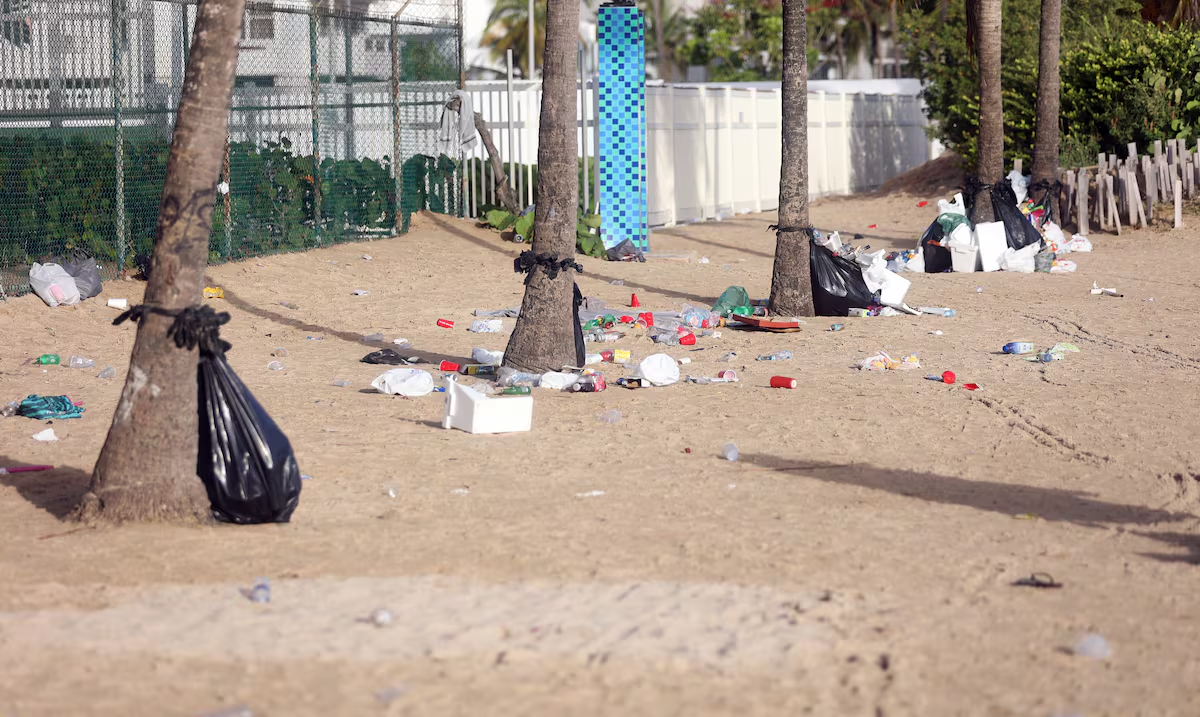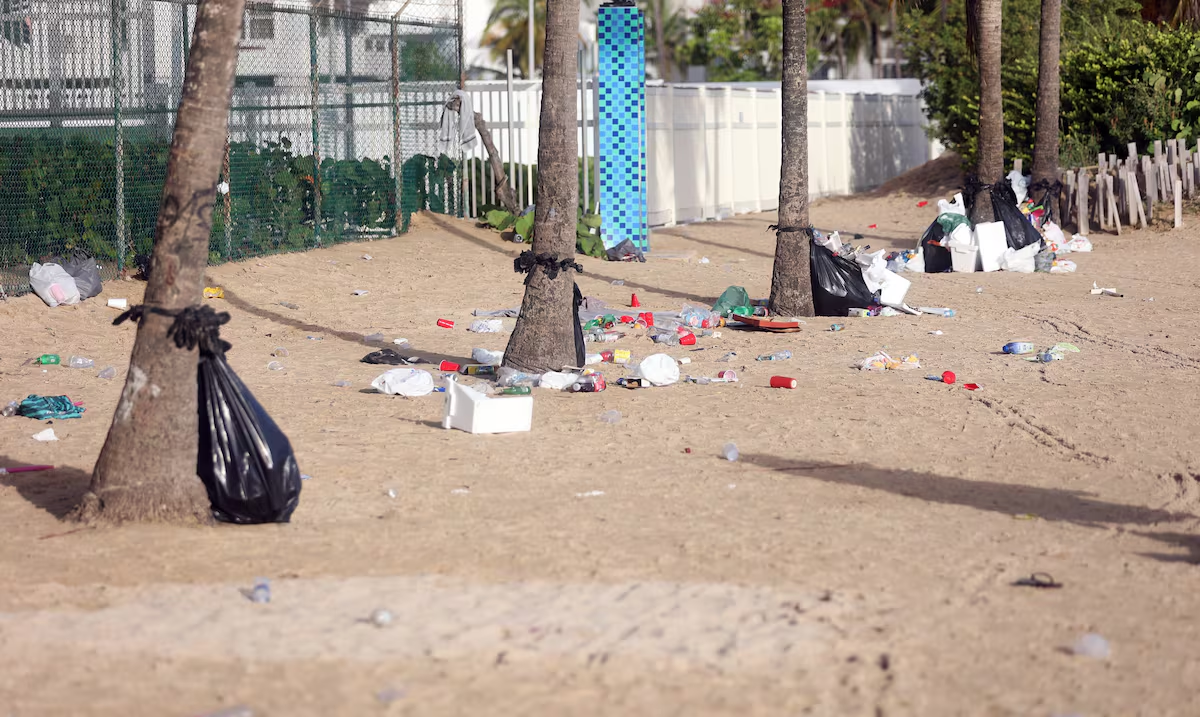
At a gas station in Cataño, Puerto Rico, the manager looks toward an empty shelf and responds, “I’m out of them; I’ll get more tomorrow,” when asked whether they have foam coolers available. He is unaware that, by law, every establishment that sells these products must display a sign informing consumers that their use is prohibited in balnearios, beaches, and bodies of water in Puerto Rico.The man was also unaware of the restriction. He explained that he learned about it a few days earlier, when, out of “laziness,” he took one of these foam ice chests to a beach and was informed there that their use was prohibited.The same situation is repeated in other businesses, particularly gas stations. The portable white coolers are displayed for sale, some surrounded by inflatable bags, floats, and beer products, while employees say they are unaware of Law 16 of July 29, 2021. Their sale is not illegal, but the statute establishes a $250 fine for anyone who uses them in bodies of water. As the law reaches its five-year anniversary since taking effect, experts consulted by El Nuevo Día agreed on its importance but pointed out that more public education and data collection from the responsible agencies are needed to determine whether the law has had a real deterrent effect on citizens’ behavior.By law, any business that sells “foam” coolers must display signs —such as the one shown in the photo— warning consumers that their use is prohibited on beaches, balnearios, and other bodies of water. (Suministrada)“I believe the measure can be strengthened through better signage requirements and expanded educational outreach. We do not see signs; at least this representative has not seen signs at any beach. The law specifies that balnearios and bodies of water must have signs. In other words, there is a prohibition on use, but the signage is nonexistent. That is an area where we can still improve,” said Brenda Reyes Tomassini, spokesperson for the organization Basura Cero.Law 16 of 2021 requires the Department of Natural and Environmental Resources (DRNA) —at the beaches and recreational areas it manages— and municipalities to place signs or notices “in a clearly visible location and in a size that is easily readable” at every **balneario, body of water, and beach within the jurisdiction of the Commonwealth of Puerto Rico,” informing visitors about the prohibition and the corresponding penalty.Every business that sells polystyrene coolers must also display warning signs. Additionally, the law authorizes the DRNA Rangers Corps, the Puerto Rico Police Bureau, and municipal police departments to issue fines for violations.On November 2, 2021, the Department of Consumer Affairs (DACO) enacted Regulation 9322, establishing consumer guidance requirements for the sale of these foam coolers. The document grants the agency authority to address, investigate, and resolve consumer complaints, as well as inspect businesses. Meanwhile, the DACO secretary may issue warnings, cease-and-desist orders, and impose and collect fines.DACO did not respond to multiple requests for information from El Nuevo Día regarding complaints, penalties, and inspections conducted each year since the law took effect. The DRNA, the agency responsible for adopting regulations regarding the process for issuing fines, also did not respond.“What remains unresolved is the issue of enforcement and data collection. The message to the responsible agencies is that they must inform the public about enforcement efforts and maintain databases where people can see how effective the law has been. I believe business support has been excellent. From what we have seen, businesses are supporting the law by providing reusable and compostable alternatives,” added Reyes Tomassini, warning that “a law that is not enforced runs the risk of becoming a dead letter.”Businesses support the lawThe president of the Retail Trade Association, José “Pepe” González, highlighted that the transition among businesses following the implementation of the regulation has been positive. He stated that many stores have removed these foam coolers from their shelves and expanded the availability of reusable alternatives.“The experience of our businesses and the information published after the approval of the law point to a substantial reduction in the sale and use of these products, particularly on beaches and bodies of water. Establishments that still sell the product have the responsibility to display the required warning sign, and there is willingness to comply with this requirement,” he explained.This newspaper consulted several Puerto Rican businesses about their policies regarding the sale of portable foam coolers.Farmacias Caridad confirmed that it currently does not sell the product and indicated that it offers alternatives such as cooler bags, plastic coolers, and “hot/cold” bags.“In accordance with the provisions of the law, SuperMax does not carry traditional foam coolers that were commonly used for beach trips. Instead, we offer a variety of biodegradable portable coolers and other reusable products that represent more sustainable options for our customers,” explained Iván Merced, food marketing manager at SuperMax.Meanwhile, Supermercados Econo stated that its stores display signs informing and educating consumers about the requirements of Law 16 of 2021.“It is important to strengthen consumer education and maintain clear and consistent communication between government agencies, municipalities, and businesses. It would also be beneficial for the government to collect and publish statistics on compliance, enforcement, and waste reduction, so the effectiveness of the law can be objectively measured,” González added.The president of the Gasoline Retailers Association, Luis Gueits Maldonado, stated that the organization has educated its members about the law and supports its implementation. However, he believes that “it is time to objectively analyze the true root of the problem.”“If Puerto Rico aims to effectively reduce this environmental problem, public policy must focus on decreasing and eventually replacing the distribution of these products with reusable, biodegradable, or environmentally responsible alternatives, such as cardboard or other sustainable materials. Rather than restricting sales to the final consumer, we should encourage the importation, distribution, and commercialization of products that represent a real environmental solution,” he said.Neither DACO nor DRNA provided data on the implementation of Law 16-2021. (Archive) Lethal impact on ecosystemsExpanded polystyrene, commonly known as foam or Styrofoam, represents a threat to ecosystems because it easily breaks down into small particles that many animals mistake for food, explained scientist Braulio Quintero, co-founder of the Caribbean Institute for Socioecological Research (ISER Caribe).When these foam coolers break apart, they fragment into tiny beads that can remain in the environment and be consumed by sea turtles, birds, fish, and other marine organisms. In the case of sea turtles, ingesting this material can be fatal.“This Styrofoam enters the turtle’s digestive system and occupies a great deal of space in the stomach. This creates the sensation that the turtle is full, but because it cannot digest the Styrofoam —its system is not designed to process this material— it eventually stops eating and dies from starvation,” he explained.He added that particles from this material can also be consumed by fish eaten by humans, meaning these fragments can enter the food chain and eventually reach people. He also noted that, although research remains limited, the impact of this material on coral reefs has been documented.According to Quintero and Reyes Tomassini, based on their observations, the presence of foam coolers during beach cleanups has decreased. However, the abandonment of these products during events such as Noche de San Juan demonstrates the need to expand environmental education efforts.The International Coastal Cleanup reports do not include specific statistics on foam coolers, but they do track containers and pieces of polystyrene, according to Reyes Tomassini. In 2022, Caribbean waters yielded 330,972 polystyrene containers collected during a single cleanup day. It was the second most common item found in the Caribbean, surpassed only by plastic bottles, and the Caribbean was the only region among continents where these materials were recorded.In 2023, polystyrene items ranked fifth in the Caribbean, with 252,830 pieces collected.Meanwhile, in Puerto Rico, the implementation of Law 51 of 2022 remains pending. This law prohibits the distribution and use of single-use plastics, including food containers made from expanded polystyrene. A legislative proposal seeks to repeal this statute.“I firmly believe that we must move toward a world without plastics. Reducing plastic use is a local way to mitigate the effects of climate change in Puerto Rico, because all the plastics we consume —including Styrofoam and others— come from petroleum and natural gas products. Reducing the amount of plastic helps reduce the amount of CO₂ emissions released into the atmosphere,” Quintero stated.“I understand that some plastics are necessary in daily life, but we should avoid single-use plastics, or at least reuse them. Buy a cooler, buy a cup, buy plates that you can reuse,” he encouraged. ---This content was translated from Spanish to English using artificial intelligence and was reviewed by an editor before being published.
Styrofoam coolers at beaches and public recreation areas: any progress since the ban took effect five years ago?
Those consulted agree that the lack of education, signage, and data on the issue threatens the environmental benefits the measure aims to achieve
1,444 words~7 min read