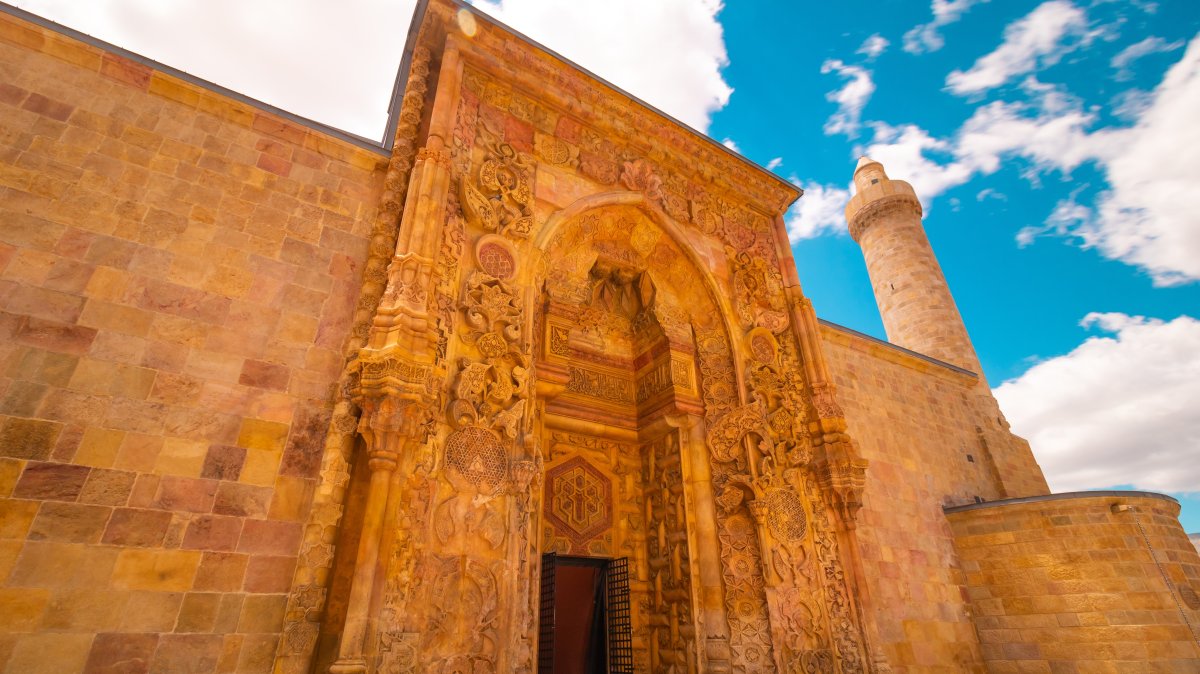
The doors of the UNESCO World Heritage-listed Divriği Great Mosque and Hospital, often described by European scholars as the "Alhambra of Anatolia," continue to astonish visitors with intricate three-dimensional carvings that cast remarkable shadows at specific times of the year and day.
Commissioned in 1228 by Ahmed Shah, son of Mengücek ruler Süleyman Shah, the Divriği Great Mosque stands alongside the adjacent hospital, built the same year by Melike Turan Melek, daughter of Behram Shah. Renowned for its extraordinary stone craftsmanship and architectural beauty, the complex is regarded as one of the finest masterpieces of medieval Anatolian architecture.
The mosque and hospital hold a unique place in history as the only surviving adjacent religious and medical complex commissioned by a man and a woman during the Anatolian Seljuk period. Today, the monument remains an important destination for both religious and cultural tourism.
A view of the "West Gate" of the UNESCO-listed Divriği Grand Mosque, Sivas, Türkiye, July 28, 2026. (AA Photo)
The 17th-century Ottoman traveler Evliya Çelebi praised the structure in his famous Seyahatname (Book of Travels), writing, "Words are insufficient to describe it, pens break before they can do it justice." His admiration is echoed by visitors today, many of whom come specifically to witness the striking shadow formations that appear on the carved portals during certain months and hours.