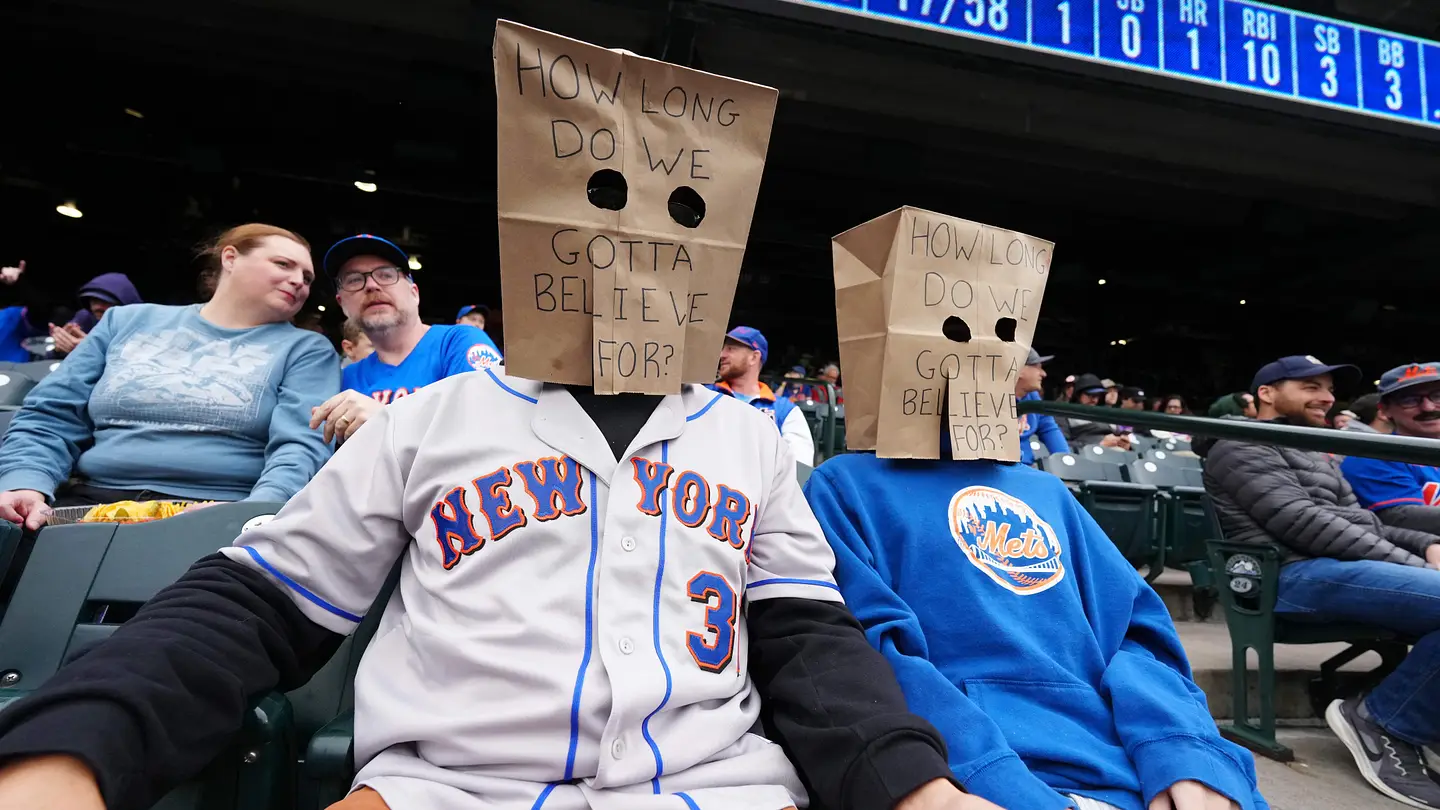
NEW YORK — For a brief moment, Frank Fleming was silent.The Mets were leading by three runs, after their offense put up five in the first three innings. Their ace was on the mound. By the standards of this godforsaken season, things were going about as well as they possibly could.That was until shortstop Bo Bichette, or, as Fleming sometimes calls him, Bo Bis—t, was unable to make a difficult play on a soft grounder in the hole. It was a single, elongating the inning, as the Mets’ lead withered away.Then it was clear that silence was merely a pause, a moment for Fleming to gather and focus his fury, before finally unleashing it.“$42 million, Bo,” he shrieked. It was audible to everyone in the section, everyone from fanatics like him to families with children, but likely not to the shortstop himself. “You’re a bum. You’re the worst Mets signing of all time.”Fleming is famous for his rants. Some criticize them for being purposefully mean-spirited. Others say they’re contrived to generate clicks. This anger, in that moment, seemed natural. It was coming out whether or not there was a camera.“B-U-M,” he continued yelling at Bichette.“S-H-U-T U-P,” an exasperated Mets fan yelled back at Fleming.“So you think this is good,” Fleming retorted, the pace of his voice becoming faster and louder. “He stinks. $42 million. He’s robbing us.”“We’re in the fourth inning,” she said. “Relax.”Here at Citi Field, “Frank the Tank” Fleming was in his element. To observe one of the sport’s most polarizing and notorious fans on his home turf is to learn about what drives him in a way that goes well beyond the one-off, 40-second clips that inevitably creep into the algorithms of so many baseball fans.At the stadium, Fleming may seem to be simply another loud, occasionally obnoxious fan, but his rants and bellows resonate far beyond the mezzanine; Fleming is one of the most marketable faces of Barstool Sports, the massively popular and often controversial sports content machine.The site’s founder, Dave Portnoy, discovered Fleming in a viral local news clip in 2017. In the years since, Barstool has featured Fleming as a media star across all its platforms, building his brand through podcasts, YouTube shows, live-streaming and short social media hits.Fleming has amassed nearly 1 million social media followers across his various platforms, including X, Instagram, TikTok, YouTube and Facebook. He’s developed friendships with high profile celebrities such as Arnold Schwarzenegger. From the walk to the subway to departing Citi Field after the three-hour plus game, Fleming was stopped for photos more than 100 times.Some love him for his candor, some hate him for his rancor. Many are inspired by his massive weight loss — dropping from 550 pounds to his current 280 through daily walks and diet, posted through monthly weigh-ins. Others believe his temperament crosses the line of a polite society.In many ways, he is the originator of this genre of content — inspiring legions of copycats screaming into their phones, turning anger into clicks. What started as Fleming Periscoping his tirades more than a decade ago has taken on a life of its own.Fleming is a regular presence at Mets games, and a vocal one. (Sam Blum)Fleming says he does not care about being beloved; that is residue from the first 40 years of his life, when he says he got used to surviving without much love or support. His controversial antics generate skepticism and frustration, both at a man who many believe is over the top, and at a company, Barstool, that critics say exploits someone who, by his own estimation, has an undiagnosed form of autism.Still, for perhaps the first time in his life, Fleming feels like he has a purpose, whether you like it or not.“Anybody who says that … ‘Oh, Barstool is exploiting the ranting,’ A. He was ranting before,” Portnoy said. “And I mean it, there is no clearer example of somebody who’s benefited (more) from having motivation than him.”“I just try to be myself,” Fleming said. “That’s all I ever try to do.”Typically a place to release vitriolic tirades and capture unedited reactions, the watch room at Barstool Sports’ main office in New York was still. The TVs that lined the walls — normally alit with games to capture live-streamed reactions — were all turned off. The large reclining chairs were empty. The office space, replete with table games, cubicles and areas to relax, lay barren as the weekend was just beginning.There was, however, one man in the room. Fleming, clad in a black Carlos Beltrán jersey, was focused on the laptop in front of him. About four hours before first pitch on this late May afternoon, a man known for ear-piercing screeds was in this moment quiet and reserved — seemingly nervous and uncomfortable in a way he’d likely never admit.The rise of Fleming coincides with the evolution of Barstool’s business model. The company first drew attention as a foul-mouthed blog that highlighted the Smokeshow of The Week. The content can still be sophomoric at best and offensive at worst, but the method of delivery has changed.Their flagship podcast, Pardon My Take, can now be found on Netflix. The company hosts a morning talk show on FS1. At bottom, Barstool makes its bones as a content generator with deep ties to the gambling industry. They do short-form video, long-form podcasts and watch-along livestreams.The company is searching for characters who can connect with consumers and stars who command attention. Within this milieu, Fleming has become something of a version of both.“I was hired to monetize him,” said his producer and close friend Matthew Piper Jenks, who has also been a source of support in Fleming’s massive weight loss. “Get sponsorships. He’s doing more for the company than he ever did in the past. He’s doing more for himself than he ever did in the past.”Who is Frank 'The Tank'? The always angry Mets superfanSam Blum and Johnny SweetPortnoy recruited Fleming after seeing him scream about delayed New Jersey transit service before the Mets home opener. They looked him up, found his (now defunct) website, which Portnoy estimated had “a great grand audience of zero.” It kept an encyclopedic history of every professional team, updated daily for decades.“People make such a mistake believing that he’s fake or simple,” Jenks said. “No dude, he’s real, and he’s complicated.”Fleming is in his comfort zone when talking, or more often ranting, about Mets infielder Mark Vientos’ low on-base percentage, or now-former manager Carlos Mendoza’s poor in-game decision making. He is less certain when talking about himself, how he got here, why he acts the way he does.
The rise of Frank ‘The Tank’ Fleming and the big business of being mad at the Mets
The Barstool Sports personality built a following on Mets misery, and in this woeful season, his anger has resonated with Mets fans.
3,248 words~15 min read