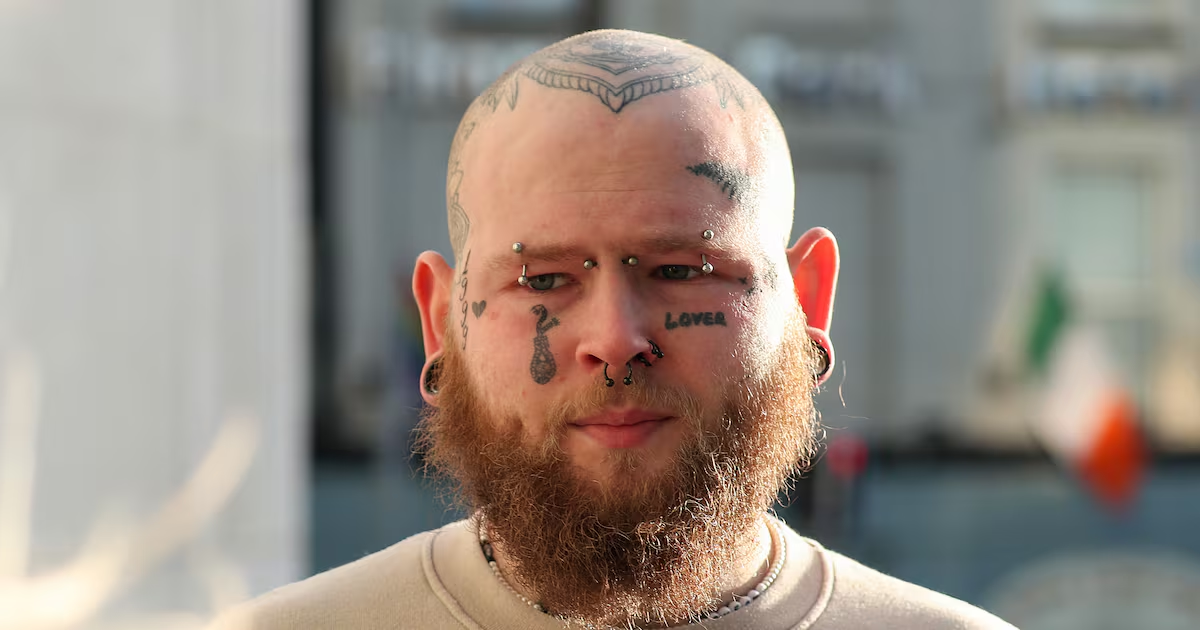
The Court of Appeal has upheld a former Defence Forces member’s conviction for the repeated rape of a fellow soldier, rejecting his argument the jury shouldn’t have heard the victim’s distressed 999 call.Kielan Mooney (30) of Bloomfield Park, Derry, was convicted following a trial at the Central Criminal Court in December 2024 of anal rape, oral rape and rape of the woman at a Dublin hotel on July 26th, 2021. He was jailed for 8½ years by Judge Tony Hunt in January the following year.Mooney had pleaded not guilty to a total of six charges – two charges of rape, two charges of oral rape, a charge of anal rape and a charge of sexual assault. The jury failed to reach a verdict on the three remaining charges.The victim, who is in her 20s, is also a serving soldier of the Defence Forces. She indicated that while she was content for Mooney to be named in reporting of the case, she did not wish to be identified.Mooney appealed his conviction, arguing that a recording of a 999 call made by the complainant after the incident should not have been admitted at trial.His lawyer Dominic McGinn said that by the time the call was made at 1.38am, the appellant had left the scene, the complainant’s friend had arrived, and she had spoken to her mother on the phone approximately half an hour earlier.He said there had been “an abundance of evidence” of the complainant’s emotional state, so the phone call was not necessary to illustrate this. He said the victim told the call handler, while in a distressed state, she had been raped.McGinn said the prejudicial nature of the evidence outweighed its probative value. He said it created “a real injustice” in the case and allowed the jury to draw conclusions that were not permissible.Patrick Gageby, for the State, said it was a paradox to suggest that because there was distress in the case and that wasn’t in issue, that the 999 call was somehow inadmissible.He said the issue of rape arose because the operator asked the complainant what had happened. He said the defence case was that the victim was distressed not because she had been raped, but because she was “disappointed” that the appellant had left and she didn’t want him to.In dismissing the appeal, Judge Tara Burns said the court did not agree with the appellant’s case that there was little probative value with respect to what was played on the call.“The reality is the issue of her distress was a matter before the jury,” she said. “While her being distressed wasn’t at issue, the reason for her distress was.”The trial heard the woman was out socialising with other army members when they met a group of soldiers from Mooney’s barracks in Donegal. She and Mooney got speaking and they decided to go back to the woman’s friend’s hotel room in the city centre.The woman told the trial Mooney anally raped her in her friend’s hotel room. She said she had asked him to stop but he did not.Afterwards she went to the bathroom and was crying. She managed to text her friend. Mooney came into the room and asked her what was wrong before he took her by the hand and brought her back into the bedroom.Mooney then forced the woman to perform oral sex on him before he pushed her on to the bed and raped her.The woman managed to get back into the bathroom and phoned her friend who told her that she and two other male friends were nearly at the hotel. After they arrived, the two men forced Mooney out of the room and the gardaí were called.
Defence Forces member has appeal for rape of fellow soldier dismissed
Kielan Mooney claimed the jury shouldn’t have heard the victim’s distressed 999 call
615 words~3 min read