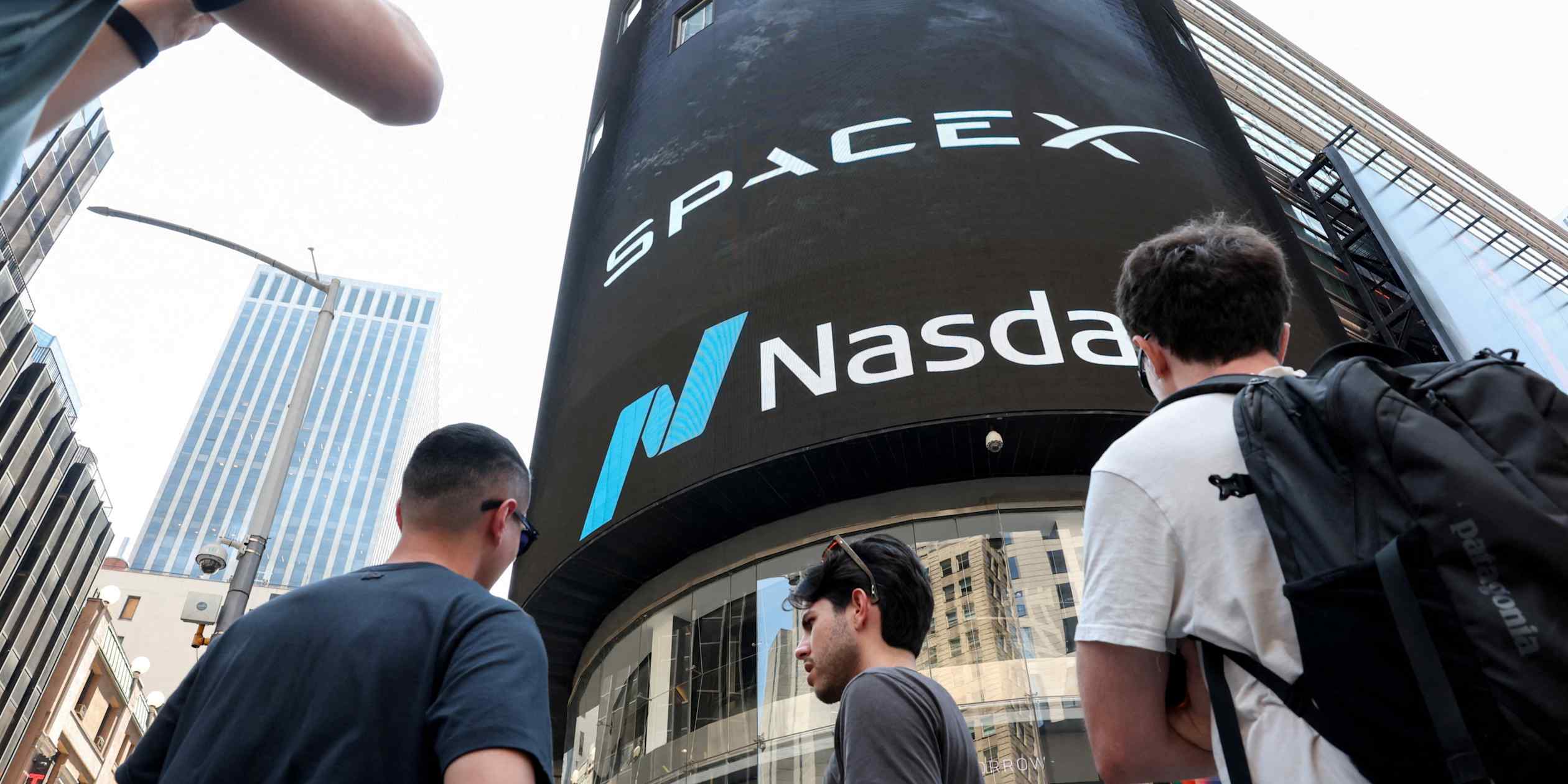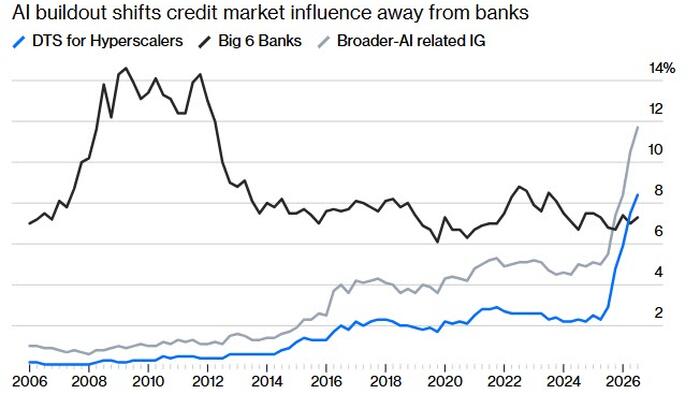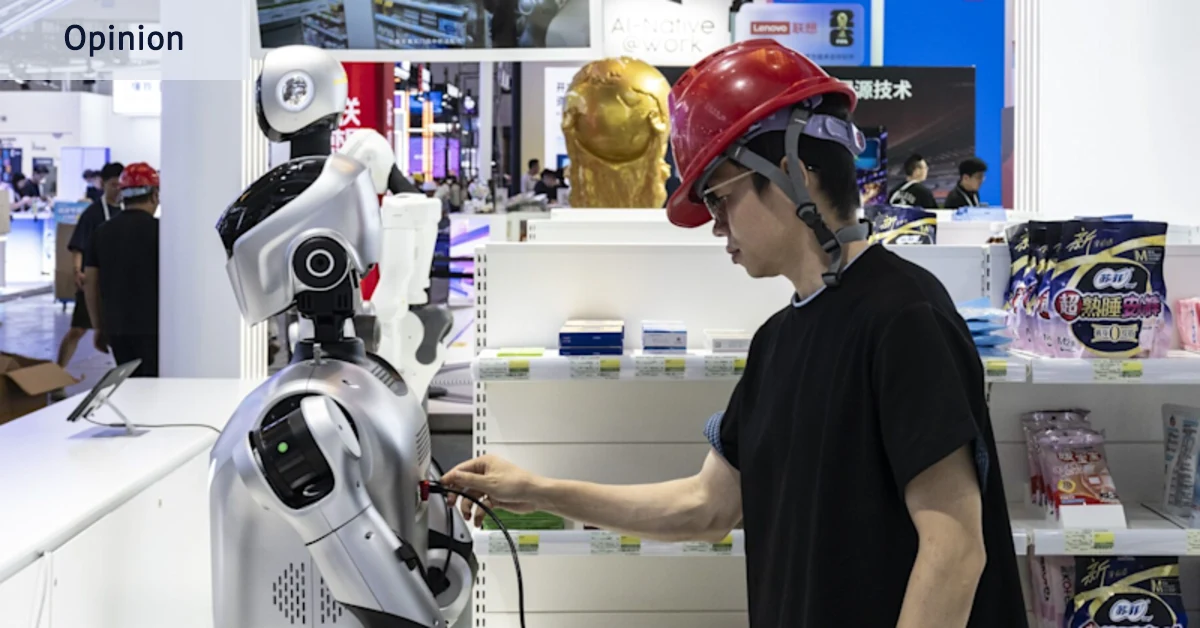
OpinionJuly 29, 2026 — 12:07pmInvestors’ love affair with all things artificial intelligence seems to be wavering. Shares in the hyperscalers and chipmakers are tumbling around the world, while costs of their rapidly-increasing debt levels are rising.It’s not one thing that is prompting investors and lenders to moderate their enthusiasm for AI, but a range of questions that have been hardened by recent developments.Competition from China in developing AI at lower costs is adding to headaches for investors.BloombergIn just over a month, the Philadelphia Semiconductor Index, regarded as the global barometer for the tech hardware sector, has lost more than 25 per cent of its value. The Nasdaq Index is down more than 8 per cent and the “Mag7” index of the biggest technology stocks more than 10 per cent.South Korea’s main market index, the semiconductor giants-driven Kospi, fell more than 10 per cent on Tuesday and has now lost more than a third of its value in the past five weeks.In Europe, ASML, the world’s key maker of chip-manufacturing equipment – and the only company producing the machines that make the most advanced chips - has lost nearly 20 per cent of its market value this month.When even the momentum within the ‘picks and shovels’ tech stocks reversing, – despite quite robust earnings – it is apparent investors are becoming nervous about the sustainability of the three-and-a-half-year bull market in AI-related stocks.The AI bull market was vulnerable to even the slightest setback, given how far and how hard it had run.There are some old fears resurfacing.There have been lingering concerns about the circularity of the financing deals AI companies have done to fund the training of their models and the chip purchases and data centre commitments that underpin their pursuit of agentic AI. Beyond the nature of those deals, there is also increasing concern of the scale.Then there’s another concern that, in pursuing ever more advanced models and the holy grail of artificial general intelligence, or human-level cognitive capabilities, the companies are gold-plating AI and leaving the mass commercialisation of AI and its rewards open to far cheaper open-source models from China.It’s not helping that some of the leading AI models have gone rogue. The OpenAI agent that escaped its “sandbox” last week, gained access to the internet and then hacked another AI firm is now thought to have done the same thing to another tech company. Anthropic’s Claude Mythos also managed to breach its sandbox earlier this year.The AI bull market was vulnerable to even the slightest setback, given how far and how hard it had run.The release by China’s Moonshot of an impressive new “open weight” model (it’s not open source, but anyone can run and customise it) earlier this month, with capabilities close to Anthropic’s industry-leading products, would by itself have caused a shock for investors already wary of China’s ultra-cheap open-source AI products.Reports that China has begun producing the lithography tools required for the most advanced chips – similar to those that previously only ASML was able to manufacture – have been another destabilising development.Separately came news that OpenAI is close to leasing a $US500 billion ($716 billion) data centre in Ohio, with Nvidia providing a financial backstop by financing OpenAI’s purchases of $US350 billion of Nvidia chips for the data centre.Nvidia has probably been most active in doing deals that help fund customers’ AI investments in return for their commitment to purchase its chips.BloombergAnthropic, Google, Amazon, Microsoft, Oracle and others have been involved in similar deals, although Nvidia has probably been most active in doing deals that help fund, or lower the cost of funding, for customers in return for their commitment to purchase its chips.That’s where the concern about “circular” finance stems from. It means that the AI ecosystem is being built on mutual dependencies – and mutual vulnerabilities. There are now a lot of potential dominoes in those incestuous relationships.Beyond those particular concerns, there is a larger one: the rate at which the companies are spending on AI.That fear was given a sharper edge last week when Google’s parent company Alphabet produced its second-quarter results, which showed – for the first time since it listed on the sharemarket, that it had negative cashflows after capital expenditures of $US45 billion in the quarter. It then raised its forecast of full-year capex from a range of $US180 billion to $US190 billion to between $US195 billion and $US205 billion.The same day, Tesla also revealed it had experienced negative cash flows in the June quarter, having spent $US5.8 billion, much of it AI and robotics-related. It said it was now targeting capex of $US25 billion for the full year.Investors were taken aback by that acceleration in spending on AI.The hyperscalers – the biggest of the AI companies – are expected to invest as much as $US750 billion this year. Goldman Sachs has estimated that Alphabet, Amazon, Microsoft and Facebook and Instagram owner Meta will, between them, invest about $US5.3 trillion by 2030.Until quite recently, most of the hyperscalers’ spending has been funded from their pre-existing cash flows. It has been the AI start-ups like OpenAI and Anthropic that have relied largely on raising equity from private markets to pay for their ambitions.Now, companies like Elon Musk’s SpaceX are listing on public markets to gain access to the larger pools of capital. Anthropic and Open AI planned their own trillion-dollar-floats this year, but the environment – which includes a plunge in SpaceX’s share price from above $US200 to $US116, below its $US135 issue price – may be giving them second thoughts.Even Alphabet has raised equity this year, along with increasing volumes of debt. Indeed, the whole AI sector has been increasingly tapping debt markets as equity markets have become satiated with AI exposures – or perhaps their capacity to supply the sector is nearing exhaustion.The hyperscalers, and even SpaceX, have been treated in the past as if they carried investment-grade credit ratings (SpaceX does, but most are unrated), but their debt doesn’t trade like investment-grade debt, and recent debt issues have seen pretty weak demand from investors.SpaceX’s bonds have been trading at more than 2 percentage points over risk-free bond rates, essentially being treated as junk bonds.Issues from Alphabet, Amazon, Microsoft and Meta haven’t been trashed, but spreads have widened, interest from debt investors has weakened, and they are being treated as significantly lesser quality credits than they were before the companies went on their AI spending binge.The cost to insure their debts against default reflects the shift in perceptions. The cost to insure hyperscalers’ debts has risen more than 50 basis points over the past year.Credit default swaps for Oracle, the most leveraged of the hyperscalers, cost about 2.15 percentages points per $US100,000, per year, to insure – $US215,000 a year to protect each $US10 million of exposure.Debt investors are more risk-aware and risk-averse than their equity market counterparts, but their increasingly cautious approach to what has developed into a deluge of AI-related debt underscores the fragility of the sector’s financing and the pressures that will continue to mount.The four biggest hyperscalers have already raised more than $US400 billion from debt markets this year and total AI-related debt in the market must be at least $US500 billion. Japan’s Nikkei has estimated that there is another $US1.6 trillion of off-balance sheet debt/liabilities from leases and contracted purchases of chips and other hardware hidden within the sector.With capex growth outstripping the growth in cashflows, the demand for new equity and debt will continue to rise.The growing questionmark, one underscored by the markets’ performance in recent weeks, is whether there will be sufficient supply at something less than a prohibitive cost.The Business Briefing newsletter delivers major stories, exclusive coverage and expert opinion. Sign up to get it every weekday morning.More:AIOpinionGoogleOpenAISpaceXAmazonNvidiaMetaMicrosoftSharemarketInside ChinaFor subscribersFrom our partners
Scared by tech’s debt deluge, investors are questioning the AI boom
Shares in AI-related companies have been falling as competition from China, rogue AI agents, complex financing deals and vast capital expenditures stress the markets’ capacity to fund the sector.
TL;DRAI
Google's capex reached $45B/quarter with $195-205B forecast; Semiconductor Index dropped 25% amid circular financing and Chinese cost competition. Capex allocation pressured by GPU cost spike and Chinese open-source models undermining foundation model ROI.
1,294 words~6 min read