This content was published on
July 29, 2026 - 03:33
6 minutes
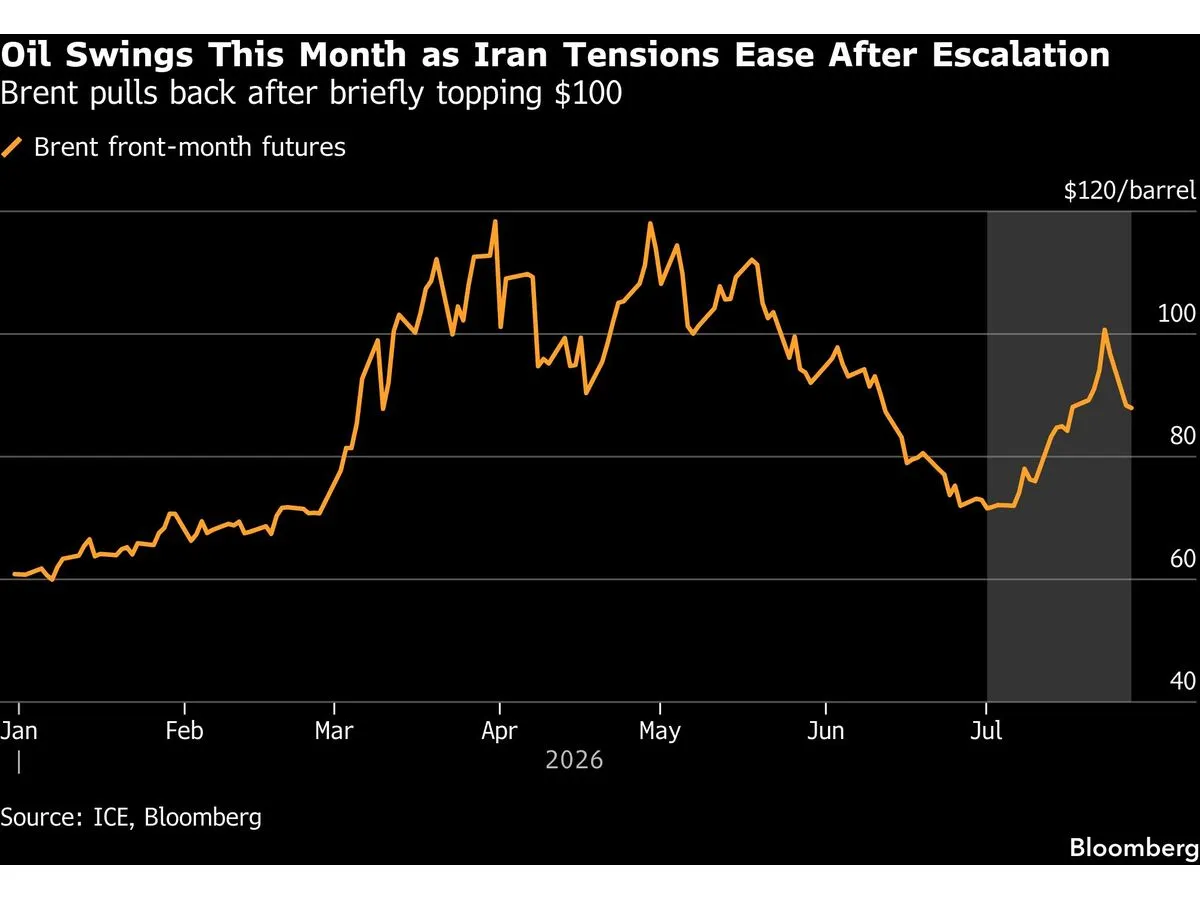
(Bloomberg) — Oil climbed and Treasuries fell after fighting erupted in the Middle East, ending several days of calm and renewing concerns over disruptions to energy supplies. Asian stocks swung between gains and losses.Brent rose more than 4% to about $87.50 a barrel, rebounding from its biggest three-day decline since April 2020, after the US military said it intercepted an Iranian “surprise attack” on its troops and struck back at the Islamic Republic.Treasuries dropped, with the yield on the benchmark 10-year note climbing one basis point to 4.62%, as investors weighed the potential inflationary impact ahead of the Federal Reserve’s policy decision on Wednesday. Gold, whose appeal diminishes if interest rates go up, slipped 0.2%, while a Bloomberg gauge of the dollar steadied.Technology shares were volatile in early Asian trading after Tuesday’s selloff in chipmakers. SK Hynix Inc. dropped 2% after quarterly profit rose 557%, still missing lofty estimates. The broader MSCI Asia Pacific Index was 0.5% higher after earlier falling as much as 0.4%. The moves came after a gauge of chipmakers slipped 4.5% on Wall Street, putting the Nasdaq 100 Index on the brink of a technical correction.The renewed fighting in the Middle East has shifted investors’ focus back to the Strait of Hormuz, with the risk of disruptions to oil flows threatening to fuel inflation just ahead of the Fed rate decision. That adds another layer of uncertainty for investors already rotating out of tech stocks amid growing doubts over whether billions of dollars of artificial-intelligence spending will generate adequate returns.Meanwhile, President Donald Trump welcomed Israeli Prime Minister Benjamin Netanyahu to the White House Tuesday as the US leader sought to avoid renewed bombing in Iran and instead laid the ground for further diplomacy.“We remain cautious of any potential deal that does not concretely settle the Hormuz topic, given disagreements over management of the Strait led to Iranian aggression and an early failure of the prior MOU,” said Ryan McKay, senior commodity strategist at TD Securities.Micron Technology Inc. and Sandisk Corp. were among the biggest drags on the S&P 500 on Tuesday, while the Philadelphia Semiconductor Index fell 4.5%, putting the gauge on course for its worst month since 2002 after its strongest quarter on record.The divergence in S&P 500 and Nasdaq 100 moves “reflects rotation” away from chipmakers, First New York portfolio manager Vikram Rai said. The Nasdaq 100 “can’t go up if semiconductors and memory don’t go up,” he added.The moves create a challenging backdrop ahead of earnings from the largest US tech companies. Microsoft Corp. and Meta Platforms Inc. report results on Wednesday, followed by Apple Inc. and Amazon.com Inc. a day later.The Fed is expected to hold interest rates steady when it concludes its two-day meeting, but market participants are eyeing the possibility of a surprise hike as patience with high inflation wears thin.Fed officials have kept rates on hold this year as they wait for temporary price pressures from tariffs and the war in Iran to wane. Concern is mounting, however, that inflation won’t reach the central bank’s 2% target unless higher rates are used to rein in demand. Following the Fed, the Bank of England will announce its decision on Thursday and the Bank of Japan Friday.Analysts at JPMorgan Chase & Co. said the probability of a rate hike is likely less than the roughly 30% chance currently priced, as “inflation, while elevated, does not appear to at-risk of an upside explosion.” They assign a 50% chance to a “hawkish hold,” as the central bank will want to stay vigilant even though recent energy prices suggest disinflation may be ahead.“A mild bout of risk aversion is looming over financial markets ahead of the Fed policy decision and two weeks of significant corporate earnings,” RSM Chief Economist Joseph Brusuelas said. With tech and oil company results ahead, there might have been “a bit more willingness to put capital to work” if not for rising concerns about AI competition from China and tech-ecosystem financials, he said.Corporate Highlights:Nvidia Corp. Chief Executive Officer Jensen Huang defended open-weight artificial intelligence systems as crucial to developing the nascent AI industry, as officials in Washington consider how to respond to a surprise breakthrough from Chinese startup Moonshot. Meta Platforms Inc. and BlackRock Inc. plan to build a 1-gigawatt data center complex in Texas that will cost about $14 billion to develop, adding to a wave of investment in the computing hubs that power AI. Ford Motor Co. posted earnings ahead of Wall Street estimates and raised its outlook for the second time this year on higher prices and strong sales of high-margin sport-utility vehicles. Some of the main moves in markets:StocksS&P 500 futures rose 0.2% as of 10:32 a.m. Tokyo time Nikkei 225 futures (OSE) were little changed Japan’s Topix rose 0.2% Australia’s S&P/ASX 200 rose 1.4% Hong Kong’s Hang Seng rose 1.2% The Shanghai Composite was little changed Euro Stoxx 50 futures fell 0.1% CurrenciesThe Bloomberg Dollar Spot Index was little changed The euro was little changed at $1.1390 The Japanese yen was little changed at 163.75 per dollar The offshore yuan was little changed at 6.7709 per dollar CryptocurrenciesBitcoin was little changed at $63,802.94 Ether fell 0.2% to $1,913.4 BondsThe yield on 10-year Treasuries advanced one basis point to 4.62% Japan’s 10-year yield declined 1.5 basis points to 2.760% Australia’s 10-year yield declined five basis points to 4.92% CommoditiesWest Texas Intermediate crude rose 4.4% to $82.72 a barrel Spot gold fell 0.2% to $4,020.13 an ounce This story was produced with the assistance of Bloomberg Automation.–With assistance from Youkyung Lee.©2026 Bloomberg L.P.