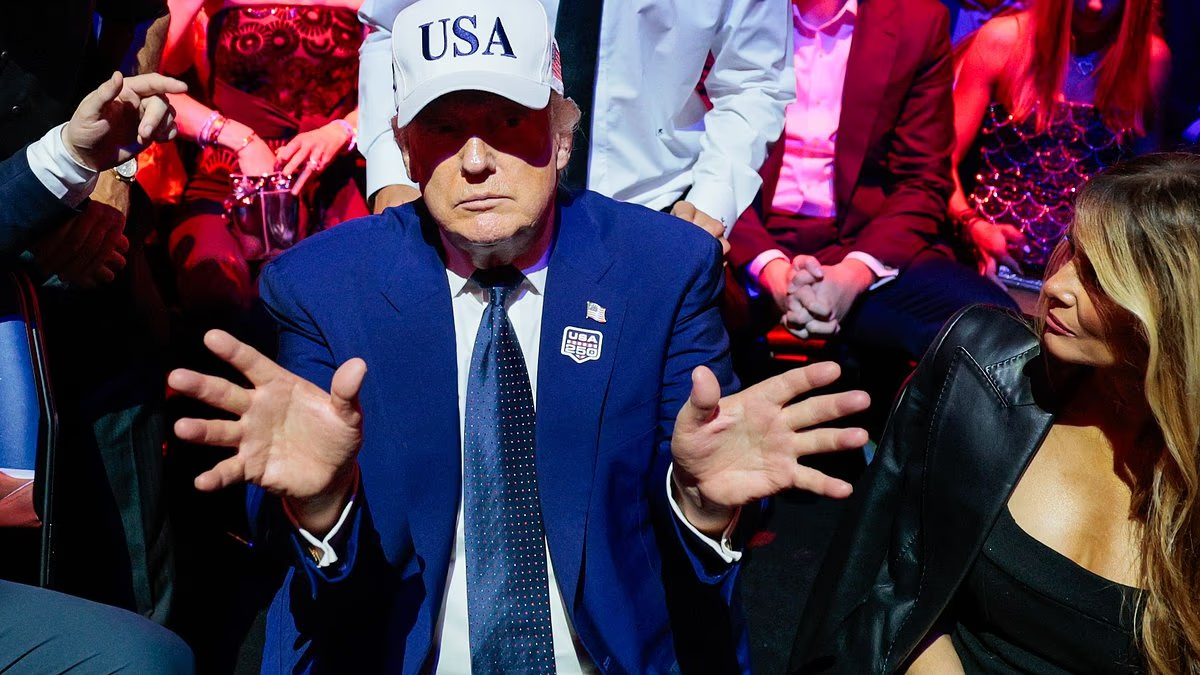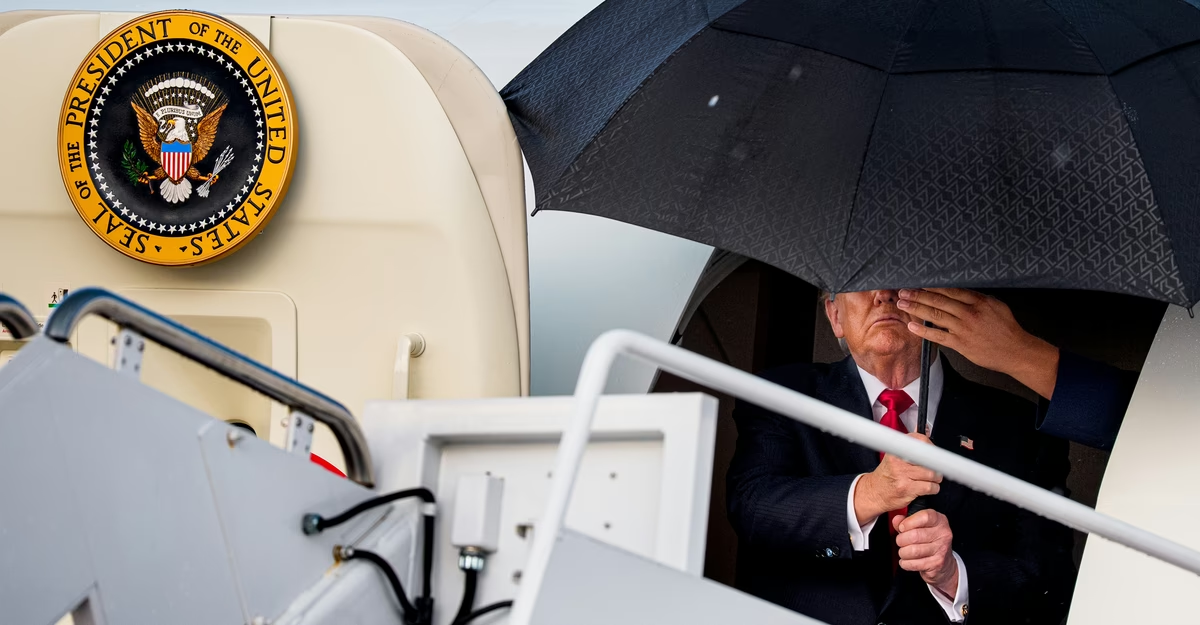
President Trump has mused about being the most powerful man in history. He has started wars and remade his nation’s economic and strategic relationships with the world. He has demanded, and largely received, total obedience from his party. He has dominated the national discourse like no president has before, and he’s tried to recast his nation’s capital—and even its history—to his liking. He’s everywhere. He has said he believes that there are “no limits” to his power.But if that was ever truly the case, it certainly isn’t now. Recent months have delivered a reckoning for Trump, who has crashed hard against some real limits. The war in Iran, a conflict that he’d once thought would take only a few weeks, hit the five-month mark today. The U.S. casualty count is growing, weapons stockpiles are running low, and gas prices are again surging. Trump desperately wants the war to end. He is receiving conflicting guidance from his advisers—escalate, some urge, as others tell him to cut and run—and has become just the latest U.S. president to be humiliated by hard-liners in Tehran.Trump is also flailing domestically. His approval numbers have sunk, and Republicans are finally, in small doses, beginning to defy him. Trump has demanded that the Senate blow up the filibuster to pass the SAVE Act, which would make voting more difficult and require voters to provide proof of citizenship. But Republicans have refused. Although the legislation seems dead, Trump called yesterday for Republicans to stay in Washington to work on it, potentially saddling them with unpopular (and doomed) votes while also preventing them from returning home to campaign ahead of the midterms. Strategists from both parties predict that at least one chamber of Congress will flip to the Democrats, allowing the party to stall whatever is left of the president’s legislative agenda and open investigations into his administration and allies.Once the midterms are over, Trump could face his worst fear: irrelevance. He will be a lame duck, down to his final two years in office, and at some point will no longer be the nation’s top topic of conversation. As focus shifts to the presidential primaries, Trump risks disappearing from the headlines. Even some of his closest allies don’t know how he’ll react.Trump gathered a team of senior advisers at the White House on Friday to walk through the latest options in the war that he’d already declared won. The meeting came after nearly two weeks of the United States bombing Iran, with Tehran striking back against allies in the region, including a hit on a military base in Jordan that killed three American service members. Trump had wanted to avoid resuming hostilities after signing a cease-fire agreement last month at Versailles, of all places. But negotiations for a permanent peace have stalled, and Iran has continued to menace the Strait of Hormuz and threatened to charge tolls for ships using the vital waterway, a nonstarter for American allies in the Persian Gulf. Meanwhile, the new wave of bombings, green-lit by Trump, has not produced meaningful change along the strait. The meeting was set to discuss the possibility of returning to an all-out war.Read: War by any other nameTrump has threatened escalations many times before, only for Iran to call his bluff. This time, a senior White House official familiar with the discussions told me, the frustrated president seemed more inclined to order a heavier assault—but he and his advisers once again opted against it. There were several reasons to discard the idea, at least for now, the official said, speaking on the condition of anonymity to discuss internal conversations. That included the risk of dangerously depleting the number of defensive interceptor missiles available to the military’s Central Command, which is responsible for operations in the Middle East. Advisers also expressed worry about the prospect of a widening war in the Middle East, the anger of key Gulf allies targeted by Iran’s counterattack, and the potential for an energy or a refugee crisis. Trump repeatedly told advisers that he worried that an escalation could spark a global economic conflagration and “turn me into Hoover,” the senior official told me.A number of influential Republicans and conservatives have begun to urge Trump to abruptly declare some sort of win and leave the Iran mess behind. They argue that the short-term benefit of doing so would be to lower prices, push Iran out of the headlines, and potentially salvage Republicans’ midterm chances this fall. But the geostrategic consequences would be significant; Tehran would possess an economic weapon—control of the strait—that it could wield at any time to inflict global economic pain. And the Iranian regime could strike with impunity at its neighbors, including Israel.Trump’s campaign swing through Michigan yesterday was a rarity in his second term. But his refrain there was not: He made unfounded claims about election fraud and, this time, appeared alongside a GOP congressman running for governor who falsely said that Trump had won the state three times. (Nope, only twice.) The president exaggerated the nation’s manufacturing rebound under his watch and, once more, mocked the affordability crisis that polls suggest is top of mind for many voters. His recent moves seem designed to dissuade or prevent voters from casting their ballot, not to inspire them. He has spent weeks talking about election security, including in a prime-time White House address, prompting Democrats to warn that Trump is trying to set up a pretext for challenging this fall’s results. His administration has appealed to the Supreme Court to curb mail-in voting, and Trump has relentlessly pushed for voter restrictions via the SAVE Act.Senate Majority Leader John Thune has refused to do away with the filibuster, a move that would allow the GOP to push the SAVE Act through. Karoline Leavitt, the White House press secretary, said last week that the president’s “patience is running out” with Thune, and a senior adviser told me that Trump has privately derided the majority leader as “one of my biggest headaches.” (Trump downplayed the friction yesterday, telling reporters on Air Force One that his relationship with Thune was “fine” while also demanding that the legislation pass.)Just over a year ago, the GOP marched in lockstep to pass the One Big Beautiful Bill Act tax legislation. Now Trump’s wish list has stalled. Some Republicans have sought permission to distance themselves from the unpopular president, and even loyalists such as House Speaker Mike Johnson said last week that, in terms of the war, it was time to “wrap it up.” By no means are Republicans in revolt. But Trump’s grip on the party has loosened, just a little.The White House spokesperson Abigail Jackson reiterated to me in a statement that the SAVE Act “has always been a top priority for President Trump and it remains one,” adding that he “will not stop fighting until it is passed.”Trump, a man who has spent his life in pursuit of attention, is also beginning to contemplate the limits of his relevancy. The former celebrity developer and reality-TV star has famously declared that he’d rather receive bad publicity than no publicity. At times, he even faked being his own publicist to plant some news. One of his superpowers is his ability to command attention, to change the news cycle or move markets with a stray comment or tweet. His ubiquity, some of his advisers believe, is a strength—because Trump is everywhere all the time, he’s hard to pin down, and controversies slide away. With loud volume and relentless repetition, he can shape the national conversation.Read: A different kind of fading presidentBut even those in Trump’s inner circle aren’t sure what to expect if people start talking about him less. The political calendar is relentless: Once the midterms clear, Washington will turn its focus to the 2028 presidential campaign. With no incumbent in the race and no clear front-runner in either party, it will be as wide-open as any race in decades. Trump may no longer be among each day’s top stories—arguably for the first time since he came down the Trump Tower escalator more than a decade ago. It’s not as if he will suddenly vanish; he’ll aim to play GOP kingmaker, and he’ll still be commander in chief. But he’ll be staring at life as a private citizen again, one whose businesses and family could face questions from a future Democratic president’s Department of Justice. His widely panned speech at last week’s White House Correspondents’ Dinner seemed to offer a preview of his future: His grievances were met mostly with silence. Some of the president’s allies have begun to privately wonder how he might handle a new, reduced status. No one suspects that he’ll take it well.
Trump Crashes Into Reality
The president is learning that limits to his power—and, soon, his relevancy—do exist.
1,449 words~7 min read