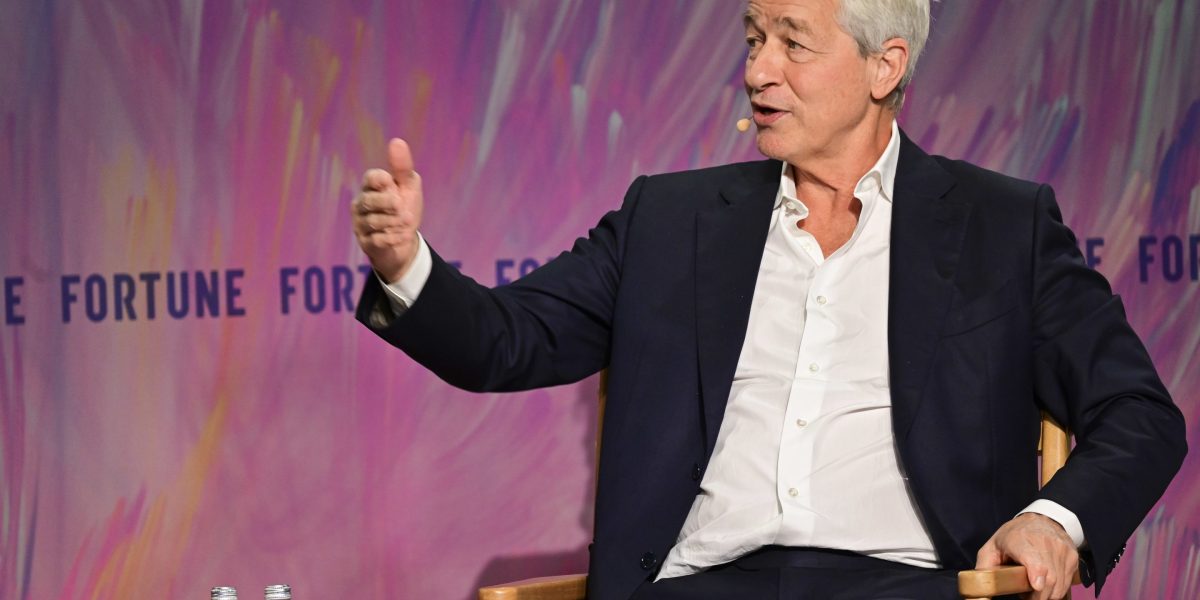
Getty ImagesJPMorgan Chase CEO Jamie Dimon is known for offering straight talk on finance and the economy, and a recent interview shows that he also applies this same candor when offering career advice for professionals. Forbes contributor Carmine Gallo reports that in a recent conversation with Wilfred Frost for The Master Investor Podcast, Dimon offered a key piece of advice to “ambitious and hungry” professionals whose goal is to occupy senior management and leadership roles. According to Dimon, disciplined communication is a leadership skill all employees should master, with the billionaire CEO adding that too many leaders are “sloppy” communicators. While many people view communication as a simple soft skill, the bank executive views it as a core leadership discipline that leads to faster and smarter decision-making. In fact, he calls out Amazon founder Jeff Bezos’ “six-page memos” as a perfect example of how leaders can create intentional communication mechanisms in the workplace. Gallo, author of The Bezos Blueprint, explains that Bezos previously required senior executives to replace PowerPoint presentations with carefully crafted “narratively written memos.” By substituting bullet points on a slide with written memos, individual leaders began to think and talk more clearly, sharpen their arguments before expressing them, and make better decisions more quickly. Many of Amazon’s former executives who left to start or run other companies told Gallo that the written memo was the most important management practice Bezos taught them.Read here to learn more about why Dimon loves Bezos’ executive communication exercise and why he believes all professionals should learn to utilize the rule of three when communicating their ideas. This is a published version of Forbes’ Careers newsletter. Click here to subscribe and get it in your inbox every Tuesday. WORK SMARTER Practical insights and advice from Forbes staff and contributors to help you succeed in your job, accelerate your career and lead smarter.If you want to be a valuable employee at a struggling company, shift your narrative from what you are doing to how you are saving with three strategies from career coach Sho Dewan.Afraid to disagree with your coworkers? Use these five phrases to be professional and have more productive conversations with your team, according to leadership expert Katie Wieczorek.Some workers slow down projects to avoid getting assigned new tasks. Learn how to avoid falling into this productivity performance trap with tips from executive coach Caroline Castrillon.Have you been out of work long term? The issue may be a skills mismatch and little support for new job transitions. See how to break through with advice from labor expert Michael Collins. ILLUSTRATION BY MACY SINREICH FOR FORBES; IMAGES BY BILL VARIE, NAUMOID, ALEX011973, WENBIN, AND JUN XU VIA GETTY IMAGESDeep Dive: Why Engineering Is No Longer A Sure Thing College Major When It Comes To JobsWhile lots of recent college graduates are being battered by a weak hiring market, perhaps no group is more shocked by their current plight than those who majored in engineering, long considered among the safest, most secure, and highest-paying majors. Yes, engineering grads still make more than education and English majors. The National Association of College and Employers projected in February that 2026 engineering and computer science grads would see average starting salaries topping $81,000, compared to less than $69,000 for those majoring in business, social sciences and communications.But that’s if they can find a job. According to LinkedIn data provided exclusively to Forbes, while overall hiring of new grads fell 20% between December 2019 and April 2026, jobs for engineering majors were down by 25%, the biggest drop for any of the 20 most common majors on LinkedIn’s platform. By contrast, jobs for education majors and those in the health professions slid 16%.“There was a time where we told everyone to code and we thought that was a very safe role,” Kory Kantenga, LinkedIn’s Head of Economics, Americas told me. “And now we see for folks who graduate with computer science degrees, unemployment is relatively elevated.”Of course it’s not just new grads suffering. Outplacement consultant Challenger, Gray and Christmas reports that in the first six months of this year, tech companies announced 139,156 jobs cuts, nearly one-third of all the layoffs announced by all industries. The dominant reason, the firm says, was artificial intelligence, “restructuring around it, automating roles, and reallocating budgets toward new [AI] capabilities.”But those layoffs hurt new grads, too. As fearful older workers cling to their current jobs, it has a cascading effect, meaning there are even fewer new openings for recent grads, says Kantenga.To navigate today’s weak job market, Kantenga says engineering graduates need to hone in on where growth is happening in their field and figure out a way to tap into it. He advises graduates to ask themselves, “How do I take the skills that I got from that major and apply them to another area or another field within engineering more broadly?”Academic leaders from Georgia Institute of Technology and Case Western Reserve University—two colleges recognized on Forbes’ New Ivies List—agree that keeping your options open to opportunities that may not be in your traditional field is key for engineering graduates looking to succeed. “We’re teaching our students to think critically and to be creative and to solve problems,” says Susan Hagness, dean of Case Western’s engineering school. “And that’s always been in high demand across all industry sectors, so our students have not only gone into engineering, but consulting, healthcare and financial services.”NUMBER TO NOTE63%That’s the number of women who said they feel pressure to accept lower salaries to re-enter the workforce after a layoff, compared with 52% of men, according to a poll by job search site Glassdoor. Bloomberg reports that this disparity could widen the gender pay gap. VIDEO
Jamie Dimon’s Advice To ‘Ambitious And Hungry’ Professionals
This week’s careers newsletter looks at the skill Jamie Dimon thinks all professionals need. Plus, a deep dive on engineering no longer being a safe bet for job security.
951 words~4 min read