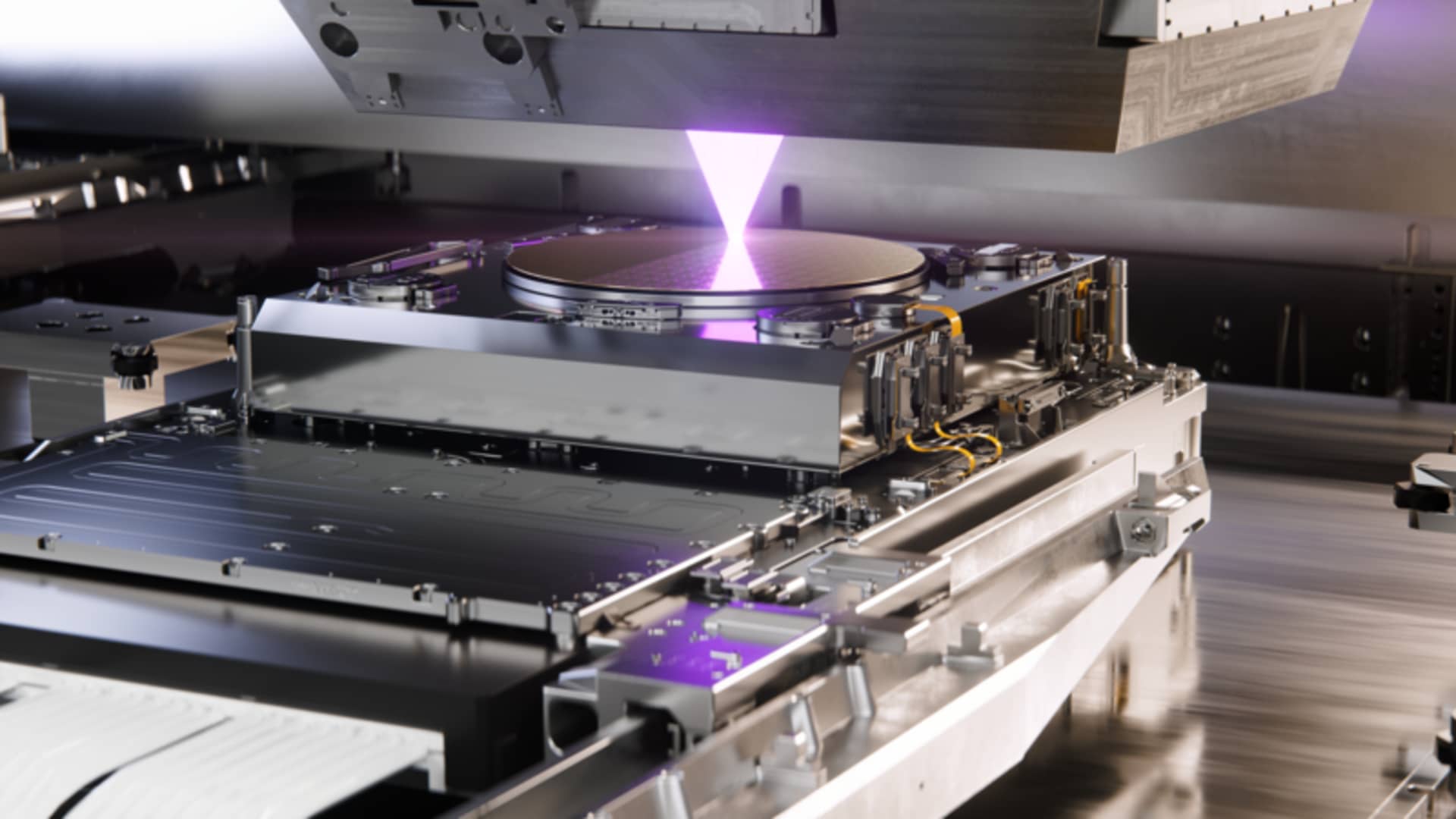
ASML has become Europe's most valuable company thanks to its dominance in making lithography systems, huge "chip printing" machines that can cost up to $400 million each and are indispensable to companies driving the AI boom.Advances in AI and a global buildout of data centres have led chipmakers to expand capacity rapidly. ASML supplies tools to TSMC, which makes chips for Nvidia, as well as to memory chip makers like SK Hynix, Samsung and Micron.The company is facing new challengers from China in the middle of its product range, while it is also under pressure from the United States over exports of some of its tools to the Asian nation.Here is a closer look at the technology behind the Dutch company's rise.How to tell apart your DUV, EUV and high NAASML is the dominant maker of deep ultraviolet (DUV) and extreme ultraviolet (EUV) lithography machines, named for the wavelength of light they use to help zap the microscopic circuitry of chips onto silicon wafers.In the DUV segment - where tools costing roughly $60 million each are used to make chips that go into industrial and consumer electronics - ASML has a market share above 80%, ahead of rivals Nikon and Canon of Japan.It has a monopoly in the cutting-edge EUV segment, though rivals in China and the United States are trying to develop alternatives. Standard EUV tools cost around $200 million and are used today in the manufacture of most AI chips and leading-edge memory chips.Chipmakers including Intel are testing ASML's newest "High NA" EUV tools, which will be used for new generations of AI chips with even smaller features in the coming five years. Only a handful have so far been made, with a price tag estimated at $350 million to $400 million each.The technology: Huge machines working at nanoscaleA standard EUV machine used for Nvidia chips is the size of a school bus, weighing 150 tons and using a complex system of lasers, mirrors and magnets to write microscopic circuitry onto silicon wafers needed in chip production.They map out layers of circuitry by shining patterns of light onto silicon wafers, each containing maybe a hundred AI chips, with extreme precision and speed.The EUV wavelength is 13.5 nanometers. By comparison a human hair is between 80,000 and 100,000 nanometers thick.Lasers and mirrorsTo generate the EUV light, droplets of tin are blasted at a rate of 50,000 times per second with some of the most powerful lasers ever built, manufactured by German industrial firm Trumpf. A system of mirrors made by German optical systems maker Zeiss, with surfaces smoother than those used in space telescopes and kept in a vacuum, guides the light into the heart of the machine.Magnetically levitated stages move wafers at faster than 3 meters per second, accelerating and decelerating at more than 15 times the force of gravity.How are ASML's huge machines delivered?EUV machines are assembled in the Netherlands, then packed into around 40 containers, and taken on cargo planes to customer chip fabrication plants. ASML shipped 48 such systems in 2025 and forecasts sales of 65 this year and 85 in 2027.
Explained: The $400 million ASML 'printers' key for the AI chip boom - The Economic Times
Advances in AI and a global buildout of data centres have led chipmakers to expand capacity rapidly. ASML supplies tools to TSMC, which makes chips for Nvidia, as well as to memory chip makers like SK Hynix, Samsung and Micron.
517 words~2 min read