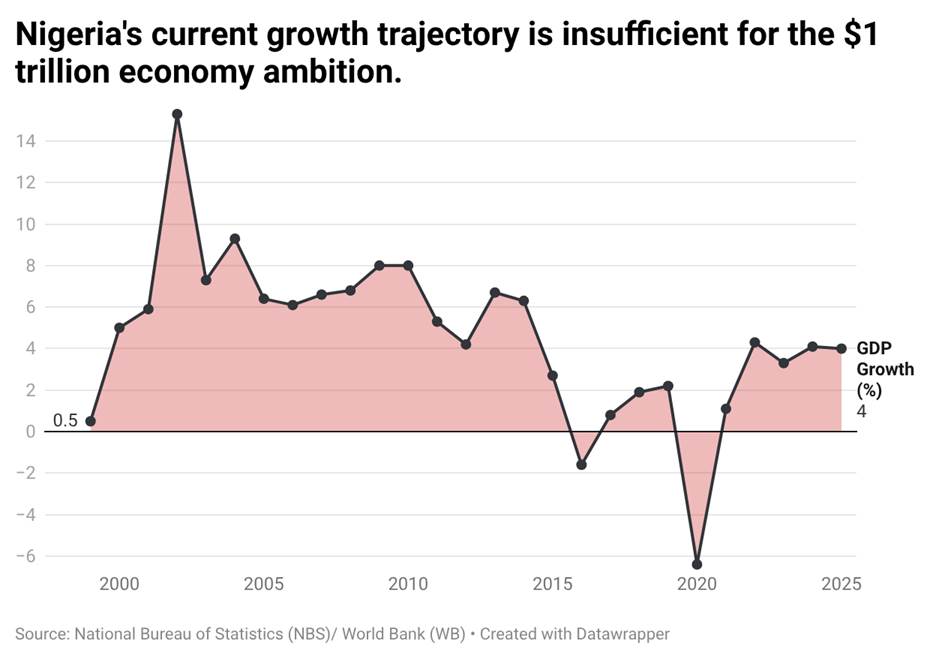
Nigeria’s ambition to become a $1 trillion economy by 2030 faces a harder test than better corporate governance. The country must grow much faster, attract productive investment and expand its capacity to produce goods and services.
Kashim Shettima, Vice-President, was right to argue this month that Nigeria cannot build a $1 trillion economy on weak corporate governance. Investors do not commit long-term capital where contracts are uncertain, institutions are weak and corporate abuses go unpunished. Stronger governance can reduce risk and improve investor confidence.
But governance is a foundation, not the engine of growth. It can help attract capital, but it cannot by itself generate the additional $700 billion in output needed to reach the target. The more difficult question is whether Nigeria can realistically become a $1 trillion economy by 2030 on its current trajectory. The answer depends on uncomfortable arithmetic.
The numbers are tougher than the politics
Nigeria’s economy was worth roughly $291 billion in 2025. To reach $1 trillion by 2030, it would have to more than triple in dollar terms within five years. That implies annual compound growth of about 28 percent in nominal US-dollar GDP, according to BusinessDay analysis, an extraordinary pace by almost any historical standard.