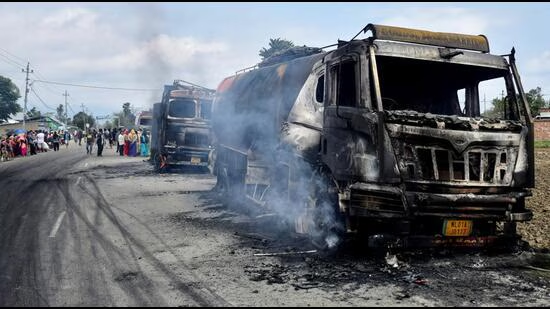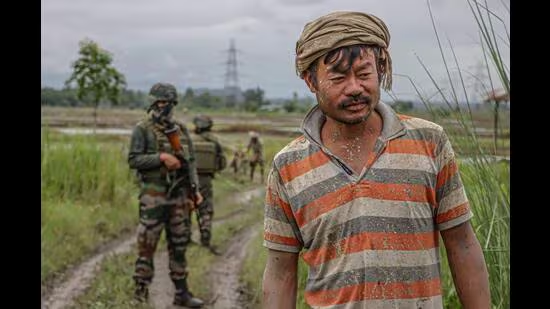
It is clear by now that the crisis in Manipur is not one that can be resolved with piecemeal solutions or patchwork government initiatives, given that inter-community hostilities have engulfed every group in the north-eastern state. It is a sorry commentary on the administration’s performance that the embers of violence continue to smoulder three years after clashes first broke out.A securitised approach focussed on pumping more forces into the state has yielded little result. (AFP)This newspaper reported on Tuesday that Kuki-Zo groups launched an indefinite counter-economic blockade on the highway connecting the state with neighbouring Nagaland. This came in response to an economic blockade by Naga and Meitei groups protesting against the killings of six Naga hostages last month. The decision was taken and implemented by Kuki-Zo civil society organisations, showing that the government was effectively rendered helpless. Naga and Kuki-Zo tensions escalated in May after twin ambushes left four people dead. On the same day, Kuki-Zo and Naga groups captured 48 civilians (20 Nagas and 28 Kuki-Zo). On May 15, 14 captives each from the two communities were released. The remaining 14 Kuki-Zo hostages were freed unharmed on June 9. The mutilated bodies of six Nagas were found the next day, ratcheting up tensions and triggering the blockades.There are two clear points of worry. One is that the circle of the violence appears to be widening — hostilities that first began between the Kukis and Meiteis in 2023 (at the time, the Nagas were considered a neutral party) are now a frontal battle between the Kukis and the Nagas. This comes against the backdrop of mounting pending litigation connected to the clashes and the fact that many people continue to live in transit camps, unable to return home.The second is the uncertain grip of the state government. In these three years, Manipur has seen every form of government, including months of President’s Rule. A securitised approach focussed on pumping more forces into the state has yielded little result. When the new government took over in February, there was hope of a new beginning given that representatives from all three major communities took part. The new government can claim that it has staunched violence to an extent. But the state is still balkanised on community lines, supply lines and highways are cut off, and tensions run high. Both the Centre and the state need to redouble efforts to bring everyone to the table and re-establish the primacy of law. An honest reckoning with the faultlines, sacrificing short-term political gains for long-term national goals, and transparent discussions on the future of Manipur are required.
Manipur needs honest reckoning
The Centre and the state must redouble efforts to bring everyone to the table and re-establish the primacy of law
433 words~2 min read