Most engineers think of the build as something that happens on their laptop. You type a command, the fans spin up, and a few minutes later you have a binary. That model is so ingrained that we rarely question it — until the codebase gets big enough that it quietly collapses.
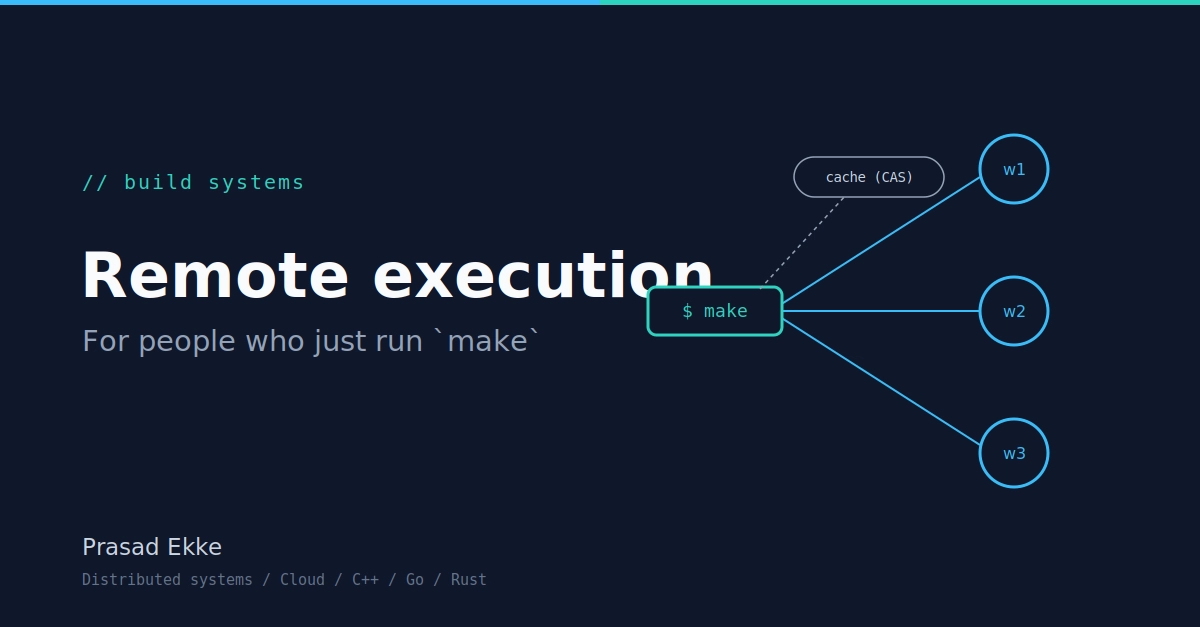
At a certain scale, the laptop build is too big for one machine, too slow to repeat, and too wasteful to run from scratch on every change. Ten engineers rebuild the same unchanged files ten times before lunch. A clean build takes forty minutes. CI is the bottleneck for the whole team. Remote execution is the answer large codebases reach for, and once you understand it, a lot of otherwise-baffling build-system design suddenly makes sense. Here is the mental model, minus the vendor jargon.
The core idea: the build is a graph of pure functions
Stop thinking of a build as a sequence of commands and start thinking of it as a graph. Each node is an action: a single command plus the exact set of inputs it reads and outputs it produces. Compiling one file is an action. Linking is an action. Generating code from a schema is an action. The edges are dependencies — the linker action consumes the object files the compile actions produced.