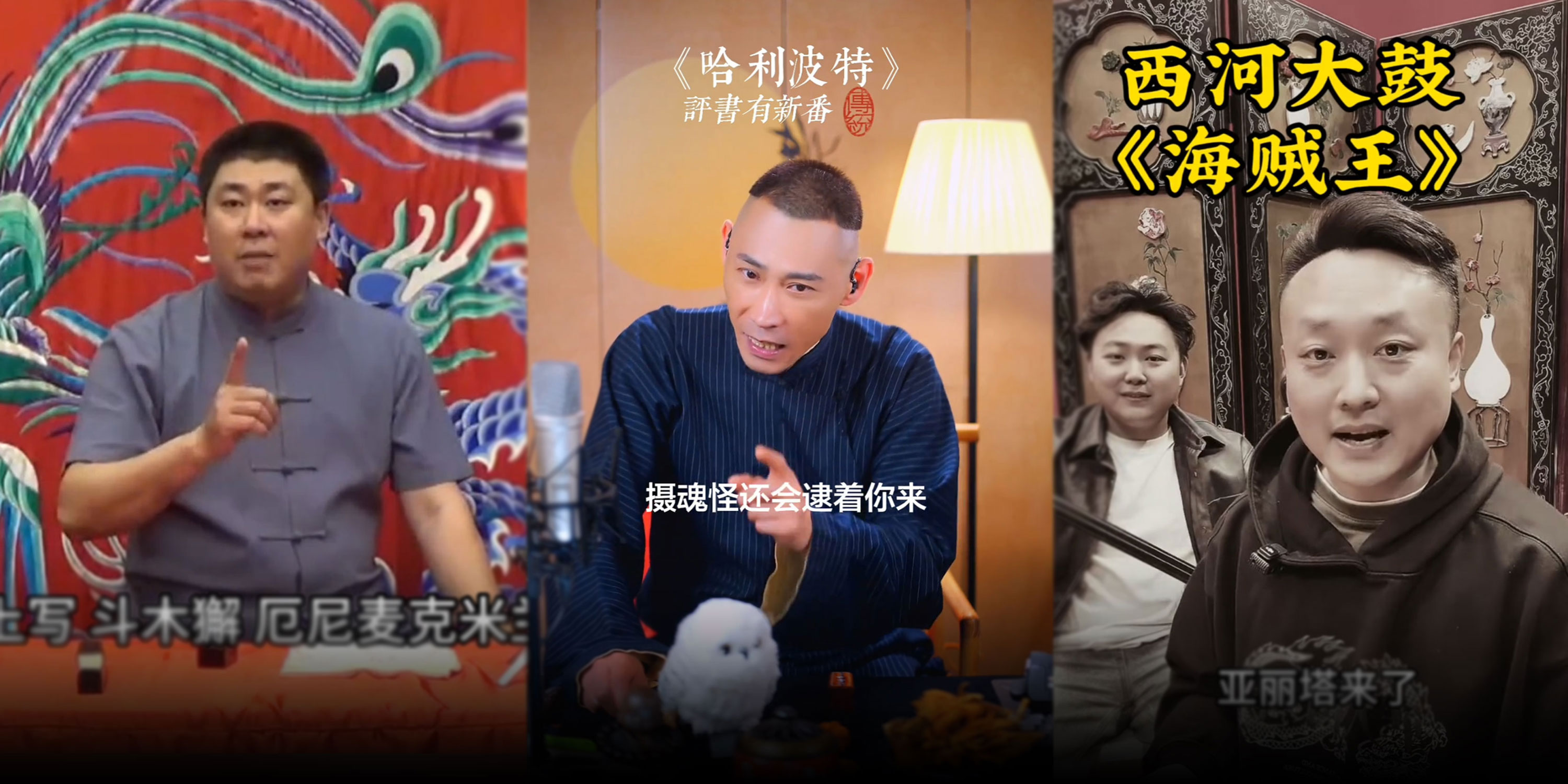
As he starts his livestream, Qi Jingchuan looks every inch the classic Chinese storyteller — loose-fitting robe, pair of walnut shells in one hand, gavel and folding fan on the table just in front of him.The only thing that doesn’t fit the scene is Hedwig, the snowy owl from the blockbuster “Harry Potter” series, who is perched on Qi’s shoulder.Qi has been performing pingshu — a form of oral storytelling tracing to the Song dynasty (960–1279) — for more than a decade, originally entertaining audiences with folk tales about epic battles and wandering swordsmen.However, to attract younger listeners on Douyin, the Chinese version of TikTok, his livestreams now more often focus on the adventures of the boy wizard from J.K. Rowling’s best-selling fantasy novels.Qi is among a new breed of performers of quyi — the umbrella term for China’s many ancient storytelling traditions — who have racked up hundreds of millions of views on social media after switching up their repertoires to include global hits such as “Harry Potter” and the Japanese manga series “One Piece” and “Naruto,” as well as modern Chinese online literature.For younger people in China, quyi — such as pingshu; xiangsheng, or crosstalk; pingtan, storytelling through song; and kuaiban, narration with bamboo clappers — is more associated with their grandparents’ generation, with most regarding it as intangible cultural heritage rather than entertainment.Performers like Qi are attempting to change that perception and breathe new life into traditional arts.“More than anything, I want younger generations in China to understand what pingshu really is,” Qi told Sixth Tone, adding that he believes the art shouldn’t be confined to just antiquated centuries-old stories.Zhao Luping, associate professor of journalism at Shanghai’s East China Normal University, believes that this fusion of ancient art forms and digital-era content could be an effective way to sustain the vitality of this heritage.The “Harry Potter” series, for example, is already available as novels, audiobooks, movies, and soon as a television show, “but when retold as pingshu, it can still capture young people’s attention,” she explained. “That’s what makes this phenomenon so interesting. Various quyi genres possess distinct artistic charms.”Serving the right dishFor 43-year-old Qi, the decision to experiment with modern narratives stemmed from pure frustration.Historically a staple of teahouses and marketplaces, pingshu was among China’s most-loved forms of entertainment after radio broadcasts brought the art into millions of homes in the 1950s. Its popularity peaked in the ’80s, when classic storytellers like Shan Tianfang and Tian Lianyuan became household names.Qi developed a fascination with the art form at an early age. After graduating from university, he began studying pingshu and eventually became a professional performer.By that time, however, interest in pingshu had long since waned. The arrival of TV, followed by the internet and then short-video platforms, had transformed people’s tastes for entertainment.As long-form storytelling struggled to compete with the endless stream of rapid-fire online content, Qi noticed a widening gap: performers were still telling historical epics and martial arts classics that older generations knew by heart, but younger audiences were turning elsewhere.To mix things up, Qi tried reaching more listeners via livestream, which at first brought attention but not income. His audience was still mostly older people accustomed to listening to pingshu for free on the radio.He realized that to preserve their art and make a living, quyi performers needed to go beyond their core audiences and seek younger fans willing to pay for content.“Maybe we just weren’t serving the right dish,” Qi said. “These centuries-old plots can feel remote, making it harder for listeners to form a connection.”In April, he started regaling his followers with storylines from “Harry Potter,” an instantly recognizable brand. Although the tales have changed, he said the performance remains unmistakably pingshu, characterized by a combination of narration, character portrayal, and commentary.In Qi’s retelling, Albus Dumbledore, the mysterious headmaster of Hogwarts School of Witchcraft and Wizardry, becomes “Grandpa Deng,” a figure who speaks with the wisdom and authority of a Chinese martial arts master, while the antagonist Lord Voldemort takes on the dramatic flair of a Peking opera villain.He also incorporates jokes and internet slang to bring this magical world closer to contemporary Chinese audiences, at one point suggesting that Harry Potter’s Nimbus 2000 flying broomstick should really be called Su7, like the Xiaomi electric car model.One of Qi’s fans, 27-year-old Zhang Cheng, grew up listening to pingshu stories with his grandfather, but gradually drifted away as he grew older. He said that hearing Qi’s “Harry Potter” adaptation immediately drew him back.“The humor comes from the contrast,” he said. “A centuries-old Chinese storytelling tradition telling a Western fantasy story feels so unexpected that you naturally want to hear what comes next.”When he started his livestream, Qi was typically attracting 20,000 to 30,000 viewers a night with classic pingshu tales. That figure increased fivefold after he switched to “Harry Potter,” and in June it climbed to around 200,000 for his adaptation of “Naruto,” a long-running manga series about a teenage ninja.The makeup of his audience also changed, with ages now ranging from 20 to 50, while overseas Chinese living as far afield as the United Kingdom, New Zealand, and the United States are tuning in and sending virtual gifts in various local currencies.Most evenings, Qi will livestream for about three hours, often pushing the limits of his stamina. “My goal is to generate around 3,000 yuan ($440) in revenue each night,” he said, referring to his income before Douyin takes its cut, about 50%.Broader revivalThis is not the first time quyi performers have attempted to innovate — Chinese artists have been adapting foreign classics for more than two decades.Experimental theater troupes have reimagined William Shakespeare’s “Othello” as Pu opera, while “Hamlet” has been staged as Peking opera and Yue opera productions under the title “The Prince’s Revenge.”However, as each traditional art form has its own rhythm, performance conventions, and aesthetic language, the challenge lies in deciding what can be adapted to appeal to modern audiences and what must remain unchanged for the sake of preservation.Liu Hechun, who performs with China’s best-known crosstalk company Deyunshe and specializes in Xihe Dagu — a traditional storytelling art from northern China that combines narration, singing, and drums — recently began adapting “One Piece,” another popular Japanese manga series about pirates and hidden treasure. He said that he often starts with the most dramatic scenes, drawing audiences into the action before revealing the characters’ backgrounds and motivations.Foreign names that might be difficult for Chinese audiences to grasp are replaced with familiar cultural references. For example, the naval officer Helmeppo becomes “Meng Yanei,” as yanei in China conjures images of the archetypal spoiled son of a powerful official, famously depicted in the classic novel “Water Margin.”Xihe Dagu is based on a musical structure that allows performers to adjust rhythm and melody according to a story’s pace and emotion. “The art’s signature techniques — the drum patterns, alternation between speaking and singing, and the methods used to introduce characters — remain the same,” Liu said.Peng Xicai, another veteran quyi performer, added that a similar approach is emerging across other traditional arts. He points to Suzhou, in the eastern Jiangsu province, where embroiderers are replacing the classic imagery of peonies, birds, and landscapes with popular anime characters and bubble tea logos.While artisans see their work as a way to preserve Chinese heritage by giving it contemporary relevance, the growing trend of adapting global franchises has drawn scrutiny over the use of copyrighted plots and characters.“Whether adapting popular intellectual property into traditional performing arts infringes copyright depends on how the original work is used,” said Wang Yu, a lawyer based in the southern city of Shenzhen for the Beijing Yingke Law Firm.If performers directly retell an original story or quote its dialogue, they need permission from the copyright holder, she explained. “Even if the expression is entirely original, retaining the same plot, character development, and sequence of events may constitute an unauthorized adaptation.”The legal risk is lower when performers create an original story and make only limited references to existing IP for comparison, inspiration, or artistic effect. However, even then it’s a tightrope, Wang added. “Performers must credit the original author and the title of the work, and the quotation must not have a material impact on the normal commercial exploitation of the original work.”As contemporary adaptations become popular, artists are seeking to move beyond the legal gray area. Rather than rely on unofficial productions, pingshu artist Qi has begun approaching copyright holders and production companies to secure authorization for their work.Meanwhile, Liu sees these adaptations as only the beginning. “It’s just the first step,” he said. “The goal is for people to fall in love with the traditional art form itself through these stories. If we take away these familiar stories, and young audiences are still willing to watch the performances of traditional Chinese tales or other stories, then we’ve succeeded.”For him, traditional storytelling shouldn’t depend on pop culture franchises, but they can serve as a bridge — one that leads audiences back to the enduring appeal of the traditional format.Editor: Hao Qibao(Header image: Performers merge global blockbusters with traditional Chinese arts. From Douyin)
China’s Classic Storytellers Recapture the Magic With Harry Potter
Performers of traditional Chinese arts win over younger fans with fresh adaptations of global blockbusters featuring wizards, pirates, and ninjas.
1,524 words~7 min read