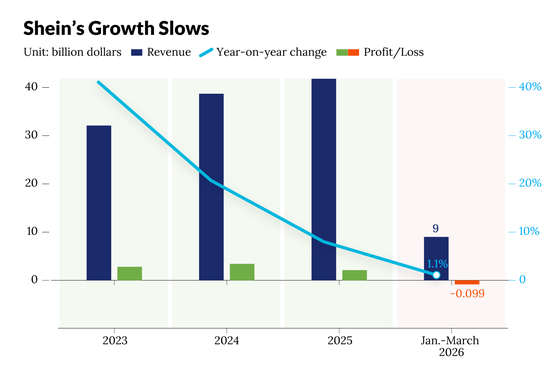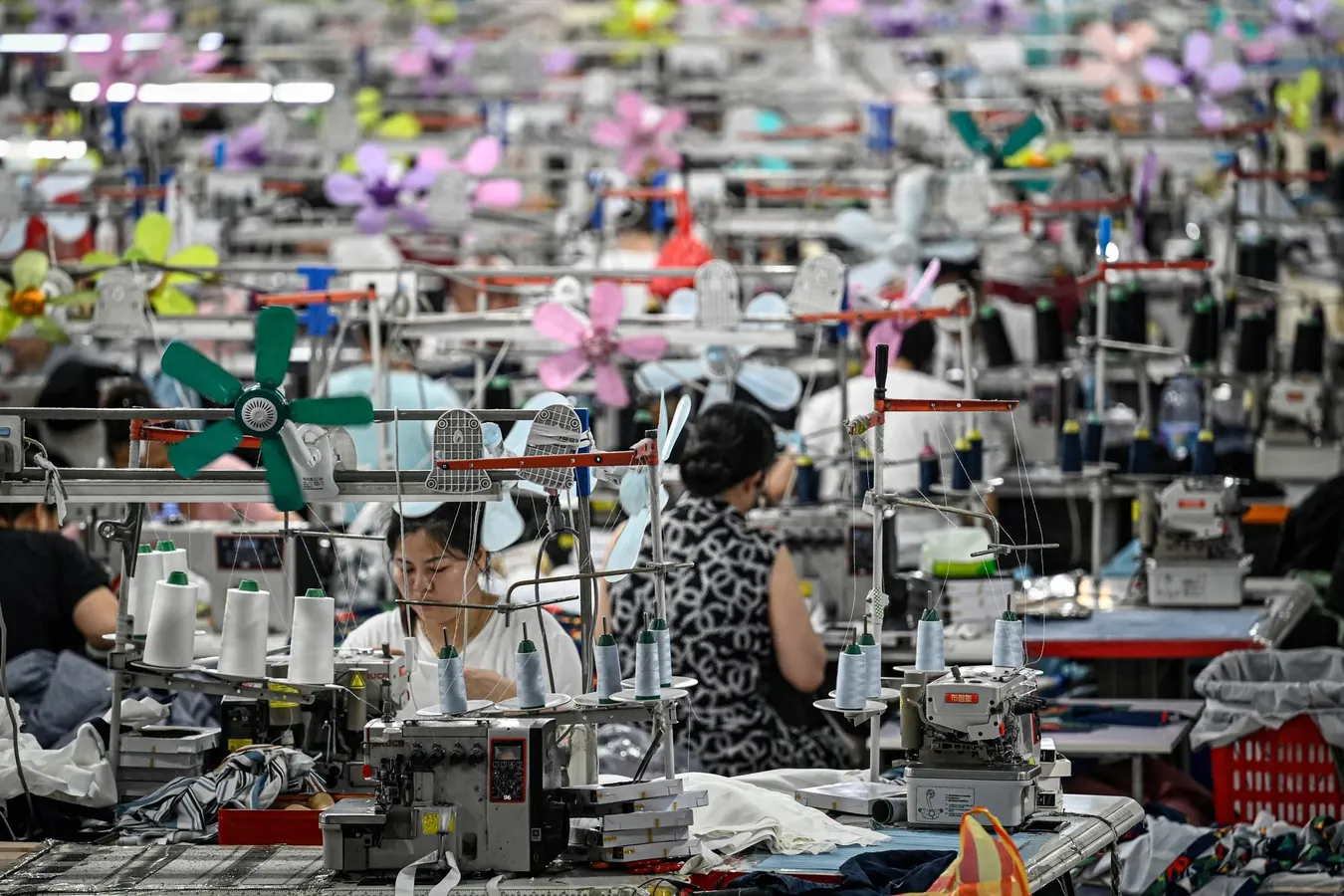
Workers producing garments at a textile factory that supplies clothes to fast fashion e-commerce company Shein in Guangzhou in southern China's Guangdong province. (Photo by Jade GAO / AFP via Getty Images)AFP via Getty ImagesShein has spent the better part of three years chasing a stock market listing, first in New York, then in London and now, finally, in Hong Kong. But the numbers it revealed to prospective investors this week suggest that the pitch has gotten considerably tougher.The fast-fashion giant swung to a $99 million loss in the first quarter of 2026, a stark reversal from the same period a year earlier. The figures, disclosed in a draft prospectus filed with the Hong Kong Stock Exchange as part of its long-awaited initial public offering, mark the clearest signal yet that tariffs and regulations are landing squarely on Shein's bottom line.Part of the loss was a one-off, a $328 million non-cash accounting charge tied to the fair-value treatment of convertible preferred shares, a technical adjustment that converts investor stock into ordinary shares once a company lists.What might concern investors more is that Shein's U.S. revenue fell 14.3% year-on-year to roughly $2 billion, as the Trump administration's removal of the de minimis import exemption in May 2025 stripped away the loophole that had let low-value parcels enter America duty-free.The exemption’s removal didn’t just raise Shein’s costs, it hit the company at the core of its business model, which depends on shipping enormous volumes of very cheap items directly to individual consumers. The U.S., which accounted for 29.4% of Shein’s annual revenue as recently as 2023, has shrunk to 22.5% of quarterly sales. Its operating margin slid to 2.9% from 3.9% a year prior, as marketing and fulfillment costs rose while sales stagnated.MORE FOR YOUShein is now weighing U.S. price increases to offset the added duties but that’s a move that risks eroding its price advantage.European Regulations Bite TooAnd if the U.S. pressure wasn’t enough, Shein flagged that Europe, roughly a third of its annual revenue, could deliver a similar or even larger blow after the European Union introduced a charge equivalent to around $3.50 on low-value e-commerce parcels this month, part of a broader push by Brussels to close what it views as an unfair advantage enjoyed by overseas marketplaces shipping directly to consumers.Shein’s own filing warned that disruption in Europe could "match or exceed" what it experienced in the U.S.Zoom out, and the full-year picture is sobering. Shein's net profit for 2025 fell 38.7%, to roughly $2.06 billion, even as revenue climbed 8% to $37.1 billion, a sharp deceleration from the 20.7% sales growth it posted in 2024.Meantime, Shein cleared its biggest remaining hurdle on July 10 when it received approval from China’s securities regulator for the Hong Kong listing, targeting for September or October this year and aiming to raise around $3 billion at a valuation of $40 billion to $50 billion.Shein's valuation has declined since previous funding rounds. (Photo by Piero CRUCIATTI / AFP) (Photo by PIERO CRUCIATTI/AFP via Getty Images)AFP via Getty ImagesThat’s well below the roughly $98.2 billion it commanded during its 2022 funding round, and even the $64 billion valuation it was assigned in a subsequent 2024 round. And some investors have reportedly pushed for the valuation to be cut further still, to around $30 billion.That repricing tells its own story. Shein's IPO has now been rerouted three times, abandoned in New York amid U.S. political scrutiny over its supply chain and labor practices, shelved in London after regulatory and reputational headwinds, and finally redirected to Hong Kong, where Beijing's backing offers a smoother, if smaller, path to market. Backers including Sequoia China, Tiger Global, General Atlantic and IDG Capital stand to get their first real liquidity event, whatever the final price.Analysts Warn Of Further SlipBut some analysts are openly skeptical that Shein can command a premium, or even hold its ground once it goes public. Shen Meng, director at Beijing-based investment bank Chanson & Co, said he doubts Shein will achieve any meaningful uplift in valuation at its Hong Kong IPO or in the secondary market compared with its last private fundraising round, arguing the retailer would have fared far better had it completed its London or New York listing years earlier.Tony Huang of Deloitte China’s Capital Market Services Group struck a more optimistic tone in a June note, suggesting that an easing of Middle East tensions and a reopening of the Strait of Hormuz could potentially give Hong Kong listings, including Shein’s, a tailwind. But even that came with an acknowledgment that Shein's own operational and geopolitical challenges remain the more decisive factor in how investors ultimately price the deal.According to the filing, proceeds from the listing will fund technology investment, including AI for demand forecasting, alongside international expansion, brand-building and Shein's corporate responsibility initiatives. Shein is also pressing ahead with plans to plough roughly $1.5 billion into logistics hub development in Guangdong province to improve operational efficiency at a time when the cost of moving goods across borders has become its single biggest headache.
Shein Long-Awaited IPO Just Got Harder To Sell As Tariffs Bite
From New York to London to Hong Kong, Shein has seen its IPO bounce continents and its value miss recent peaks. Now it awaits investor appetite in a likely Fall listing.
TL;DRAI
Shein swung to $99M Q1 loss as US revenue fell 14.3% following May 2025 de minimis tariff removal; EU regulations now threaten similar damage. IPO valuation plunged to $40-50B from $98.2B, signaling tariff walls have structurally broken its price arbitrage.
842 words~4 min read