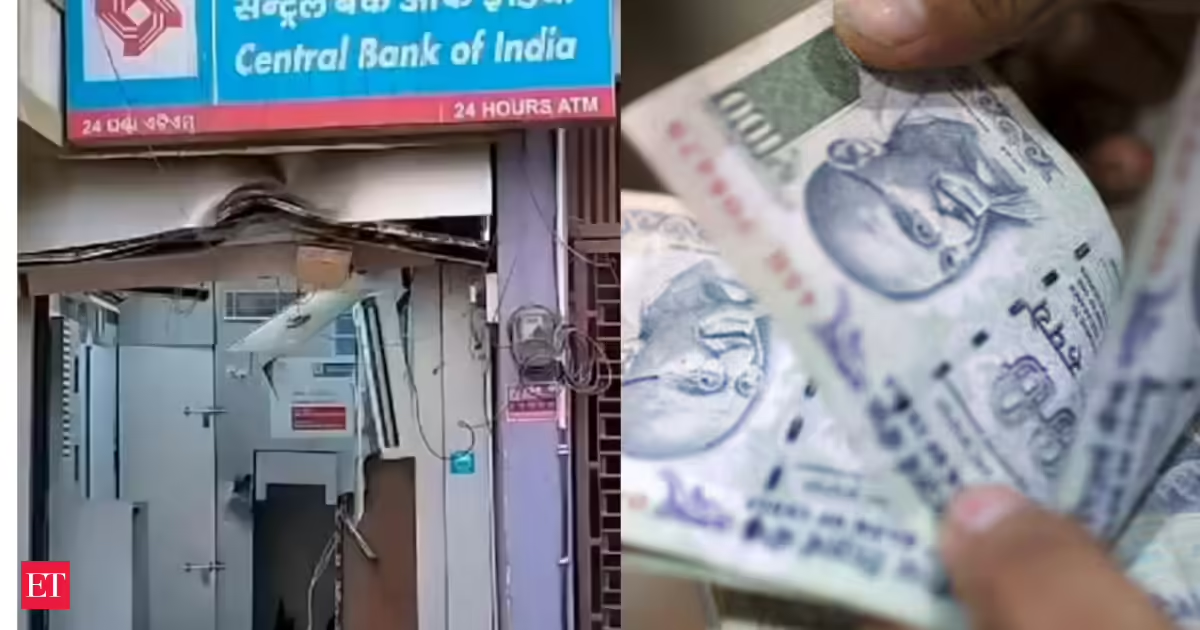
Canara Bank recovered a gold loan by wiping a Kerala woman's savings account clean on a Sunday, without her knowledge or consent, and without first attempting to sell the gold ornaments she had already pledged as security. A consumer commission has now ruled that the bank had no right to do any of it. The Palakkad District Consumer Disputes Redressal Commission, in an order passed on 13 July 2026, held Canara Bank guilty of deficiency in service and directed it to pay Rs 35,000 as compensation and Rs 10,000 as costs to the complainant, Jamseena M. What the bank did Jamseena held a savings account and a gold loan account with Canara Bank. The loan, availed on 10 March 2023, was due for closure exactly one year later, on 10 March 2024. That date fell on a Sunday. On that day, the bank's automated system debited Rs 53,463 from her savings account in full and transferred it to the loan account, leaving her balance at zero. Jamseena contested this. She said she had only been required to pay Rs 10,000 as annual interest and had not been informed that the bank would sweep her entire account. She said the money was taken without her consent. The bank's position was that it was entitled to do exactly this. It cited the terms and conditions of the loan agreement, the savings account opening form, and Section 171 of the Indian Contract Act, which gives banks a general lien over goods deposited with them. It also pointed out that Jamseena herself had taken a fresh agricultural loan of Rs 90,000 the very next day, 11 March 2024, and that a portion of that loan was also used to settle the remaining balance on the old loan account. What the commission found The commission examined the loan agreement closely and reached a conclusion that cut through the bank's defence entirely. It found that none of the 19 clauses in the loan agreement authorised the bank to automatically debit the complainant's savings account. What the agreement did authorise, under Clause 8, was a specific remedy in the event of default: the bank could sell the gold ornaments pledged as security. The bank had gold in its custody. It did not attempt to sell it. Instead, it reached into the complainant's savings account on a Sunday through an automated system. The commission was unambiguous on this point. It held that when a loan is secured by adequate collateral, as this one was, the question of invoking a banker's lien over a savings account simply does not arise. The bank also failed to produce the savings account opening form to show that the complainant had ever agreed to such an auto-debit arrangement. The commission's canonical finding deserves to be quoted directly. It held that debiting the savings account on a Sunday, when the loan was secured by gold ornaments already in the bank's possession, was "unwarranted, illegal and perverse" and amounted to a "unilateral violation of mutual contractual obligations." Why this matters beyond this case Auto-debit arrangements between banks and borrowers are standard practice across India, and banks routinely invoke them when loans fall due. But this order draws a clear line: when a loan is already secured by physical collateral, a bank cannot bypass that security and go straight for the borrower's liquid savings without explicit contractual authorisation to do so. The ruling also flags a procedural concern that affects everyday borrowers. Banks hold significant informational and systemic advantages over customers. Automated systems can move money in seconds, often before a customer even knows it has happened. The commission's finding that the bank failed to prove it had contractual authority for the debit puts the burden back where it belongs. This is consistent with a broader direction in Indian consumer jurisprudence. Courts and commissions have increasingly held that banks cannot rely on fine print or general legal principles to override the specific terms of individual agreements, particularly when those agreements already provide a defined remedy. What the commission ordered The commission directed Canara Bank to pay Rs 35,000 as compensation to Jamseena and Rs 10,000 as costs, totalling Rs 45,000. The bank has 45 days from receipt of the order to comply. If it fails to do so, it will be liable to pay an additional Rs 500 per month until the full amount is paid.Check the case judgement here:
Canara Bank recovers loan by emptying account on a Sunday: Woman says money was debited without consent; court orders Rs 45,000 payout
A Kerala consumer commission has ordered Canara Bank to pay Rs 45,000 in compensation and costs after it automatically debited Rs 53,463 from a woman's savings account on a Sunday to recover a gold loan, without her consent and without first invoking its right to sell the pledged gold ornaments it already held as security.
734 words~3 min read