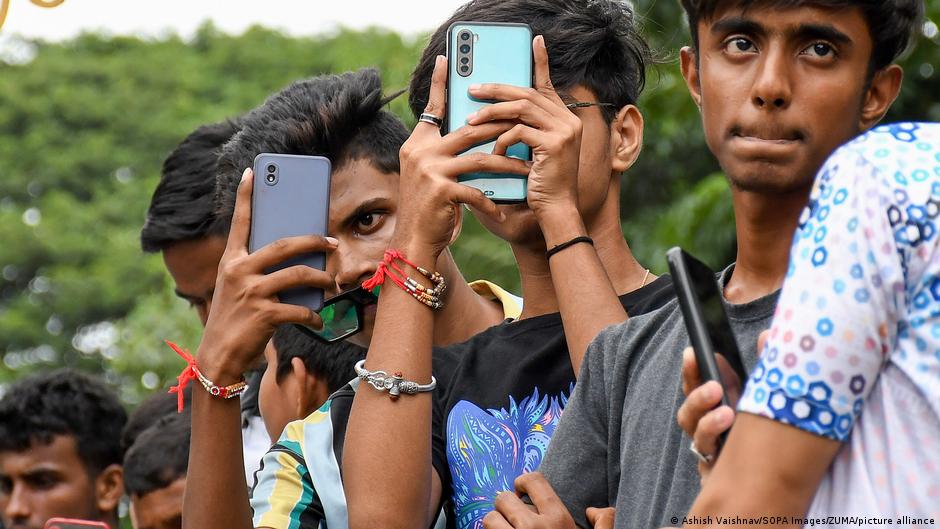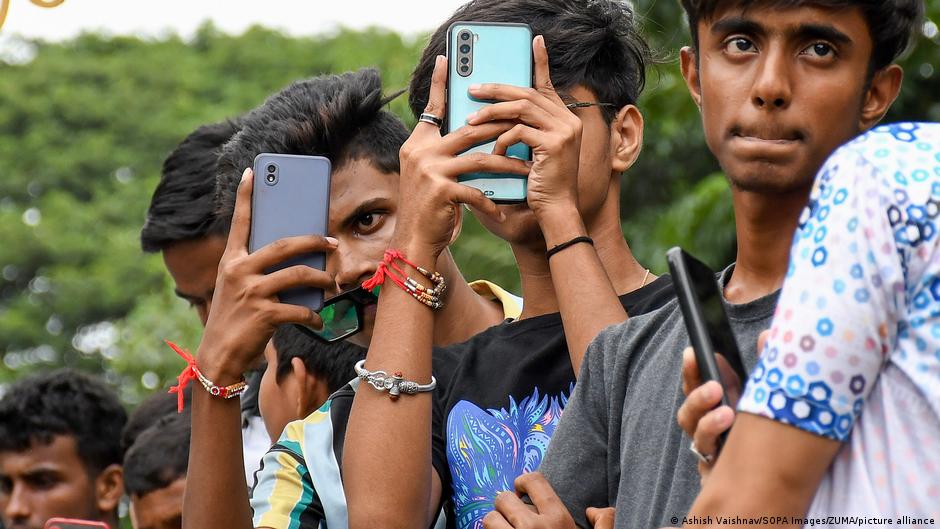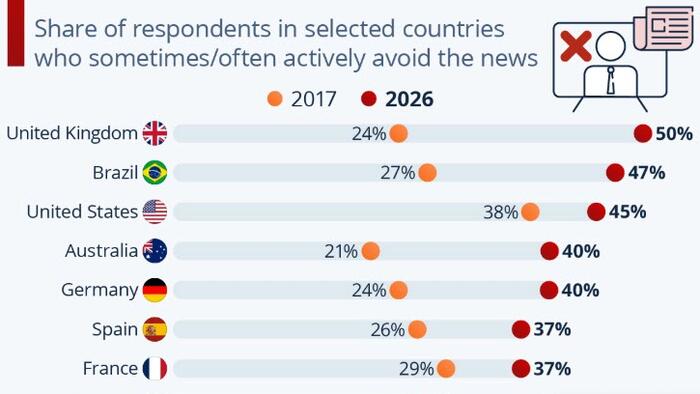
Nearly half of Irish adults now say they actively try to avoid the news. In this year’s Digital News Report Ireland, produced by DCU’s FuJo research centre and published by Coimisiún na Meán, the figure reached 47 per cent, up from 41 the year before. The share who say they never avoid the news fell from 28 per cent to 22 per cent. Some may read this as a public growing bored with current affairs, or too emotionally fragile for it. That would miss the point.Avoiding the news once required little or no effort. You simply didn’t buy the paper or switch on the six o’clock bulletin. Indifference was easy. Consumption was something you opted into and, just as importantly, something that had an end point. You closed the paper. The broadcast finished. That contract is now gone.A second set of figures in the report makes a related point. While trust in “news” in general fell to 42 per cent, trust in actual news organisations barely moved. RTÉ News and local radio command the trust of 71 per cent, The Irish Times and local newspapers are at 69 per cent. Admittedly, those two sets of numbers are not measuring quite the same thing. When people are asked about “news” they are describing an entire ambient category, most of which is not journalism but aggregation, press releases, influencer commentary, chatbots and all the algorithmic slurry in between. When they are asked about a specific title they can name, they are rating a specific practice. They distrust the category but largely trust the practice.What has changed is not the standards of the practice, despite the pressures on revenue and resources, but the manner of its delivery. To survive the flight of readers to platforms, news organisations are rebuilding themselves around engagement. They chase the feed, the notification, the autoplaying vertical video or the search result. Each of these reaches into moments the reader never consciously surrendered to. The push alert about a distant atrocity pops up on your lock screen without you asking for it, in the same scroll as a work email and a friend’s WhatsApp message.The Irish report is the local edition of a much larger ongoing study run by the Reuters Institute at Oxford. That international research has found that people who often avoid the news are less likely to sign up for alerts and more likely to switch them off. Among those who now receive no push notifications, 43 per cent say they deliberately disabled them. Nic Newman, lead author of the international report, suggests that readers are not losing interest. They just don’t want the news coming at them around the clock.And an awful lot of it comes at them. The average smartphone now receives somewhere between 46 and 63 push notifications a day. News competes for that lock screen against games, messages and everything else, and loses meaning in the crush, until even a genuinely urgent alert is just one more buzz to be dismissed. Matt Taylor, a product manager at the Financial Times who felt he was getting too many alerts from the BBC News app, dug out an old phone, loaded 61 news apps on to it and signed up for every notification. A script he wrote feeds each alert, in close to real time, into a public archive he calls Project Push, which now holds more than 180,000 of them. He built it to compare how publishers around the world use the button that fires a message into millions of pockets at once. What it captures almost by accident is how relentless the global stream has become. The oppressiveness rapidly becomes overwhelming.Then there is what the news is actually about. For good reasons, journalism has always led with threat and tragedy, with the crash rather than the safe landing. That is the job of the watchdog. But the engagement machine takes that core instinct and strips away every buffer that once made it bearable. The Reuters data shows people avoid news because it lowers their mood (about 36 per cent of avoiders), and leaves them feeling powerless (about 16 per cent). Powerlessness is the key. A grim story you read at a time of your own choosing leaves some room for agency. The same story fired at you at half past 10 in the morning offers only a sense of helpless distress. [ Why the Phoenix magazine failed after 43 years of pestering those in powerOpens in new window ]Research from Pew in the US has found that the news makes Americans more than five times more likely to feel sad than happy, and more than three times more likely to feel confused than empowered. One developmental psychologist, writing about this year’s figures, described news fatigue not as weakness but as the predictable response of a human brain meeting an environment it was never built to navigate.None of this is a plea for cheerier news. The answer is not to hide ugly truths. The problem is not the material, it’s the delivery system. We have taken journalism, the thing people still appear to trust, and forced it through a distribution system designed to be inescapable, uninvited and emotionally maximal, and then we act surprised when people flinch.There was very good reason to do all of this. Every tactic that makes the news more pervasive was adopted to claw back attention that was being lost to other platforms. But the aggregate effect has been to create a news environment that is so intrusive and oversaturated that it manufactures the very avoidance we then treat as a reason to push harder. The remedy is in danger of becoming the poison. The way out is unlikely to be a stronger dose of the same medicine.
The news learned to follow us everywhere. No wonder we are hiding from it
Many people no longer feel they have control over when they read the news as outlets chase engagement
959 words~4 min read