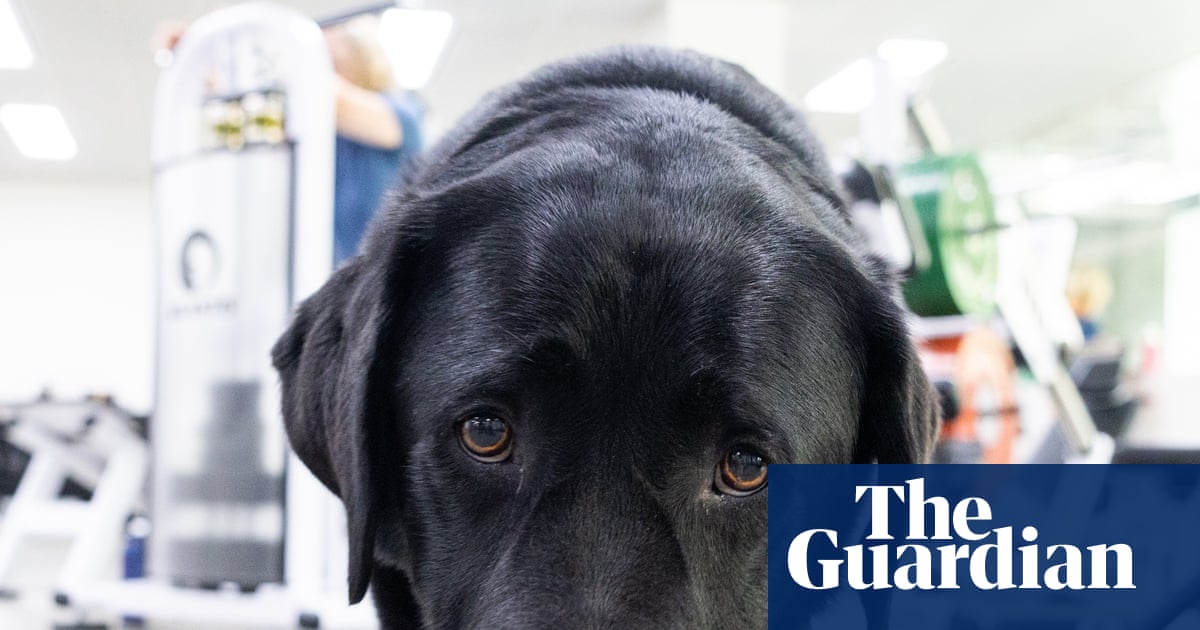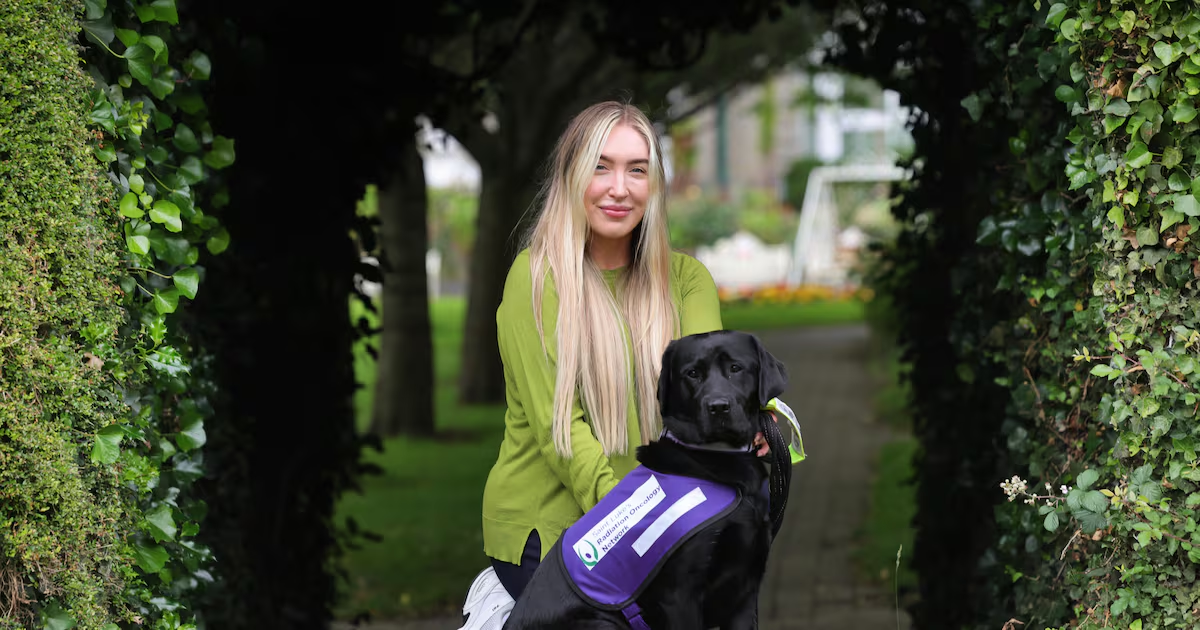
Patient and staff wellbeing at St Luke’s Hospital in Rathgar in Dublin has been greatly enhanced over the past 12 months thanks to the addition of one four-legged employee. Tori is a beautiful two-year-old black Labrador who, having completed her training at The Irish Guide Dogs in Cork, came to work in St Luke’s as a community dog just over 12 months ago.She is one of the first community dogs to work in a hospital setting in Ireland. St Luke’s Hospital is a national referral centre for patients with cancer who require radiotherapy treatment. It is one of three sites that make up the St Luke’s Radiation Oncology Network (the others being based at Beaumont and St James’s Hospitals in Dublin). It is also the sole radiotherapy centre for children with cancer in Ireland. Tori’s office (cosy bed) is in the psycho-oncology department of the hospital where she is cared for by Dr David Shannon, senior counselling psychologist, and Dr Nicola or Niccy Elmer, principal psychologist. Her quiet, calming presence, gentle nature and velvet-soft ears mean she has quickly established herself as everyone’s favourite colleague.Tori with Dr Nicola Elmer and Amy Doyle. Photograph: Bryan O’Brien Psycho-oncology is a sub-speciality of oncology that aims to support patients and loved ones with the psychological and emotional impact of a cancer diagnosis. Dr Elmer says the psychology service in St Luke’s cares for people across the lifespan from very young children to older people and those nearing end of life. “We work with patients’ families as well, because we understand that oncology and cancer doesn’t only impact the individual; it impacts the whole family,” she says. Tori with St Luke's general manager Jennifer Carey, palliative care consultant Dr Maeve O'Reilly and senior psychologist Dr David Shannon. Photograph: Bryan O'Brien Apart from the devastation of a cancer diagnosis and the gruelling impact of treatment, patients can also face very difficult challenges due to the side effects of radiation, which for young women with gynaecological cancers, for example, can include loss of fertility, body image and sexual function. According to Dr Elmer, it can be easier for cancer patients to talk about their experiences to a professional because they feel that they don’t want to worry or burden their family members.“I think what a psycho-oncology service does, it enables patients to maybe unpack those really difficult emotions and just to free up themselves, so that they can spend the time with their family members, but also just to make sense of what they’re going through, so that we can move into the survivorship, we can move into living well with the cancer diagnosis and postcancer diagnosis. The psychological impact of cancer is something that is very often not spoken about, and I think within our service we give the space and the opportunity for that.” Elmer and Shannon were the driving force behind bringing Tori to St Luke’s; a big part of that was securing approval from senior management. Elmer credited the immense support from the executive management team as being instrumental in Tori’s successful appointment. The general manager of St Luke’s, Jennifer Carey, describes Tori’s appointment at St Luke’s as “one of the best things we have done”.She also recommends that other hospitals should look at introducing a community dog. “I think she has been a brilliant addition to the staff here. We have put her on the staff ... I would thoroughly recommend it. I would be quite happy if other hospitals want to reach out and learn about our experience of how it works.”In the 12 months since Tori has been in St Luke’s, she has had an immensely positive impact on both patients and staff. “She’s been absolutely wonderful,” says Dr Elmer. “She’s just really changed the landscape of healthcare for us here from a psychological perspective ... We would often get staff knocking on the door and saying, can we just have a ... tummy rub with Tori? Which is amazing.“Walk down the corridors, you see the smiles on faces, you know, it’s just different, and I think it just brings just a lightheartedness in a way, to what can be a very difficult environment sometimes, because of the nature of what we do.”Elmer has seen countless occasions when Tori’s gentle presence has had a transformative effect on patients. She sees Tori as a conduit for open communication around what can sometimes be some very difficult conversations.“We were sitting here in this office, and my patient was really quite upset. Tori was lying in her bed, and she obviously could pick up on the patient being upset. She got up, she walked across, put her head on the patient’s knee ... I just watched the patient stroking Tori, and ... that image is something that you really can’t capture in words, but it plays out in the room, and it’s so, so, so real ... Whenever the patient comes back in, Tori is here. She remembers him and there’s just a bond there. My sense is the patient is more open in terms of communication, and there’s just a freedom in it.”Tori at St Luke's Hospital, Rathgar Tori’s penchant for tummy rubs is well known at St Luke’s. She seems to have a second sense when she is needed and immediately greets everyone by rolling on to her back in a nonthreatening, calming manner. This incredibly effective and gentle intervention is always a hit, particularly with the smallest patients.Radiotherapy treatment can be a frightening experience, particularly for young children; however, Tori’s gentle presence can help to alleviate that stress. For one young child, the promise of playing with Tori before and after radiotherapy sessions is seen as a very special treat. Tori can also accompany children to their treatment session and wait outside, ready to offer cuddles when it’s finished.Louise Noonan is a clinical nurse specialist in paediatrics and anaesthetics at St Luke’s and is responsible for co-ordinating and supporting children and their parents through their treatment. St Luke’s is the only paediatric centre for radiotherapy in Ireland. Children aged from just three to 16 come from Children’s Health Ireland at Crumlin to St Luke’s for treatment, and Noonan says Tori “brings magic” and is “a beacon for these kids”. Tori’s presence can help alleviate pretreatment anxiety for children. She also brings emotional support and is a very welcome nonclinical distraction from illness, Noonan says. “She is an angel. When she comes to see them, you can usually see her little tail wagging. It’s like she knows that she’s supposed to be there for the little people, and then she will just throw herself down on the floor with her belly pointing up to the sky, and let them rub her belly, and I think she feels like that’s her most nonthreatening pose.“You can’t see her around and not smile, and it’s not just the patients who benefit from her too; she just brings so much lightness to a very heavy environment at times. I can’t see a place where there would not be a value in having a therapy dog. She has been an amazing light for all of us here in St Luke’s and we are very lucky to have her.”Dubliner Amy Doyle was just 34 years old when she was diagnosed with stage 2 cervical cancer. Today she is clear of disease; however, she has had to endure a very difficult 18 months of treatment, while also having to adjust to the life-changing impacts of her diagnosis. Doyle praises the staff for the wonderful care she received at St Luke’s and says having Tori during her therapy sessions has been hugely beneficial. She also believes that community dogs should feature in more Irish hospitals as they would greatly benefit all patients at any stage of their treatment. “You’re going through so many life-changing things. There’s a lot of information, there’s a lot of emotions, there’s a lot of anger, a lot of sadness, a lot of mixed feelings.“It’s just nice to have that extra comfort of a dog coming over to you and just playing with a toy for a minute. It just kind of takes you out of that, like, really serious chat, or might give you a few minutes to kind of re-evaluate and just pause. But I found it really, really beneficial; it’s just so comforting.” Tori is a graduate of the Irish Guide Dogs Community Dog Programme in Cork. The charity, which this year is celebrating its 50th anniversary, has become Ireland’s leading provider of guide dogs, assistance dogs and community dogs.Tim O’Mahony, chief executive officer of Irish Guide Dogs, says the charity is “incredibly proud of our community dog programme and the lasting impact these remarkable dogs have in communities across Ireland”.Community dogs are specially trained to work alongside trained handlers in a wide range of settings, such as schools, colleges, and healthcare settings. “Currently, we have 37 community dogs supporting over 15,000 individuals across the country,” says O’Mahony. “Their work is a powerful reminder that a dog’s greatest gift is often the difference they make simply by being there.“Their calm, reassuring presence can transform someone’s day. For some children, knowing their community dog will be there each morning to welcome them can mean the difference between feeling anxious about going to school and arriving with confidence and enthusiasm. That simple connection can have a profound impact on wellbeing, learning and inclusion.”Over the past 50 years, Irish Guide Dogs has matched more than 2,000 dogs with people and families across Ireland, delivering independence, confidence and improved quality of life to people with visual impairments and children with autism.Dr Maeve O’Reilly, a consultant in palliative medicine at St Luke’s, has seen first-hand how Tori can make a real difference to patients. She recalls one young man who was approaching the end of his life and found it incredibly difficult to discuss his wishes. However, on meeting Tori, the patient formed a special connection with her that allowed him to open up and have those incredibly difficult conversations around end-of-life care. “I think what made the difference is the dog created the safe space,” says Dr O’Reilly. “Dogs don’t ask difficult questions; they don’t break bad news. So I think that just providing that unconditional love is what works for patients at the end of life.”
Tori the hospital dog: ‘She brings so much lightness to a very heavy environment’
At St Luke’s Hospital in Rathgar, the community dog provides comfort to cancer patient and helps them open up
1,722 words~8 min read