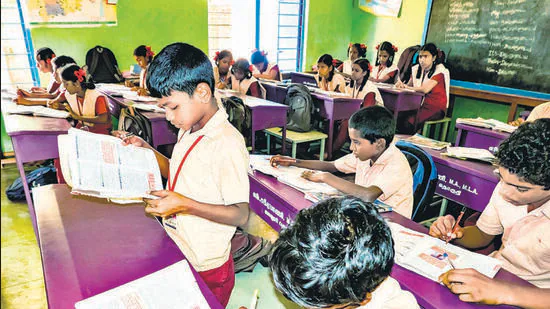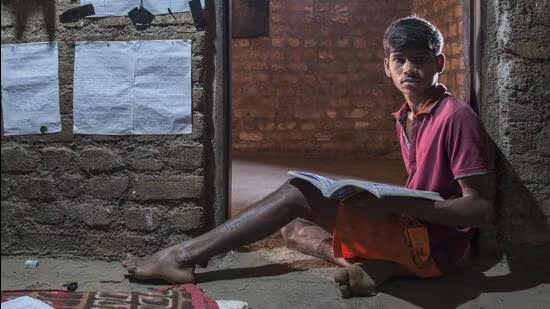
MUMBAI: Maharashtra has brought back only 187 of the nearly 11,85,412 out-of-school children in the 14-18 age group into the open school system, pointing to its inability to rehabilitate school dropouts and improve enrolment numbers.Mumbai, India - March 5, 2020: Ravi Mali, 15, Fulorepada----Fulorepada and Pisepada near Padgha, Bhiwandi the ongoing board exams are a great moment of pride. For the first time, children from the village are writing their SSC exams this year at Bhiwandi in Mumbai, India, on Thursday, March 5, 2020. (Photo by Satish Bate/Hindustan Times) (Satish Bate/HT Photo)The figures were noted in the minutes of the Project Approval Board (PAB) meeting of the Union ministry of education held in June 2026. According to the data, Maharashtra has 11,85,412 out-of-school children in the 14-18 age group, based on the Periodic Labour Force Survey (PLFS) 2025, which measures children’s participation in the workforce conducted by the Union labour ministry. However, the state’s action plan for open schooling supported only 187 students in this age group.The state established an open schooling system on the lines of the National Institute of Open Schooling (NIOS) in January, 2019, and had assured the centre in 2025 that it would strengthen it through special efforts to bring these children back into education. However, the PAB observed that the progress has remained negligible.The board has urged Maharashtra to improve its identification of out-of-school children, and identify districts, blocks and villages with a high number of school dropouts and children who have never enrolled in school. It also asked the state to actively involve school management committees (SMCs) to conduct door-to-door surveys in school catchment areas to identify such children and encourage them to return to education.Out-of-school in villages and metrosEducation activist Heramb Kulkarni said child marriage and child labour are among the biggest reasons children remain outside the education syastem. Nearly 23% of child marriages in some rural areas involve girls aged between 14 and 18,” he said.Kulkarni, who works to bring the children of families working in sugarcane farms into the education system, said child labour in agriculture remains largely invisible. “Whenever we discuss child labour, we mostly count children working in industries, hotels or shops. There is almost no system to count children working on farms with their families. Many of them leave school permanently,” he said. Merely having an open school board is not good enough. The government needs to create awareness of this system, Kulkarni added.He also pointed to the lack of opportunities for higher education and skill-based courses in rural Maharashtra. “Many Industrial Training Institutes in rural areas still offer traditional courses that no longer provide good employment opportunities. The government should take education and skill training closer to villages so children do not leave school,” he said.Social activist Purnima Upadhyay, co-founder of NGO Khoj Melghat, said while there are residential ashram schools in tribal regions, migration is a challenge. “Many tribal families migrate every year to work in brick kilns and sugarcane fields. During this period, children often discontinue their education,” she said. “The brick kiln sector should be declared an industry so that employers can be made responsible for providing educational facilities to workers’ children.Dropping out of the education system is not restricted to rural areas. In urban areas like Dharavi in Mumbai, among Asia’s largest slums and home to a large number of migrant workers, girls often stop studying after Class 7. Boys often drop out after Class 9 or 10 to work as labourers or start small businesses, said Jagdish Indalkar, principal of Lion MP Bhuta Sion Public English Medium School.Indalkar said in Dharavi, many girls get engaged after reaching Class 8. Boys also get engaged very young, and many marry once they turn 18. As a result, they face pressure to start earning two years before marriage, which forces them to leave school.Way forwardThe only long-term solution, said Indalkar, is to make parents responsible for their children’s education, just as schools are required to give admission under the Right to Education (RTE) Act. “Keeping children out of school should be treated as an offence. Only then will the situation change,” said Indalkar.Recent research shows that many aged between 14 and 18 join family farms, small family businesses or retail shops. “As they start earning, education takes a back seat. This has long-term consequences not only for individuals but also for the country’s economy,” said Neeraj Hatekar, an economist, warning that India is approaching a critical stage in its demographic transition. “Studies show that from around 2040, India will begin losing its demographic dividend. Many countries reached much higher income levels before facing this stage. If we fail to educate our young population now, it will impact future economic growth,” he said.
State has brought only 187 out-of-school kids back to school
The figures were noted in the minutes of the Project Approval Board (PAB) meeting of the Union ministry of education held in June 2026 | Mumbai news
787 words~4 min read