This content was published on
July 28, 2026 - 02:43
5 minutes
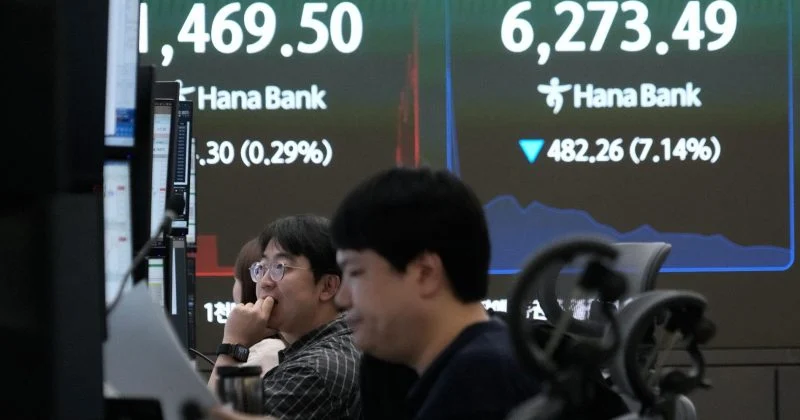
(Bloomberg) — Asian equities declined as renewed concerns over artificial-intelligence spending fueled another selloff in chipmakers.MSCI’s Asia Pacific equity gauge fell 1.9%, with chip majors SK Hynix Inc. and Samsung Electronics Co. contributing the most to the decline. The Kospi Index in South Korea — a bellwether for AI investments — tumbled 7.1%, while the Nikkei 225 Stock Average lost more than 3.5% after a Wall Street gauge of semiconductor stocks sold off for a third day.SK Hynix, whose American depositary receipts slipped below their initial public offering price, slumped almost 10%, while Samsung lost more than 8%. Japanese semiconductor stocks such as Tokyo Electron Ltd. and Disco Corp. also tumbled in excess of 9% as investors increasingly question the spending spree in the sector after a sharp runup in shares this year.“Investors are clearly not yet ready to brush aside concerns over the AI sector,” said Hebe Chen, a senior market analyst at Vantage Global Prime. “The latest selloff in chipmakers shows that doubts over spending, returns and valuations are still deepening rather than fading.”Elsewhere, Brent extended Monday’s biggest decline in more than three months, falling another 1% to about $87.60 a barrel, as the US paused daily strikes against Iran and President Donald Trump said there’s a “good chance” of an Iran deal. Treasuries gained for a second day as inflation fears eased. The yield on the benchmark 10-year declined two basis points to 4.63%.Alongside geopolitical developments, investors face a packed week of risk events, with policy decisions from the Federal Reserve, Bank of Japan and Bank of England, as well as earnings from megacap technology companies. Investors are increasingly looking for signs that the biggest spenders on AI can justify the billions of dollars they have poured into the technology.“This is a week with more than its fair share of potential surprises, good and bad,” said Chris Larkin at E*Trade from Morgan Stanley. “Geopolitics and oil prices may be the biggest wild cards, but a bullish response to strong Magnificent Seven earnings isn’t a given, especially if AI spending levels continue to raise eyebrows.”Chip companies remained in focus during the US session, with the Philadelphia Semiconductor Index dropping 2.2%. Sandisk Corp., Advanced Micro Devices Inc. and Nvidia were among the S&P 500’s biggest decliners.The cost of protecting Nvidia Corp.’s debt against default surged amid a round of AI deals worth more than $750 billion. ASML Holding NV sank on a report that a Chinese state-backed firm is producing certain chipmaking machines that may threaten its sales.Traders’ attention will be on a slew of earnings later this week, with more than 170 companies in the S&P 500 set to report. AI spending is in sharp focus after last week’s selloff in shares of Alphabet Inc.Microsoft Corp., Meta Platforms Inc., Apple Inc. and Amazon.com Inc. are among the companies reporting this week. In Asia, SK Hynix and Samsung will announce earnings.“Those companies embody the critical theme weighing on sentiment in the markets right now — excess capital expenditure and spending by AI companies that, investors fear, will eat into returns,” Kyle Rodda, a senior analyst at Capital.com, wrote in a note to clients.Elsewhere, the policy announcement by the Fed on Wednesday is in sharp focus. Traders continued to see a roughly one-in-three chance of a rate hike.Citadel Securities expects the Fed to raise rates this week — a surprise move strengthening Chairman Kevin Warsh’s credibility in the battle with inflation. A quarter-point increase on Wednesday would reinforce Warsh’s repeated pledge to restore price stability while showing policymakers no longer rely on signaling every policy move well in advance, Frank Flight, the firm’s head of macro strategy, wrote in a note.On the geopolitical front, Trump said the US and Iran were engaged in diplomatic talks to end their conflict, but warned the two sides would return to fighting if negotiations didn’t yield a deal.Separately, Iran and Oman are trying to reach an agreement to restart shipping through the Strait of Hormuz, according to people familiar with the matter.“The only reason they want to meet is because we’ve been hitting them very hard,” Trump told reporters. “There’s a good chance that something could happen. If it doesn’t, we go back to doing what we were doing.”Some of the main moves in markets:StocksS&P 500 futures were little changed as of 9:43 a.m. Tokyo time Hang Seng futures rose 0.3% Nikkei 225 futures (OSE) fell 3.9% Japan’s Topix fell 2.6% Australia’s S&P/ASX 200 fell 0.1% Euro Stoxx 50 futures were little changed CurrenciesThe Bloomberg Dollar Spot Index was little changed The euro was little changed at $1.1373 The Japanese yen was little changed at 163.78 per dollar The offshore yuan was little changed at 6.7648 per dollar CryptocurrenciesBitcoin fell 2% to $63,607.84 Ether fell 3.1% to $1,884.18 BondsThe yield on 10-year Treasuries declined two basis points to 4.63% Japan’s 10-year yield was unchanged at 2.775% Australia’s 10-year yield advanced one basis point to 5.01% CommoditiesWest Texas Intermediate crude fell 0.9% to $81.88 a barrel Spot gold fell 0.3% to $4,065.39 an ounce This story was produced with the assistance of Bloomberg Automation.–With assistance from Rob Verdonck.©2026 Bloomberg L.P.