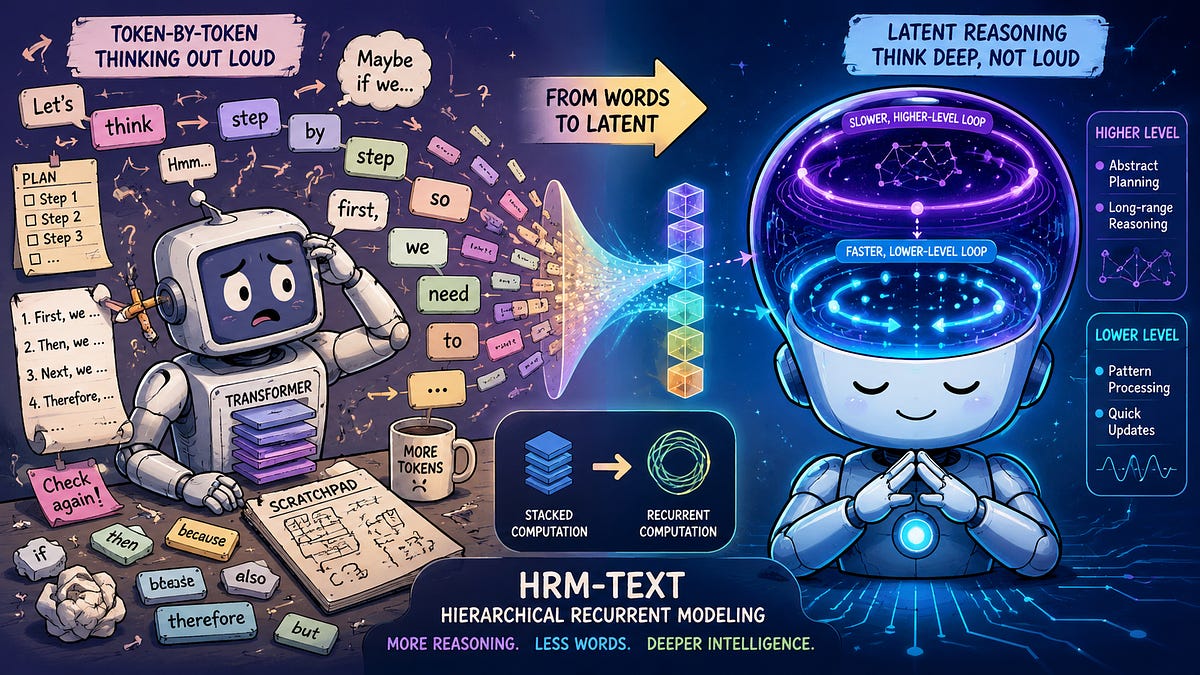
Today’s editorial: Reasoning models currently spend thousands of tokens working through difficult problems in language, even when nobody sees the resulting text. A growing group of researchers wants to replace those token chains with continuous hidden states that can carry more information and explore several directions at once. The shift could reduce inference costs and improve planning, but it also makes the model’s reasoning considerably harder to inspect.This Week in Turing Post / Summer schedule:Sunday / Library: The most interesting Computer-use AI agentsWhat if AI stops thinking in words?For the past few years, it was fun watching AI talking to itself:“Let’s think step by step.”“Wait.”“Alternatively…”“Let me reconsider.”“Am I an idiot?” – just joking, no model was ever that self-aware. This “talking” is Chain-of-Thought, and it worked so well that the industry turned this behavior into a scaling strategy. Models learned to produce longer reasoning traces. Reinforcement learning rewarded successful traces. Inference systems began allocating thousands of hidden thinking tokens before returning an answer.The results were outstanding: models became better at mathematics, coding, and planning.They also became slower and much more expensive. We taught machines to reason by writing essays that nobody would ever read. And it became $$ feasible.Along the way we picked up a second habit: we started reading those essays. Evaluators read them, safety teams built monitors on top of them, and a whole practice grew around the idea that a model's reasoning is a document you can inspect.It is worth remembering where that document came from. Chain-of-Thought was a way to give a language model more computation. Readability was a side effect, because the only workspace a token predictor has is the token stream. Nobody designed a window into the model. We built a scratchpad, and the scratchpad happened to be written in English.Now researchers are asking another interesting question: why should a machine think in language at all?Language was useful scaffoldingLanguage models generate one token at a time. Each token becomes part of the context used to select the next one. This makes text a convenient workspace. A model can break a problem into steps, preserve intermediate results, notice mistakes, and try again. But natural language was designed for communication between humans, not for computation inside a neural network.Every word forces the model to make a discrete choice. A rich internal state containing several possible interpretations must collapse into one token: “therefore,” “seven,” “left,” “false.” The rest of the reasoning then proceeds from that commitment.Language also comes with overhead. Transitions, repetition, grammar, and phrases such as “let us analyze carefully” consume tokens without necessarily advancing the solution. Plus, you have to be polite, since humans might read you. Another $$ on top.Yes, Chain-of-Thought gives the model more computation time, that’s why it might work so well. But it requires every intermediate state to be translated into something resembling a sentence. A chess engine does not need to write a paragraph about every move it considers. AlphaGo did not compose an internal essay before placing a stone. Yet many current reasoning systems effectively do exactly that.Chain-of-Thought versus latent reasoningChain-of-ThoughtLatent reasoningReasoning mediumDiscrete language tokensContinuous hidden representationsComputationOne textual step after anotherIterative updates inside the modelPossible pathsUsually commits to one written pathCan preserve several possibilitiesInference costGrows with reasoning-token lengthMay use fewer decoding stepsTrainingWorks naturally with token-level RLRequires new objectives and policiesVisibilityPartly readable, although not always faithfulDifficult to interpret directlySo what is the most important distinction between latent reasoning and CoT?Latent reasoning separates computation from communication.The model can work in its native representational space and return to language only when it is ready to answer.From chains of words to continuous thoughtRecently, we have been seeing more and more papers on latent reasoning. But let's take a brief trip back and look at the work that made the idea legible to everyone else.Meta’s Coconut, short for Chain of Continuous Thought, was not the first attempt – pause tokens, filler tokens, and implicit Chain-of-Thought by distillation all came earlier – but it was the clearest demonstration. Instead of decoding a hidden state into a token, Coconut feeds that state directly back into the model. That apparently small change alters the reasoning process. A token represents one selected direction. A continuous state can preserve a mixture of possible directions. In some planning tasks, Coconut showed behavior resembling breadth-first search, considering several possibilities before committing to one.Soft Thinking takes a related approach. It creates intermediate "concept tokens" by combining multiple token embeddings instead of selecting one word. The researchers reported modest accuracy improvements, up to 2.48 points on pass@1, while reducing token use by as much as 22.4 percent. Those two headline numbers come from different models, which is worth knowing before quoting them.There is one more finding in that paper that deserves attention, because it complicates the story that usually gets told. The authors report that Soft Thinking outputs remain readable. A probability-weighted mixture of embeddings can be projected back into text. Coconut offers nothing comparable. A hidden state is not a sentence with the punctuation removed.So latent reasoning is not one thing. One branch softens the token stream and keeps something we can look at. The other branch leaves the token stream entirely. They do not cost us the same amount of visibility, and the difference will decide how much we lose.Other projects use recurrent loops, diffusion-style refinement, compressed reasoning states, or small networks that repeatedly revise their answers. The terminology is already getting crowded: continuous thought, soft thought, latent chains, implicit reasoning, recurrent depth, abstract Chain-of-Thought. AI research remains very good at discovering one continent under twelve different flags.But the trend is coherent. Reasoning is starting to separate from text generation.Reinforcement learning was the wallLatent reasoning has had one serious disadvantage.Explicit reasoning works naturally with reinforcement learning because the model produces tokens. Each token has a probability. Researchers can compare trajectories, reward successful answers, and update the policy using methods such as PPO or GRPO.Continuous hidden states do not provide the same clean interface. They are representations. It is harder to assign probabilities to transitions or determine when the model should stop thinking.The last several months have been a concerted effort to solve this, and the number of groups involved is the interesting part. Latent-GRPO reported improvements over both its latent initialization and explicit GRPO while using reasoning chains three to four times shorter. Dropout-GRPO claimed the first working application of GRPO to Coconut-style hidden-state reasoning. TARPO routes token by token between latent and explicit steps under a shared advantage signal.Image Credit: The original paperSLPO introduces a surrogate policy over transitions between latent states, giving reinforcement learning something it can optimize. It also trains the model to decide when to stop, rather than forcing every question through the same fixed number of reasoning steps. Four groups attacking the same problem in a single research season is a legit signal. The reinforcement learning interface was the bottleneck, and it is no longer holding.What the excitement leaves outNone of this has been demonstrated at frontier scale.The Coconut line of work lives on GSM8K and small backbones. The headline result in Dropout-GRPO moves a baseline from 27.29 to 29.01 percent, which is a real finding on a model nobody would deploy. Training remains brittle and often requires staged curricula. No frontier lab has shipped a latent reasoner or announced plans to.The fair summary is that the idea is well motivated, the reinforcement learning machinery is arriving, and the scaling evidence does not exist yet.That does not make the question less urgent. It means we have no schedule.We may lose the interface before replacing itSorry to break it to you, but Chain-of-Thought was never a reliable transcript of what happened inside a model. Models can skip crucial steps, invent plausible explanations, or rationalize an answer after reaching it through another route.Still, text gives us something to examine. When reasoning moves into continuous vectors, even that imperfect interface disappears. Researchers can probe representations, compare trajectories, and train models to decode hidden states, but reading a vector is not like reading a sentence.This creates a tradeoff. Language may be an inefficient medium for reasoning, but it is also a partial governance surface. It gives developers and evaluators some visibility into how a model approached a problem.Latent reasoning exchanges part of that visibility for greater bandwidth and potentially lower costs. How much of it depends on which branch wins, which is why the distinction between soft tokens and hidden states is worth tracking closely.We will therefore need more than better reasoning models. We will need tools that observe latent trajectories, detect abnormal internal states, test alternative paths, and verify conclusions independently. Interpretability will have to move from reading the model’s notes to instrumenting its computation.The excitement around Chain-of-Thought is still fresh. We thought it might reveal how AI thinks. But it was always a byproduct of the cheapest available method for giving a model more computation, and byproducts do not survive the arrival of something cheaper.Which brings us back to that stopping policy in SLPO. The next thing these systems learn is how long to think.What will we do when they start making that decision without telling us why?If any of those thoughts resonate with you – share them across your social networks. Let’s keep the conversation going.📹 In this episode of Attention Span, we examine why Jensen and Anthropic represent two competing approaches to AI safety, what their companies gain from those positions, and who ultimately gets to control the model layer. Check it out →We are reading / watching News from the usual suspects ™Model first, megawatts next. Such was the week.Moonshot and Kimi K 3Demand for Kimi K3 exceeded Moonshot AI’s available compute, forcing the company to pause new subscriptions and prioritize existing paying customers. They also just releases Kimi Ks open weights and published tech blog with some incredible resultsThinking MachinesLilian Weng – a co-founder of Thinky – is leaving the company to focus on her health. She announced that on X. So far, four of Thinking Machines Lab’s six cofounders have left: Andrew Tulloch → Meta, Barret Zoph → OpenAI, Luke Metz → OpenAI, and now Lilian Weng.Anthropic: model up, megawatts upAnthropic released Claude Opus 5, built for long-running agents, coding and professional work.The API price remains $5 per million input tokens and $25 per million output tokens, unchanged from Opus 4.8. Anthropic says the new model completes difficult work with fewer turns, fewer tool calls and less compute. Yesterday’s premium model has become today’s comparison column. Oh, AI.Then came the hardware. Anthropic agreed to buy up to two gigawatts of AMD MI450 infrastructure, beginning in 2027. AMD will invest as much as $5 billion in Anthropic as deployment milestones are reached.AMD finances the customer. The customer buys AMD systems. Both companies report strategic progress. Circular, certainly; unusual, no longer.SSI: silence, scaledNVIDIA invested in SSI and will provide Vera Rubin systems expected to increase the lab’s compute capacity by an order of magnitude. Before investing, NVIDIA received rare access to SSI’s closely guarded research.No public model accompanied the announcement. SSI now has ten times more compute and the same public product count. Microsoft: American hardware, European assurancesHDv2 machines will support data preparation, search, reinforcement learning and agent coordination. HXv2 will serve chip design and scientific computing. ND MI455X v7 will handle large-scale reasoning and inference through AMD’s Helios platform.Azure customers will be able to use Mistral’s French data centers. Mistral added Medium 3.5 and OCR 4 to Microsoft Foundry, while Azure Local customers gained options for running Mistral’s open models on their own infrastructure.Microsoft supplies the American cloud, the European alternative and the software connecting them. Sovereignty, conveniently compatible with Azure.Google: excellent growth, expensive growthGoogle Cloud revenue rose 82% to $24.8 billion in the second quarter, driven by AI infrastructure demand.Alphabet raised its 2026 capital-spending forecast to between $195 billion and $205 billion. It also began recognizing direct revenue from TPU sales. For the first time on record, Alphabet reported negative quarterly free cash flow: minus $5.9 billion.Google is finding customers for its AI infrastructure. It is also finding the cost of serving them.NVIDIA: chips, agents and national industrySK Telecom plans a two-gigawatt Vera Rubin AI factory. SK hynix will enter a long-term partnership with NVIDIA covering HBM and other next-generation memory. The first factory is planned for 2027.The announcement linked compute, telecommunications, memory and national industrial policy in one package. NVIDIA no longer sells only accelerators. It helps organize the economies around them.The new tools let engineering agents run physics simulations, use accelerated solvers, perform quantum-chemistry calculations and assist with chip and system design. Cadence, Siemens, Synopsys and Samsung are among the early adopters.NVIDIA and SpaceXAI and many others: openness becomes a coalitionNVIDIA formed the Open Secure AI Alliance with Microsoft, IBM, Salesforce, Hugging Face, Palantir, Cisco, CrowdStrike, SpaceXAI and dozens of other companies.The alliance will develop open tools, models, harnesses and standards for securing AI agents and software systems.SpaceXAI contributed an open-source version of its Grok Build coding agent and said it plans to release weights from the Grok model lineResearch Trends we see looking at every paper related to AI and ML published last week:Agent training moves into the harnessExperience moves from context into weightsSkills gain measurable regression costsLatent reasoning becomes trainable with RLRetrieval becomes evidence-path optimizationProvenance enters agent securityMultimodal models learn where to lookWorld models gain persistent shared stateEfficiency shifts toward full-stack co-designAgents, memory and learningAREX: Towards a Recursively Self-Improving Agent for Deep ResearchBuilds a research agent with an inner evidence-gathering loop and an outer loop that audits unresolved claims and launches targeted follow-up research. Its context-update mechanism preserves verified evidence while compressing long interaction histories. → read the paperOpenForgeRL: Train Harness-native Agents in Any EnvironmentMakes it possible to train agents directly inside complex inference harnesses such as Codex, OpenClaw, and computer-use systems. The larger point is important: the harness influences what the model learns, so agent training cannot remain separate from the system used at deployment. → read the paperSample-Efficient Learning from Agent ExperienceConverts an agent’s trial-and-error history into persistent model behavior through “experience distillation.” It retains much of the benefit of in-context experience using at least 9.6 times fewer environment interactions than the tested RL baselines. → read the paperLLMs Get Lost in Evolving User IntentTests agents when users gradually reveal, revise, or redirect what they want. Strong performance on fully specified tasks does not transfer reliably to these conversations, exposing a serious gap hidden by static evaluations. → read the paperReasoning and reinforcement learningSLPO: Scaling Latent Reasoning via a Surrogate PolicyExtends outcome-reward RL to latent reasoning, where intermediate computation happens in continuous representations rather than decoded chain-of-thought tokens. It also learns to spend more latent computation on harder problems and stop earlier on easier ones. → read the paperAlignment, provenance and groundednessAuditing Provenance Sensitivity in LLM Agent Action SelectionSeparates whether information is relevant from whether it is authorized to influence an agent’s decision. The experiments show that untrusted evidence can still alter tool selection even when models recognize textual source-authority cues. → read the paperSparse Evidence Can Suffice: Agentic Evidence Seeking for Multimodal Video Misinformation DetectionSeparates evidence collection from verification. An RL-trained agent searches for a compact set of decisive video clues, producing an inspectable evidence trail and avoiding the noise created by processing everything at once. → read the paperMultimodal systems and efficiencySelf Gradient Forcing: Native Long Video ExtrapolationTrains autoregressive video models to write earlier visual context into more useful causal memory. The method reportedly extrapolates from five-second training windows to videos lasting several minutes while improving identity and scene consistency. → read the paperModelsSANA-Video 2.0: Hybrid Linear Attention with Attention Residuals for Efficient Video GenerationCombines mostly linear attention with periodic softmax layers to recover interactions that pure linear attention loses. The 5B model generates 720p video on one H100, with the compiled backbone reporting a 3.2-times speedup over a matched full-softmax design. → read the paper
Latent Reasoning in AI: Thinking Beyond Token-Based CoT
Latent reasoning moves AI computation from token-based CoT into continuous hidden states. It could make reasoning faster and more flexible, while removing one of the few parts humans can still inspect
TL;DRAI
Researchers propose latent reasoning—continuous hidden states replacing language-based Chain-of-Thought to cut inference costs and explore multiple solution paths, but reasoning becomes harder to inspect. IT leaders face a tradeoff: faster, cheaper inference versus reduced auditability; compliance and governance of opaque reasoning systems become harder.
2,641 words~12 min read