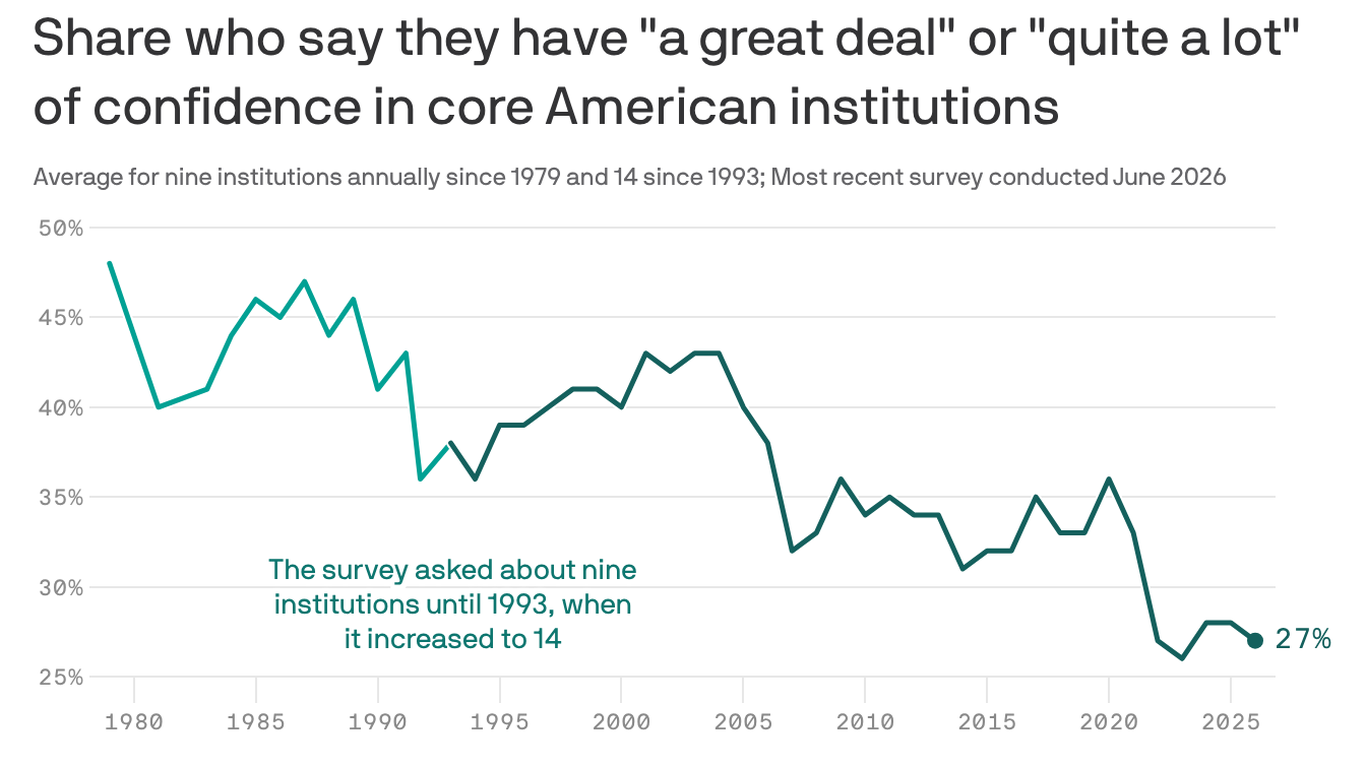
Gallup released its annual confidence in institutions poll last week, and the dismal results were familiar. Only 27% had a great deal or quite a lot of confidence in the nine private and public institutions Gallup has measured since 1979.Looking at two governmental institutions in Gallup’s poll provides some clues. Averages are useful, but they obscure some fascinating differences. The military took its usual place at or near the top of the governmental institutions in terms of high confidence in the new poll. Sixty-one percent had a great deal or quite a lot of confidence in the military. Only one subgroup of the 16 Gallup examined voiced very little or no confidence in the military: 18 to 34-year-olds. Young people often lead change, so it is worth paying attention to their views.
Congress usually ranks at or close to the bottom, with high trust this year at 9%. In only one of the Gallup subgroups did fewer than 50% have very little or no confidence. Thirty-six percent of Republicans, the president’s strong supporters, had little or no confidence. Half or more in every other age, race, income, and education group had little or no confidence.Why the difference? Both are big institutions employing thousands. Both have significant responsibilities. But the military’s mission is clear and strictly defined, and the public believes it is carrying out its responsibility to defend and protect the country well. While many disagree with the president’s actions in Iran, the criticisms don’t extend to the military’s performance. By focusing on its core mission, the military overcame severe, unjustified criticism after the Vietnam War. Scandals beginning with Tailhook in 1991 have rarely stuck to the military in the way scandals affect other institutions, such as Congress. This is because the public believes the military quickly addresses its problems and moves forward.Abstract virtual financial graph hologram on a modern furnished classroom background, financial and trading concept. Multiexposure