The dangerous part was not the classifier. It was the label file sitting there looking convenient.
A saved train_y.npy artifact existed, but for this baseline it was a trap: it contained magnitude-filtered positive targets only, which made it unusable for a directional classifier. If I had trained on it anyway, the result would have looked like a model comparison while quietly being a dataset-artifact comparison.
That is the reason I made the LightGBM minute baseline read Pramaana's per-asset feature parquet files directly. The point was not to tune trees until they confessed. The point was to close the model-class capacity objection in the minute-level ceiling experiment without letting label construction, overlapping windows, or temporal bleed sneak into the room wearing a lab coat.
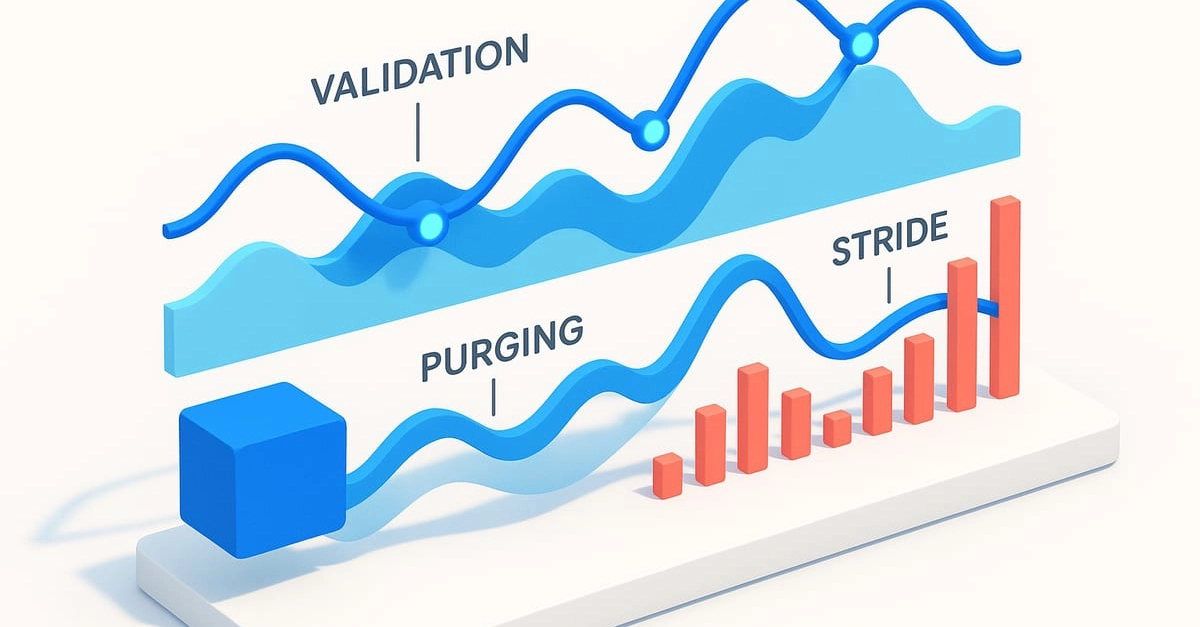
The research question behind the ICAIF 2026 paper is deliberately narrow: minute-scale cryptocurrency direction from OHLCV candles appears reproducibly capped near 52% across a broad set of model and feature configurations, while the same research stack recovers a materially larger directional signal at the hourly horizon. Across seven minute configurations and approximately 36 million rows of minute-scale OHLCV history, the observed range is 51.4% to 52.3%. The LightGBM baseline is the seventh configuration: 46 microstructure-proxy features, a 15-minute forward return target in basis points, a stride-15 de-overlap, a no-trade filter at |target| > 10 BPS, and a per-asset 85/15 temporal split with a 15-row purge before validation.