I kept running into the same problem: after a few weeks away from a project, I'd forgotten why I made certain architecture decisions. Switching between Claude, ChatGPT, and Gemini meant re-explaining everything from scratch. And in long chats, the platform's compaction slowly erased the details I actually cared about. The problem wasn't the tools; it was that my knowledge was trapped inside one chat or one platform, and it didn't stay with me.
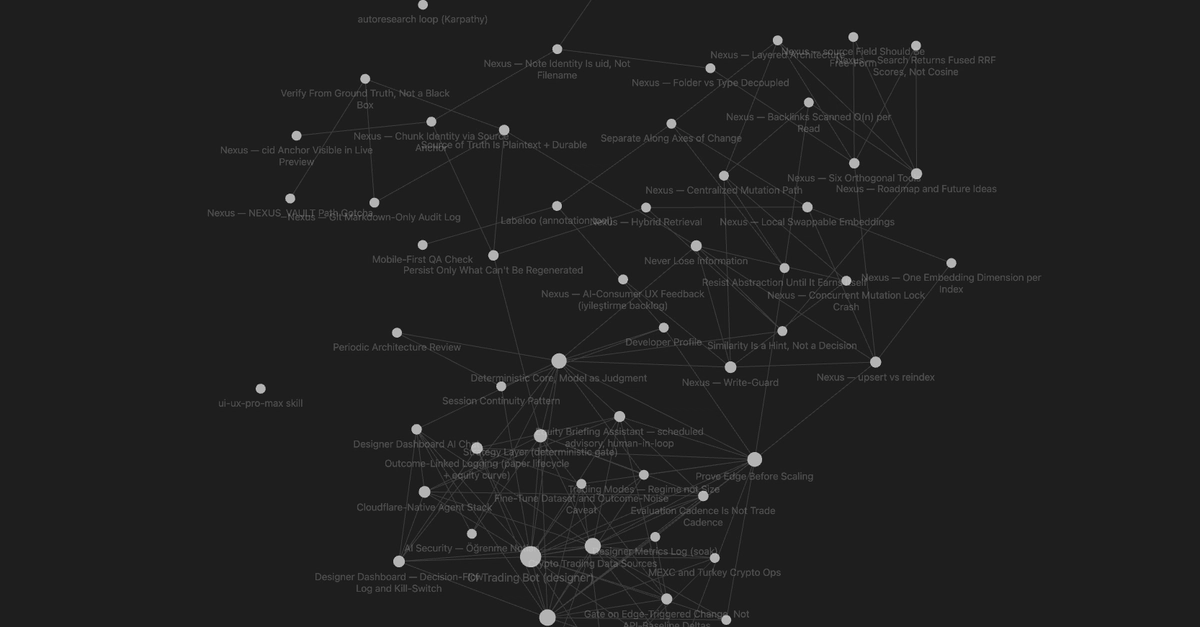
So I built Nexus: a local, LLM-agnostic memory layer that lives in plain Markdown, not in any one model.
I looked at the existing Obsidian MCPs first, but most are tied to a plugin, require Obsidian itself to be running, or are locked to one platform. What I needed was independent of both the model and the storage: Markdown as the single source of truth, everything above it (index, embeddings) rebuildable from that, and working with any LLM. And honestly, I wanted to build the knowledge system myself, make the design decisions myself, and end up with an engineering pipeline that works with me, not against me.
A teammate that actually remembers
Where it has helped me the most is keeping continuity on a project across long breaks. A while ago, I was building a fairly complex project. I worked out the architecture with Claude in a chat, turned it into a roadmap, and had Claude save it into Nexus. From there the loop was simple: Claude planned each milestone, Claude Code implemented it, and Nexus remembered the progress.