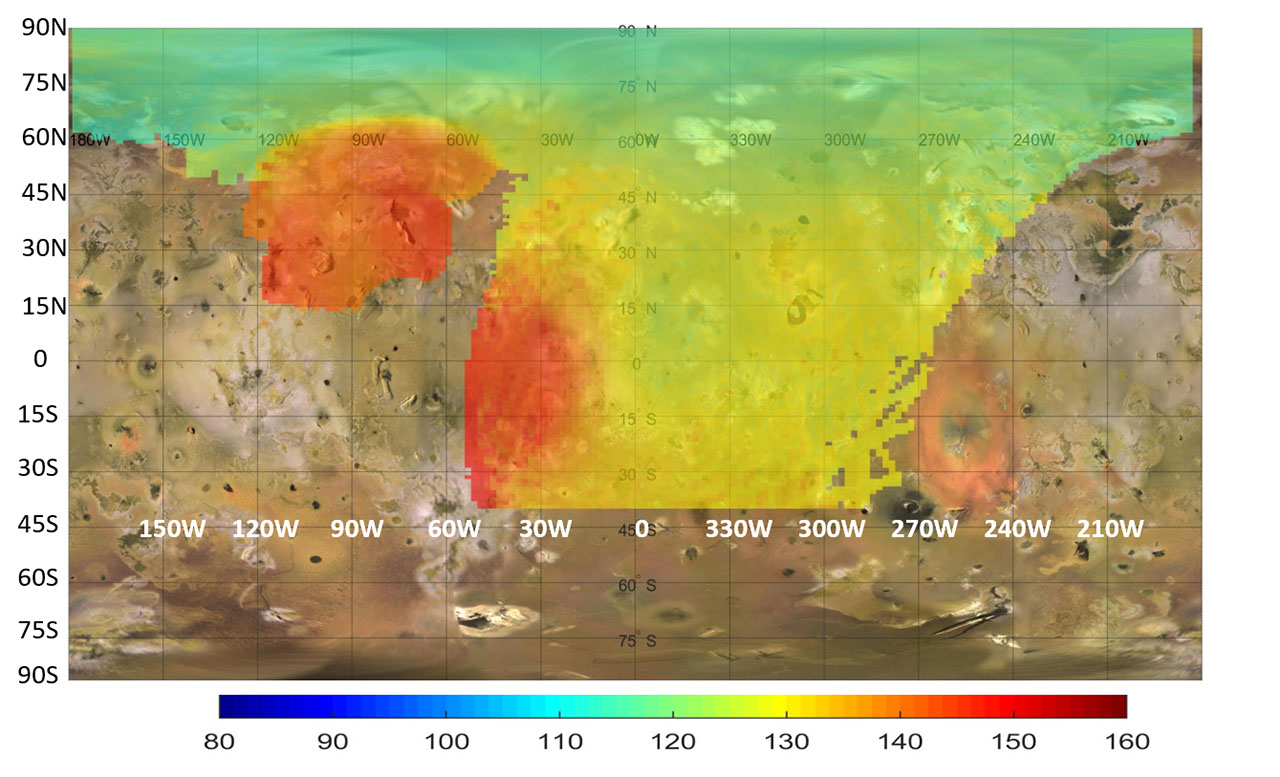
A NASA probe peered beneath the surface of the most volcanic world in the solar system, revealing scorching heat rising from below its crust. During two recent close flybys of Jupiter’s moon Io, NASA’s Juno mission measured the temperature below its surface for the first time. The data showed significant heating within the shallow subsurface of the moon that may be rising steadily through a conductive crust. The findings were published in the Journal of Geophysical Research: Planets, and could help provide new insight for both fiery and icy worlds of the solar system. Jupiter’s tortured moon Io is covered in hundreds of volcanoes, which spew fountains of lava that constantly refill impact craters on the surface with scorching molten lakes. Io’s volcanic activity is the result of a gravitational tug-of-war between Jupiter’s strong pull on the moon and precisely timed gravitational pulls from neighboring moons: Ganymede and Europa. The tortured moon is the subject of extreme tidal forces, causing its surface to bulge up and down by as much as 330 feet (100 meters) at a time, according to NASA.
The moon’s torment generates an internal heat output that’s much greater than that of Earth’s. Until now, scientists have only known about Io’s heat through infrared observations that sense the temperatures of the top surface.