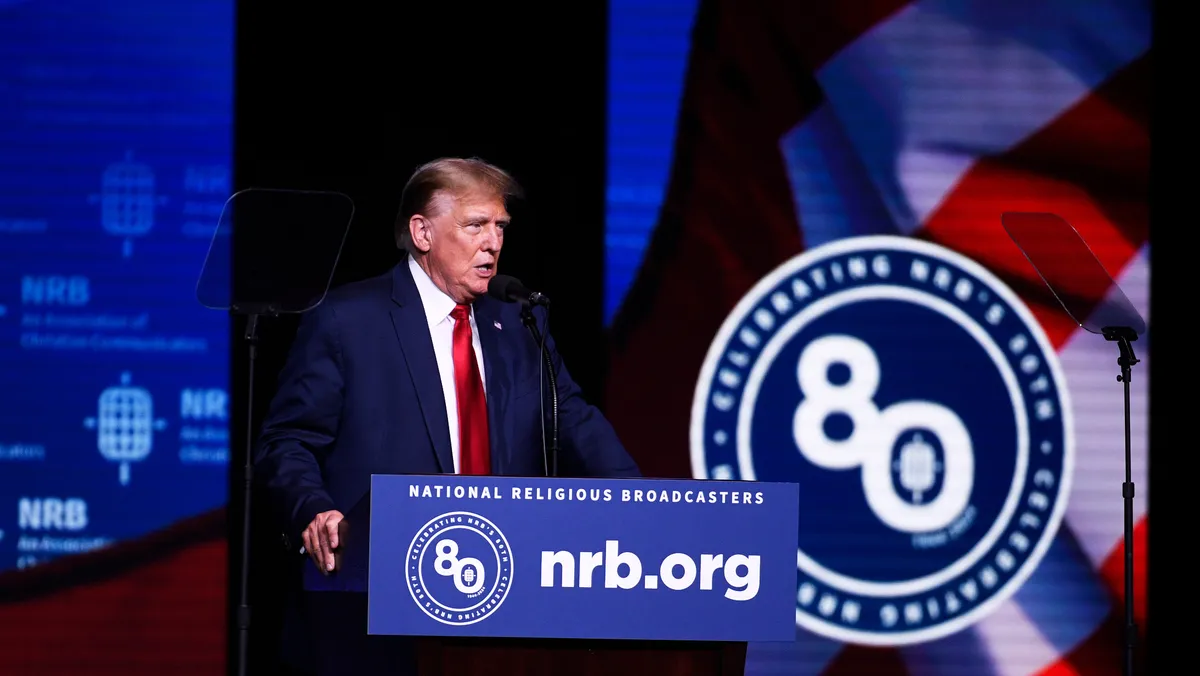
Show Caption
The so-called Johnson Amendment banned all tax-exempt 501c(3) organizations, like churches and charities, from “directly or indirectly” participating in politics.A group of churches and organizations sued the IRS in 2024, saying the rule violated the First Amendment.The IRS agreed to allow religious 501c(3) organizations to endorse political candidates in certain circumstances as part of a settlement agreement in 2025, but a judge dismissed the case in 2026.The plaintiffs appealed the dismissal in July, reigniting the case in the months leading up to the heated midterm election.As the midterm campaign heats up, a legal battle continues to unfold over whether churches will be able to endorse candidates and more openly take part in politics – without drawing the ire of the Internal Revenue Service.The IRS has long banned tax-exempt houses of worship from direct involvement in politics. But since 2024, there has been a heated court battle trying to overturn the rules. At one point, a settlement paved the way for the reversal of decades of precedent – only for a judge to throw it all out.The so-called Johnson Amendment was added to the Internal Revenue Code in 1954 and banned all tax-exempt 501c(3) organizations, like churches and charities, from “directly or indirectly” participating in politics, specifically in endorsement or opposition of candidates. The National Religious Broadcasters, an international association of evangelical Christian communicators, as well as the conservative advocacy group Intercessors for America and two Texas churches − First Baptist Church Waskom in Waskom, Texas, and Sand Springs Church in Athens, Texas − sued the IRS over the rule in September 2024, alleging that it violated their First Amendment rights to freedom of speech and freedom of religion. The parties reached a proposed settlement in 2025. It included the IRS reversing decades of legal precedent by saying churches and other religious 501c(3) organizations could endorse political candidates in certain circumstances. In court documents, the agency said political endorsements made by a church would not be seen as “participating” or “intervening” in political campaigns, but instead as a “family discussion concerning politics.” But a judge dismissed the entire case in a surprise ruling in late March, saying federal courts do not have the jurisdiction to change the tax status of a plaintiff or create exemptions from tax laws. Days later, President Donald Trump’s administration announced that it would issue guidance on the Johnson Amendment for religious organizations amid the legal back-and-forth, saying it would “continue to protect religious freedom as a fundamental right.” That guidance hadn’t come as of July 24, by which point the legal wrangling continued as the plaintiffs formally appealed the dismissal. Their July 7 filing said the decision resulted in “a dismissal no party requested, an agreed resolution undone and Plaintiffs left in the silence they sued to end.” The filing outlined the plaintiff’s beliefs that the IRS “pursues disfavored conservative and religious speakers while letting others speak freely.” Religious leaders and organizations across the ideological spectrum have similarly condemned what they describe as outsize scrutiny of their allies and institutions while overlooking tax infractions on the other side of the aisle. In an April interview with USA TODAY, the Rev. Jamal Bryant, senior pastor of New Birth Missionary Baptist Church in Stonecrest, Georgia, condemned what he said was a “double standard” when it comes to the Johnson Amendment, saying “it is very selective, how it has been used in American discourse.” The ongoing rhetorical and legal battle over the Johnson Amendment is leaving religious institutions with uncertainty about what political involvement the Trump administration will and won't allow in the leadup to the heated November elections.Complaints, but rare enforcement over Johnson Amendment's historyThough it’s been around for more than 70 years, the Johnson Amendment − named after former President Lyndon B. Johnson, who introduced it when he was serving as U.S. Senate majority leader − has rarely been enforced. A New York church did lose its tax-exempt status after it took out newspaper advertisements to discourage Christians from supporting former President Bill Clinton in the 1992 election. A court rejected the church’s First Amendment arguments, and the church also lost its case on appeal. The decades since have seen myriad churches and religious leaders wade into the political realm. According to religion watchdog groups, those efforts have at times crossed a legal line. Among them is the Freedom From Religion Foundation, which has filed scores of complaints to the IRS about alleged Johnson Amendment violations over the years.In June, for example, it asked the agency to investigate Sheridan Church in Tulsa, Oklahoma, after Pastor Jackson Lahmeyer said supporters could pick up campaign signs for his since-dropped congressional bid at the church. Chris Line, the foundation’s legal counsel, told USA TODAY in March that alleged Johnson Amendment violations do seem more common in conservative churches, though he said it’s “not an insignificant issue on the Democratic side either.” The organization previously criticized Bryant for what it characterized as his church’s efforts to secure votes for then-Vice President Kamala Harris ahead of the 2024 presidential election. The Freedom From Religion Foundation was not alone in doing so. Americans United for the Separation of Church and State also criticized Bryant for denouncing former Republican U.S. Senate candidate Herschel Walker from the pulpit in 2022. The Trinity Foundation, too, alleged that one of Bryant’s Instagram posts endorsed U.S. Sen. Raphael Warnock, D-Georgia, in the 2022 election. Leaders say faith, not criticism, shapes decision-makingBryant was one of several religious leaders who told USA TODAY they see it as imperative for faith to influence other areas of believers’ lives, including politics. “Our responsibility is to interpret the times and to speak to the time,” Bryant said. In a February opinion article for The Atlanta Journal-Constitution, Bryant wrote that the Black church has historically been a space for “both worship and witness, sanctuaries and staging grounds for social change.” In his view, that “dual role” has “often made us targets – surveilled, scrutinized and selectively policed.” In his interview with USA TODAY, he referenced White evangelical leaders and churches that have explicitly aligned with Trump over the years. Among them was the Rev. Franklin Graham, the president and CEO of the Billy Graham Evangelistic Association who has been a steadfast Trump supporter and served on Trump’s Religious Liberty Commission.Justin Arnot, general counsel for the Billy Graham Evangelistic Association, defended Graham’s involvement with the Trump administration in a February interview with USA TODAY. More religious leaders, in his view, should leverage the influence of both the church and the state in an effort to shape the nation’s moral character. At the same time, Arnot said only a fraction of the organization’s work touches the political sphere. He called complaints about such work “dubious,” describing efforts by groups like the Freedom From Religion Foundation as acts of intimidation. The IRS audited both the association and Samaritan’s Purse, a disaster relief nonprofit also led by Graham, in 2012. Graham said “someone in the administration was targeting and attempting to intimidate us” in a letter to then-President Barack Obama about the matter. Then-acting IRS commissioner Steven Miller resigned around the same time amid a wider controversy surrounding IRS scrutiny of tea party groups. Ultimately, Arnot said the organization’s political decision-making isn't guided by critics. “We make decisions based on our biblical convictions and our mission and informed by the law to make sure we’re compliant, and we’re confident that we are,” he said. Johnson Amendment's future could reshape religious, political lifeLeaders on all sides of the Johnson Amendment debate told USA TODAY that the ultimate outcome of the National Religious Broadcasters’ lawsuit could have a significant impact on American church and political life moving forward. Retired United Methodist Church Bishop Julius C. Trimble said opening the door for political money to influence churches could limit what he described as faith communities’ prophetic and unifying role in society. Line similarly feared that churches could “just turn into super PACs” if they are permitted to endorse political candidates as tax-exempt entities. He also expressed concern that political groups could attempt to be redesignated as a church for tax benefits, given that the IRS does not have a specific definition of what counts as a “church.” On the other hand, Arnot said the Johnson Amendment as it currently stands has negative constitutional and financial implications for religious organizations. “The threat of revocation chills not only the speech, but it potentially chills the giving,” Arnot said. In his view, the since-tossed settlement would have simply compelled the IRS “not to enforce it [the Johnson Amendment] in random or arbitrary ways against houses of worship.” Church voter guides, registration drives ahead of midtermsAs the midterms draw closer, religious leaders and organizations are making their own decisions about the extent to which they want to get involved as the battle over the Johnson Amendment continues. The United Church of Christ created a toolkit to support “nonpartisan faithful engagement” in the midterms, while a New York church hosted a “Getting Into Good Trouble” voter registration drive in honor of the late U.S. Rep. John Lewis, who was among the 13 original Freedom Riders beaten and jailed for their civil rights advocacy in the 1960s. The United Methodist Church, too, has long offered resources and allowed individual churches to host voter registration drives to boost civic participation. UMC leaders pointed to the denomination’s Social Principles, which are established by the church’s general conference and are not church law, drawing a line between partisan political activity and necessary engagement with social justice issues. “Some people see it as right versus left when I think ... we see it from the standpoint of what’s right versus what is wrong,” Trimble said. Contributing: Angele Latham, The Tennessean BrieAnna Frank is a First Amendment reporter at USA TODAY. Reach her at bjfrank@usatoday.com. USA TODAY's coverage of First Amendment issues is funded through a collaboration between the Freedom Forum and Journalism Funding Partners. Funders do not provide editorial input.