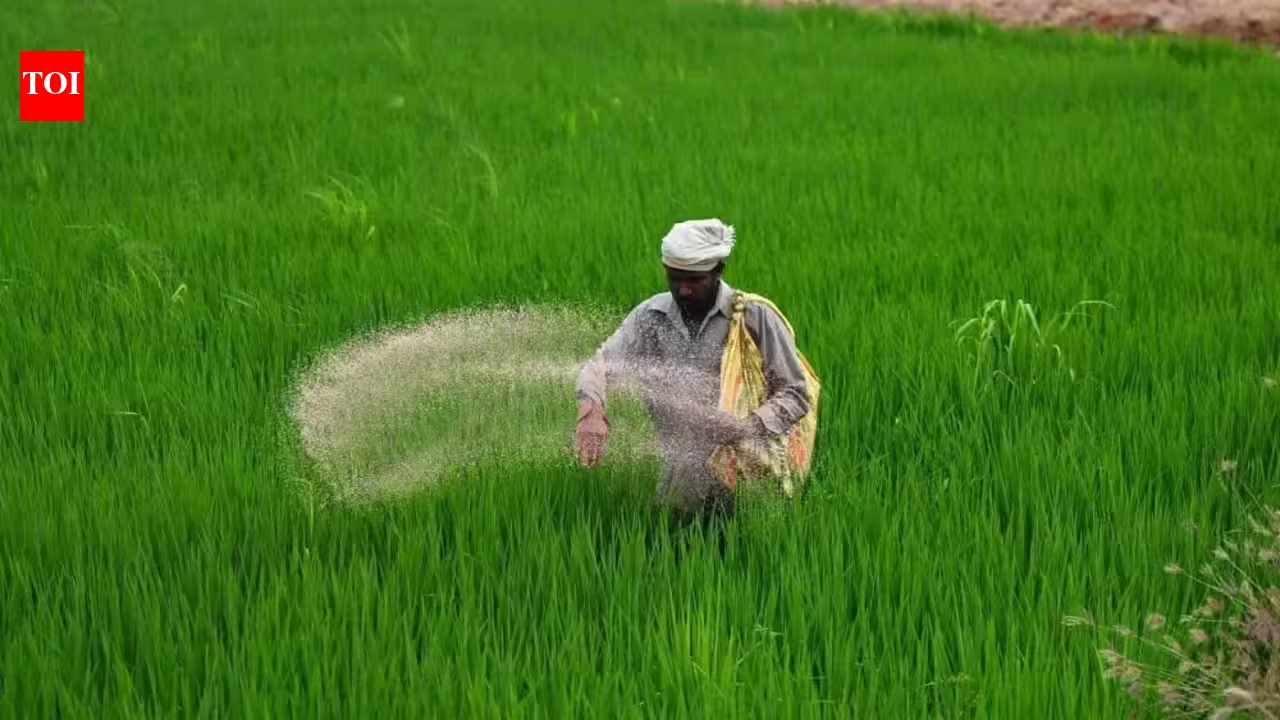
A sack of urea fertiliser at a Multipurpose Primary Agriculture Cooperative Society in Karnal, Haryana. The demand for urea has surged this month after surplus rains in first 10 days as over 60% of the month’s demand has already been sold by July 17 as against less than 50% in DAP and complex and 30 per cent in MOP. July is the key month when maximum sowing takes place and it also shares maximum rainfall of the monsoon season.
| Photo Credit:
REUTERS/BHAWIKA CHHABRA
Amid high demand and limited availability of urea—which contains 46 per cent nitrogen (N)—India has allowed ammonia containing 82 per cent N, for agricultural use. However, the country has to go a long way to put in place an infrastructure network for delivery and application of the gas on the farmer field since it needs to be injected under soil.Industry sources said if it becomes successful, India will be the fourth country in the world after the US, Canada and Australia to use ammonia directly in farming.According to a notification published on July 23, the Union Agriculture Ministry said that “Anhydrous Ammonia” fertilizer having minimum 82 per cent Nitrogen by weight is allowed to be manufactured by any unit for a period of three years from the date of Gazette notification, under clause 20A of Fertiliser (Inorganic, Organic or Mixed) (Control) Order, 1985.“Permitting the use is good as it is the first step. But, to implement it is the key challenge because of the risks involved due to the possibility of gas leaks,” said a top official of a urea manufacturing company. He noted that his company would not get into it as it is neither its domain nor looks profitable from a business point of view.Sulphur-coated ureaCiting the example of sulphur-coated urea, he explained how there is hardly any actual use for the fertilizer though it was given regulatory clearance for manufacturing and sales. “Nowhere in the world sulphur is coated in prilled urea (the subsidised nitrogen product in India) as it is not suitable. Only in granular urea, sulphur can be coated and there is hardly any manufacturing of it in India,” he added.Industry sources said that many urea plants generate 2,000-6,000 tonnes of surplus ammonia every year which could not be diverted for urea due to limitations in production capacity, and, as a result, they sell it. The government has mandated these ammonia sales as a priority for complex fertiliser (combination of N, P, K nutrients) units.businessline in July 2025 had reported ACME Cleantech Solutions’ application seeking approval of Indian Council of Agricultural Research (ICAR) for a collaborative pilot programme to validate the use of “anhydrous and aqueous ammonia, backed with green ammonia,” as an efficient, environment friendly alternative fertilizer to conventional urea.As the approval missed the Kharif 2025 season, anhydrous and aqueous ammonia was said to be put into trial in 13 ICAR’s institutions during Rabi 2025-26 season. Sources said that the trial was supposed to be for three seasons, but the approval by ICAR was fast-tracked to facilitate the pace of its manufacturing so that in next Kharif season at least some areas could be covered under a pilot scheme.An investment of ₹13,000—₹15,000 crore is needed to set up a green ammonia plant of 1,200 tonne per day capacity.Demand surgesThe demand for urea has surged this month after surplus rains in first 10 days as over 60 per cent of the month’s demand has already been sold by July 17 as against less than 50 per cent in DAP and complex and 30 per cent in MOP. July is the key month when maximum sowing takes place and it also shares maximum rainfall of the monsoon season. India imports about 100 lakh tonnes (lt) of urea and domestically produces about 300 lt, though mostly from imported LNG.Sources said that field trial conducted at an ICAR institute during Rabi 2026 season to evaluate the performance of green ammonia in direct seeded rice showed higher biomass and higher greenness in some cases when compared with application of normal urea. However, in some plots, there was non-uniform growth due to non-uniformity of NH3 application, which potentially requires standardisation of injection methodology of the green ammonia technology.“It is very important to test its efficacy in low land transplanted crops, particularly in rice and maize and standardise the time of application, time gap between application and puddling,” said a scientist involved in the trial.The Fertiliser Ministry last month said that the interests shown by prospective players in green urea indicated its domestic production will be a reality in the near future. Under a pilot project a 150 TPD Green Urea plant at Pudimadaka, Andhra Pradesh will be developed by NETRA, the R&D arm of NTPC — as a technical reference point. The facility integrates Carbon Capture and Utilisation (CCUS) systems with water electrolysis, it said.The Department of Fertilizers (DoF) held a high-level pre-Expression of Interest (EOI) meeting for the establishment of Green Urea Plants in India.Green urea production requires carbon dioxide as a synthesis feedstock, making captured CO₂ from thermal power, cement, and steel plants an essential input. A world-scale urea plant of 12.7 lt annual capacity would require nearly 10 lt of CO₂ per year.Published on July 27, 2026