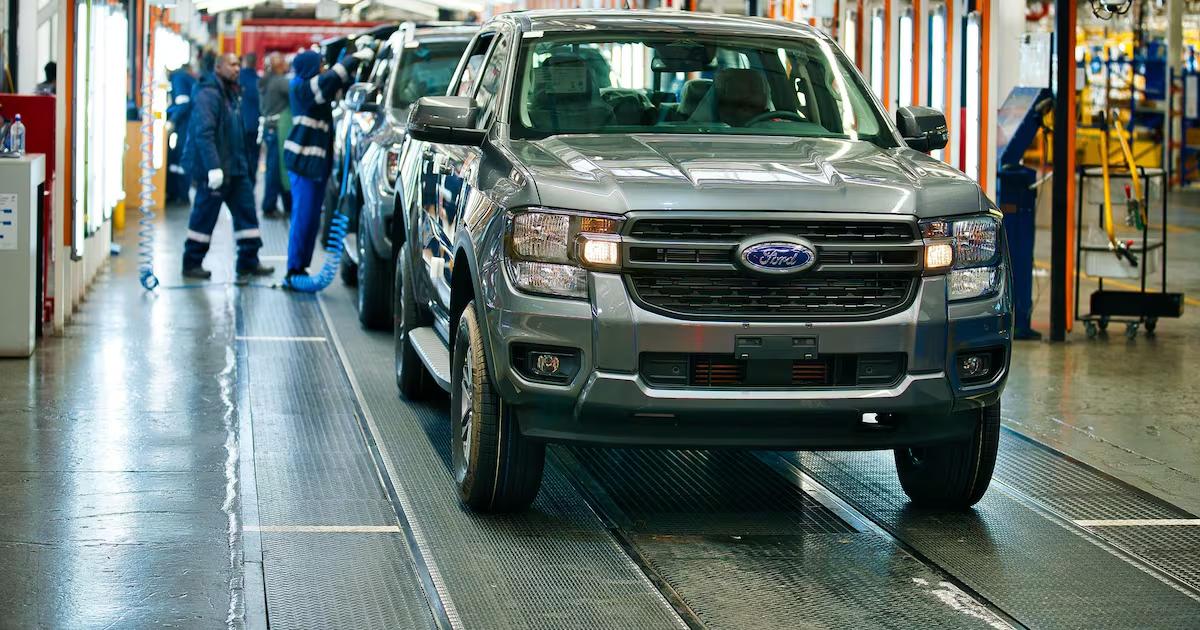
Industrial success in South Africa has always required a high tolerance for paradox. To walk the floor of a modern assembly plant in Gauteng or the Eastern Cape is to witness first-world manufacturing precision operating within a developing economy. We build vehicles that compete on showroom floors in London and Sydney, even as the local environment tests our operational resilience daily. Ford’s manufacturing plant in Silverton, Pretoria, was recently named the best Ford quality plant in the world. That’s no mean feat.As we cross the midpoint of 2026 the local automotive sector is entering a defining six-month stretch. The conversation in our boardrooms has shifted. We’re no longer simply managing post-pandemic aftershocks or global supply chain snarls but face five distinct pressure points that will dictate the industrial trajectory of this country well into the next decade and beyond.(Karen Moolman) First, the immediate reality is the broader macroeconomic environment: South Africa’s economic growth remains stubbornly sluggish. The structural constraints are well documented, with logistics and energy reliability chief among them. Yet the automotive sector still remains a vital shock absorber for the national economy. We account for a large portion of manufacturing output and export revenue. To leverage this, the economy needs far more momentum. We cannot export our way to prosperity if the basic arteries of trade are congested. The public-private partnerships formed to fix our ports and rail networks must accelerate from boardroom agreements to visible, operational results on the docks.Second, we must protect stability. Economic momentum requires a foundation of deep political and municipal stability. This brings us to November. The upcoming local government elections are not merely another political event; they are a critical business variable. Automotive manufacturers do not operate in an abstract national ether. Our plants, suppliers and employees exist within specific municipalities. When local infrastructure fails, water supply is interrupted or the local grid collapses, production schedules are immediately compromised.Capital is highly observant. Global boards looking to allocate billions in future investments pay close attention to local governance. We need municipal administrations that understand their role as facilitators of industry. The November elections must yield local governments capable of basic service delivery and infrastructure maintenance. Industrial policy written in Pretoria means little if the road leading to the factory gates is impassable.Third, it’s not just about regulatory certainty but also about clarity: alongside municipal stability the sector desperately needs ironclad regulatory certainty at a national level. The global transition toward new energy vehicles is advancing ruthlessly. South Africa has made welcome progress in drafting policy frameworks, but frameworks are not legislation. Capital requires a map. As we look toward 2028 we need absolute clarity on the taxation (especially the ad valorem tax framework), incentive structures and import duties that will govern the production and sale of vehicles. The key here is a framework that acknowledges not just battery electric derivative options; we simply cannot compete globally as a country in that space alone.Ambiguity is the enemy of investment. When global parent companies are deciding whether to allocate a new vehicle programme to South Africa, Thailand or Mexico they look for regulatory predictability. We have the engineering talent and the manufacturing pedigree to be a leading hub for both green and traditional internal combustion engine-based mobility. We simply cannot afford to lose the race because the rules of the game were published too late, or they did not take the whole picture into consideration.Fourth, household realities need to be addressed urgently, as they’re the real indicators of people’s daily experiences. While we focus on building vehicles for the world we must also confront the harsh reality facing the domestic consumer. South African households are under immense financial pressure. A prolonged cycle of high interest rates, rising utility costs and sticky inflation has severely eroded disposable income. The middle class (where our primary tax base exists) is being squeezed, and overall affordability is becoming a structural challenge rather than a cyclical dip. Simply put, we cannot tax our way to prosperity.For the automotive sector this is a profound concern. A healthy export market must be anchored by a robust domestic base. Manufacturers and financial institutions will need to innovate rapidly over the next six months. We have to rethink vehicle financing structures and introduce products that keep mobility accessible without compromising on safety or technology. If we price the South African consumer out of the new car market we undermine the domestic scale required to sustain local supply chains.Fifth, competition can only exist when the playing fields are equal in every respect: we must face the reality of a radically altered competitive landscape. The global market is crowded, and aggressive new entrants have arrived on our shores with compelling products and sharp pricing strategies. Legacy market share means nothing in 2026. Consumers are pragmatic and they will vote with their wallets.For established manufacturers like us this competition is entirely welcome. It forces innovation, tightens supply chains and ultimately benefits the consumer. But it also means the South African manufacturing base must sharpen its edge. We must build smarter, eliminate inefficiencies and push our local component suppliers to match global best practices. Protectionism will not save us from better competitors. Only sheer quality and aggressive efficiency will.But, and there is a but, true competition only exists when the playing fields are equal. That means the same investment requirements, the same adherence to employment standards, the same commitment to transformation, and the same quality standards.South Africa has a habit of deferring difficult decisions until a crisis forces its hand. We simply can’t afford that luxury in the back half of this year. The automotive sector is proof of what this country can achieve when capital, skill and ambition align. We have the capability to anchor the industrialisation of the African continent. We have the global product mandates.The next six months will determine whether we simply manage our decline or aggressively engineer our growth. The private sector is ready, the capital is deployed and the assembly lines are moving. Now we need the entire ecosystem to match that pace, which requires government to move beyond consultation and accelerate into rapid execution. Policymakers must listen closely to the realities of the factory floor and define long-term policy with committed local players firmly in mind. We’ve invested the capital, built the supply chains and trained the workforce. Now, the state must act with equal urgency and commitment. If Pretoria aligns its speed and policy focus with established automotive manufacturers that have deeply rooted themselves in South African soil, this country will not just survive the global industrial transition but thrive in it.Hill is president of Ford Motor Company Africa.
NEALE HILL | How the next six months will define SA’s automotive decade
South African consumers face affordability squeeze as carmakers rethink strategies
1,109 words~5 min read