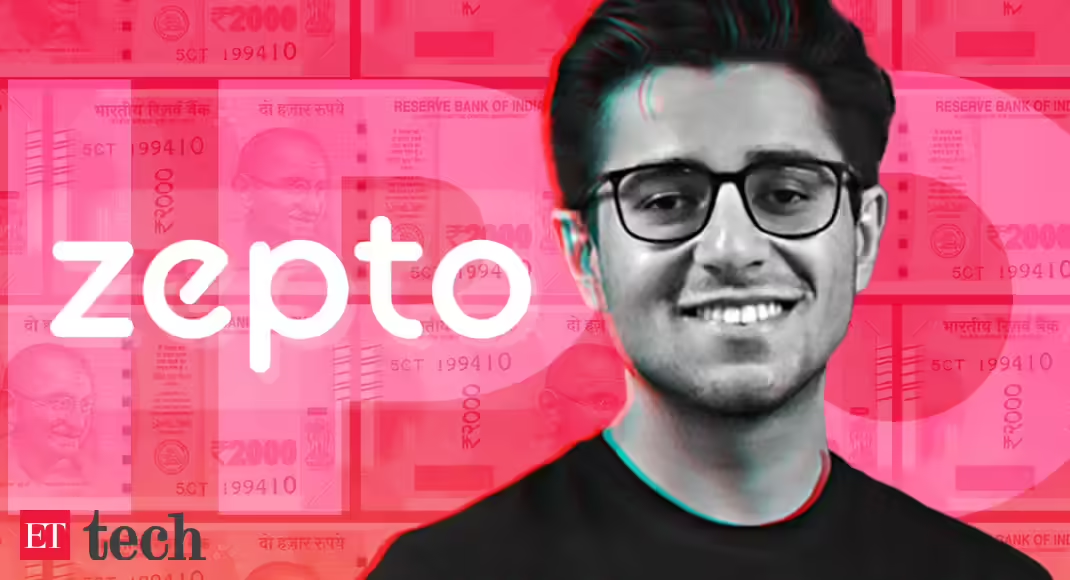
Happy Monday! Zepto's IPO valuation has run into resistance from top mutual funds. This and more in today’s ETtech Morning Dispatch.Also in the letter:■ Brands remain mum in Delhi protests■ IT price wars hit Infosys■ PhonePe’s FY26 reportMutual funds flag Zepto IPO valuation Aadit Palicha, CEO, ZeptoTop domestic mutual funds are pushing back against the valuation sought by quick commerce startup Zepto for its proposed initial public offering (IPO), people familiar with the matter told us.What's happening?Sources said leading mutual funds have told Zepto they are unwilling to invest even at $4-5 billion, the valuation the company is considering.These investors are seeking a 30-40% cut.This has prompted the bankers and one of the company's key investors to step up discussions with money managers while also reaching out to High Networth Individuals (HNIs) and large family offices for support.Zepto already lowered its IPO valuation expectations to around $4-5 billion, down from its peak valuation of $7 billion in October 2025, when it raised $450 million from US pension fund Calpers. Tell me more: Zepto is targeting the launch of its IPO within the next two weeks. Sources said the company hopes to wrap up discussions with asset managers by Tuesday, although mutual funds are yet to accept its proposal.ET had reported earlier this month that the company may cut the size of its IPO by around 20%, raising around $650-700 million in fresh capital against the originally planned $850 million (Rs 8,010 crore)."What we are saying is if you can get the participation of the majority of the other big funds, we will also look into it again," said a top official with a large mutual fund.Also Read: Inside Zepto's profit push ahead of its IPOPrivate equity investors shift tech bets from IT services to AI startups Private equity firms are redrawing their tech investment strategy, shifting capital from traditional IT services and software companies toward AI-native startups, with investors now also looking beyond infrastructure into application-layer businesses that automate workflows.Driving the news:Kedaara Capital has planned a $30-40 million investment in healthcare AI startup RapidClaims at a valuation of $150-160 million, per sources.ET reported that EQT Partners is in talks to invest $100-120 million in enterprise AI integration startup UnifyApps.Other funds such as Creaegis and A91 Partners have also invested in AI startups like Emergent and Deccan AI.Why this is happening: AI adoption is pushing down valuations in legacy software and IT services, making those companies more attractive as buyout targets. At the same time, investors see AI-native firms with strong data, workflows and profitability potential as better bets than generic “wrapper” products.Context: AI-native companies accounted for 59% of software and AI deal value across private equity and venture capital transactions in the first half of 2026, up from 19% a year earlier, according to a DC Advisory report. Over the same period, deal value involving non-AI software companies fell about 40%.Now what: Funds now want a meaningful “sleeve of AI” in their portfolios, but the type of capital matters. “A large part of India’s opportunity will be in AI enablement and applications that use domain expertise, proprietary data and workflow ownership to solve real business problems. This is where we expect private equity and growth capital to increasingly focus, identifying businesses where AI creates durable competitive advantage, stronger growth and structurally better economics,” Neeraj Shrimali, managing director at Avendus Capital, said.Also Read: Vibe-coding startup Emergent's valuation jumps 5x to $1.5 billion in new fundingBrands’ silence becomes conspicuous amid student protest CJP protest in DelhiThe Cockroach Janta Party (CJP) protests, which were withdrawn on Sunday after union minister Dharmendra Pradhan resigned, has exposed a gap between brand-led “cause marketing” and the unpredictability of real political events.What’s the news: Most brands chose silence to avoid backlash, as experts said bad timing or a tone-deaf post can damage reputation faster than no response at all.Harish Bijoor, brand strategist and founder at Harish Bijoor Consults, told us, “Authenticity is most certainly one of the key attributes that Gen Z looks forward to. Brands in India have missed the bus on this because authenticity is not being catered to. Brands are too bogged down with a fuddy-duddy approach of feeling that positioning is permanent.”What worked: Some local, practical gestures got attention, such as Blue Tokai offering water and shelter to protesters. One expert told us such actions felt real because they were immediate and useful, not polished campaigns. Gen Z has grown wary of performative corporate support and responds better to behaviour than messaging.Also Read: No specific law authorises live facial recognition at protests, legal experts warnHow Gen Z turned protest into content: Reels, memes and the new language of dissent The student protestors who camped at Delhi’s Jantar Mantar prevailed when union minister Dharmendra Pradhan resigned. The peaceful demonstration quickly became a social media movement, with reels, shorts and parodies carrying the story far beyond the protest site. How Gen Z watched: Memes, chants and edited videos helped the issue spread across platforms and into public conversation. Rather than follow one long speech or debate, many young people pieced together the protest through short clips.IT price wars squeeze Infosys out of three multi-million dollar accounts Infosys, India’s second-largest software services firm, has lost three major contracts to rivals in recent months.What’s the news:Earlier in July, the Bengaluru-headquartered firm lost nearly half of its $2 billion engagement with Mercedes-Benz.In February, Cognizant won a $300-million workplace solutions contract with Daimler Truck, which was earlier with Infosys.The lost work from clients shows intensifying competition among large IT firms as customers consolidate vendors to squeeze out more cost savings. Infosys said last week that loss of a large European client weighed on its first-quarter revenue growth.Also Read: Infosys names Ashiss Kumar Dash to succeed Salil Parekh as CEOExpert take: “Large legacy contracts signed five to ten years ago often carry very different commercial assumptions from today's market, and some have become increasingly unattractive as wage inflation, contractual obligations and client expectations have evolved,” said Phil Fersht, chief executive officer of HFS Research.Also Read: IT growth under pressure amid delayed deal ramp-upsOther Top Stories By Our Reporters Sameer Nigam, CEO, PhonePePhonePe FY26 losses surge: Walmart-owned fintech firm PhonePe reported a 62% increase in net loss last fiscal year at Rs 2,792 crore, impacted by higher expenses and a sharp slowdown in revenue growth. Operating revenue grew 11% to Rs 7,920 crore in FY26, slowing from a 40% rise the year before, and 74% growth in FY24, showed regulatory filings sourced from Tofler.Fractal CEO on June quarter: Newly listed enterprise AI firm Fractal Analytics Friday reported its first major quarterly profit setback in recent years, as execution lapses and the ramp-down of two large clients in its technology, media and telecom (TMT) business weighed on earnings. The stock slumped 8.69%.IITs’ specialised cybersecurity degrees: The launch of new courses such as Bachelor of Cybersecurity by Indian Institutes of Technology in Madras and Kanpur has triggered a fresh debate over whether specialised undergraduate programmes can meet the cybersecurity industry’s evolving talent needs, as artificial intelligence changes the nature of cyber defence and hiring.Global Picks We Are Reading■ Silicon Valley is completely divided over Chinese AI (Wired)■ Waymo explores split with Uber as robotaxi tensions deepen (FT)■ Fed up with Big Tech, communities turn to data collectives for control (Rest of World)
Zepto valuation row; PE takes AI bets
Happy Monday! Zepto's IPO valuation has run into resistance from top mutual funds. This and more in todays ETtech Morning Dispatch.
TL;DRAI
Private equity pivots from IT services to AI-native startups: AI deal value jumped from 19% to 59% in H1 2026. For tech leaders, it signals traditional outsourcing is commoditized; future value lies in domain AI with proprietary data and workflow automation.
1,219 words~6 min read