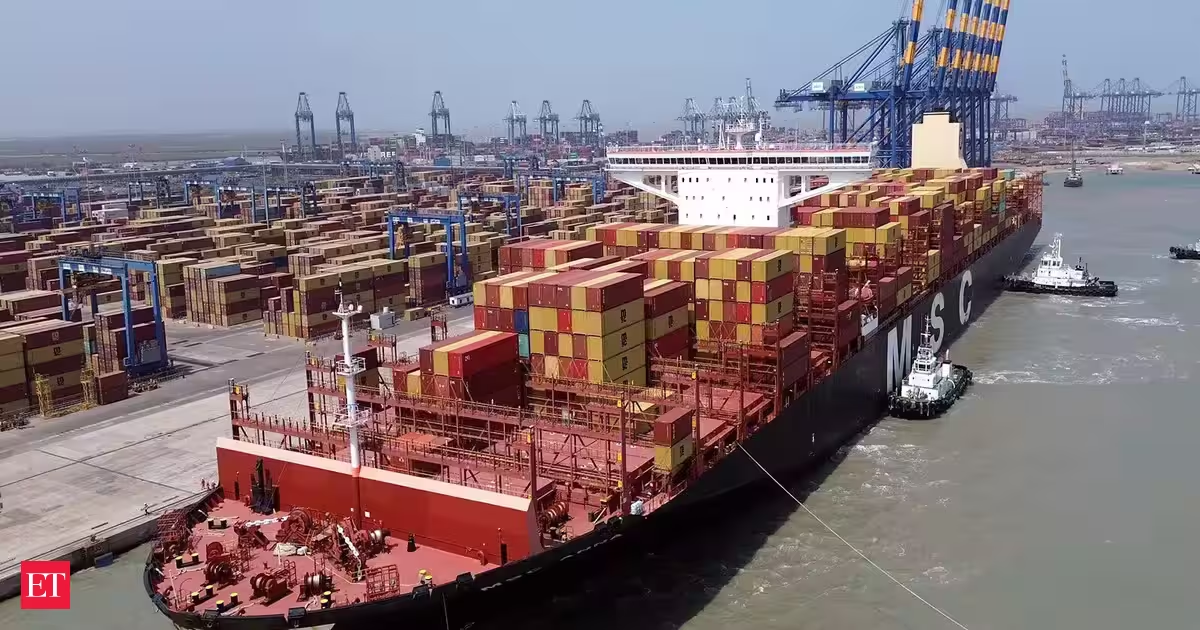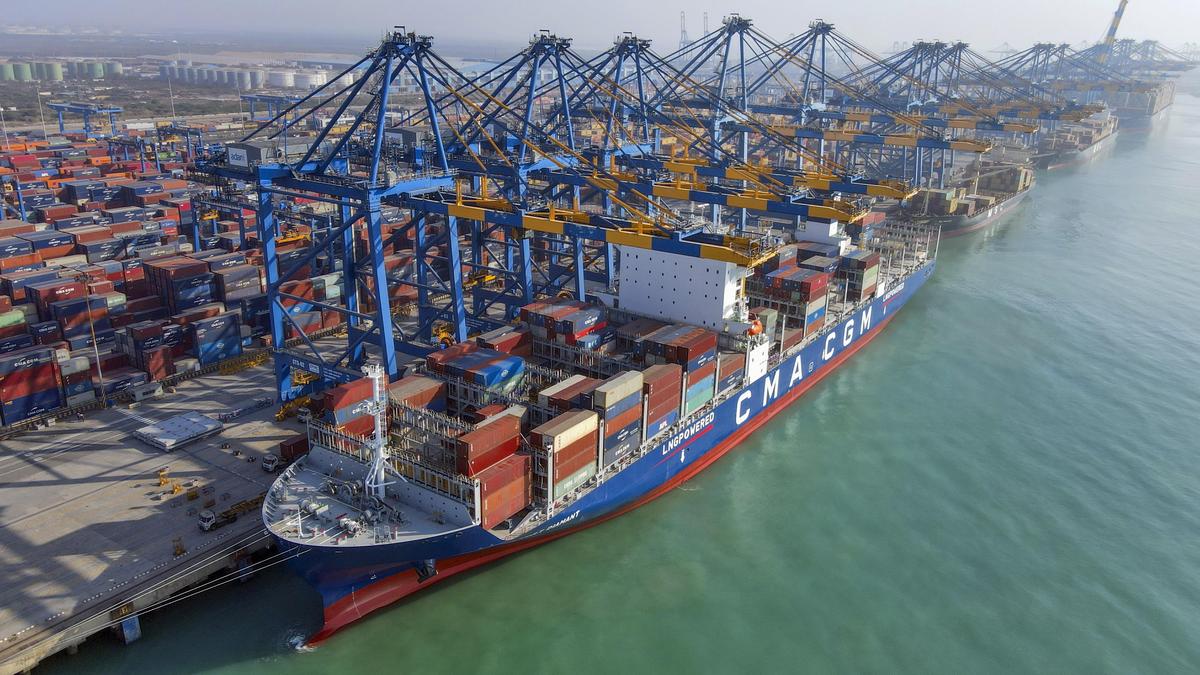
OPTIMISING USAGE. The cargo handling capacity of a port must balance flexibility with congestion control
| Photo Credit:
India’s maritime sector has experienced remarkable growth in recent years as the country seeks to strengthen its role in global manufacturing, trade and logistics networks. Government initiatives such as Sagarmala and Maritime Amrit Kaal Vision (MAKV) 2047 aim to expand port capacity, improve multimodal connectivity, promote coastal shipping and reduce logistics costs. Major investments are being made in new berths, deeper draughts, mechanised cargo handling, freight corridors, logistics parks, inland transport and digital infrastructure to create an integrated maritime and logistics ecosystem.However, infrastructure expansion alone cannot ensure sustainable development. Port capacity must be aligned with realistic cargo demand projections. Since port projects involve substantial capital investment and a long gestation period, inaccurate forecasting can result in significant operational and financial inefficiencies. Excess capacity leads to underutilised terminals and idle equipment, and poor returns on investment. As global trade patterns and domestic economic conditions continue to evolve, port planning is becoming increasingly complex.Operational efficiencyIn port planning, the concept of ‘highest efficient attainable throughput’ (HEAT) refers to the maximum cargo volume a port can handle efficiently without causing significant congestion. As traffic nears this threshold, berth occupancy rises, vessel turnaround slows, storage yards become congested and cargo-handling equipment comes under pressure. Beyond this level, efficiency declines quickly, leading to higher logistics costs, supply chain disruptions and reduced competitiveness.To sustain efficiency, ports require timely capacity augmentation, operational modernisation, improved hinterland connectivity and digital integration. While infrastructure expansion remains important, equal emphasis must be placed on optimising existing assets and improving operational performance.India’s major and non-major ports are already showing signs of capacity imbalance. As of March this year, the country’s ports had a combined handling capacity of nearly 2,762 million tonnes, while actual cargo traffic was about 1,668 million tonnes, reflecting around 60 per cent utilisation. International port planning practices, including guidance from the United Nations Conference on Trade and Development, generally consider around 70 per cent utilisation as efficient, as this balances flexibility with congestion control.Since the 1970s, the UNCTAD has encouraged ports to maximise operational efficiency and optimise existing infrastructure before undertaking largescale expansion. The MAKV 2047 envisages creating nearly 10,000 million tonnes of port handling capacity by 2047, whereas the projected cargo traffic, assuming annual growth of about 6 per cent, is estimated at only 5,630 million tonnes. This suggests that the planned capacity of around 8,000 million tonnes would adequately meet future demand, highlighting the need for demand-driven infrastructure planning.Rising competition among ports on the eastern and western coastlines, particularly with the rapid expansion of private ports, has led to overlapping infrastructure development and dispersed cargo movement. Future port development should be guided by realistic demand forecasting, integrated logistics planning and continuous market assessment.This approach will improve competitiveness, optimise investments, strengthen supply chain resilience and ensure the long-term financial sustainability of India’s maritime sector.