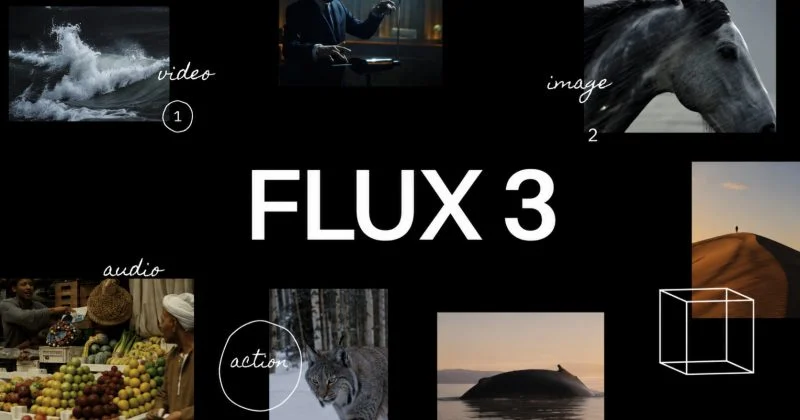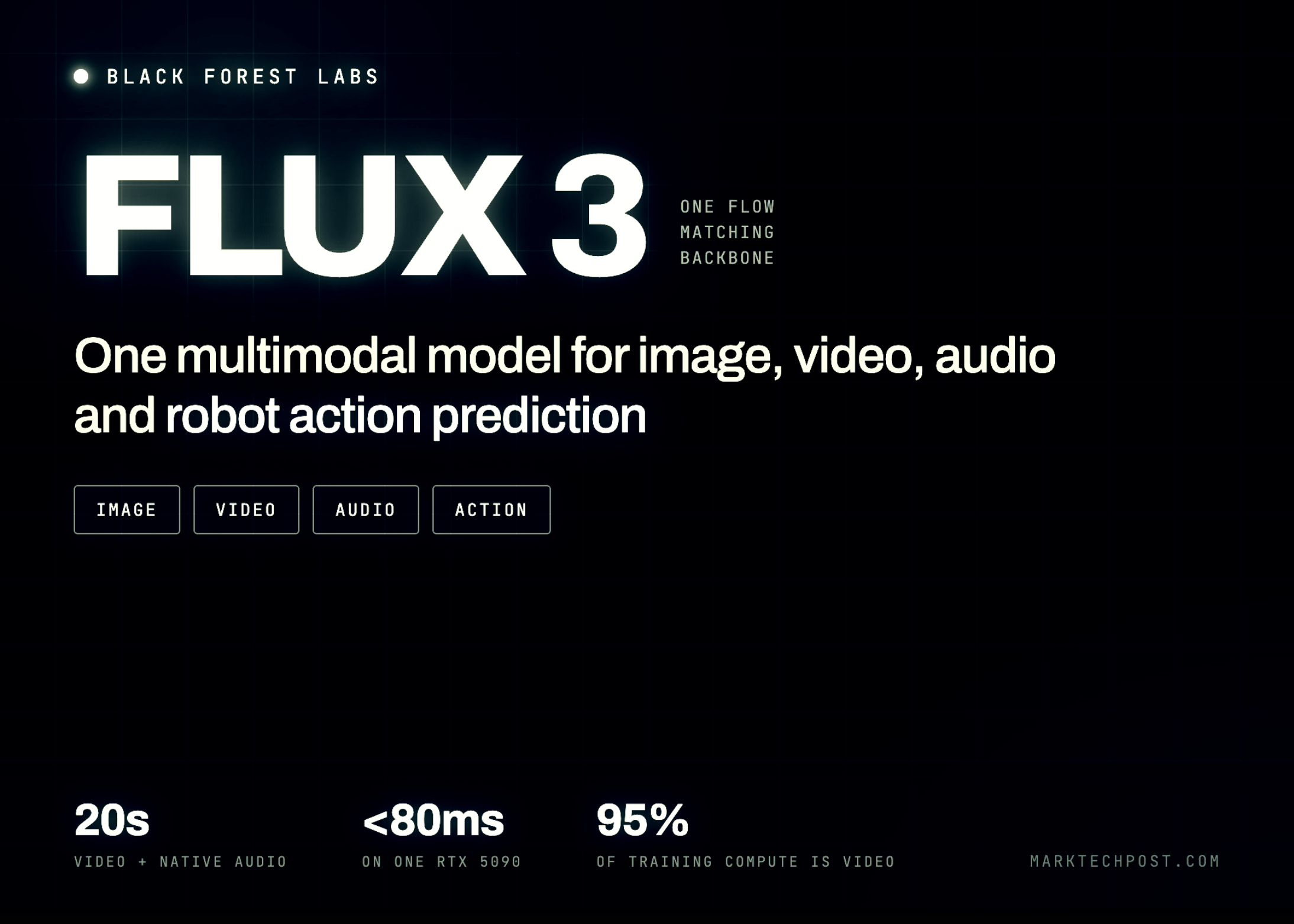
Black Forest Labs (BFL) has released FLUX 3, a multimodal foundation model that learns from images, videos and audio inside a single architecture. It is also the first FLUX model to ship video, audio and action prediction from one set of weights.
The Black Forest Labs (BFL) research team argues that no single modality gives a complete description of the world. Images capture spatial structure at one instant. Video restores time and exposes physical dynamics. Audio reveals causal relationships between mechanical events and sound. Each is treated as a lossy projection of the same underlying reality.
Training on all of them at once means the modalities constrain each other. The sound has to match the impact. The motion has to obey the mass. The research team calls FLUX 3 its first model built entirely on that principle.
The method underneath: Self-Flow
FLUX 3 builds on Self-Flow, BFL’s method for aligning multimodal generation and understanding in one architecture. Self-Flow combines the flow matching objective with a self-supervised feature reconstruction objective. The reference implementation on GitHub is Apache-2.0 and uses SiT-XL/2 with per-token timestep conditioning. It trains with a 25% per-token mask ratio and self-distillation from an EMA teacher at layer 20 to a student at layer 8.