In brief
Thinking Machines Lab released Inkling on July 15—a 975-billion-parameter open-source model trained entirely from scratch.
It's the first major model from Mira Murati's lab since she left OpenAI in September 2024.
The model is live on OpenRouter at $1 per million input tokens and $4.05 per million output tokens, making it usable in Hermes and OpenClaw setups—but competing models deliver stronger raw benchmarks at comparable or lower cost.
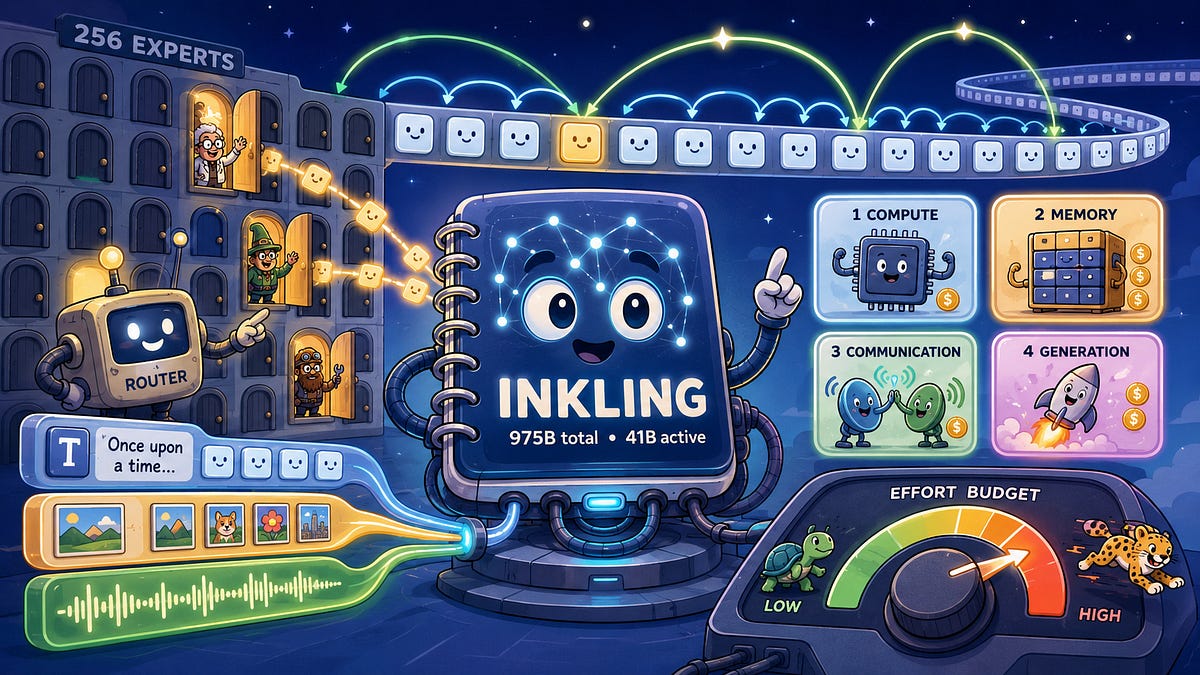
Mira Murati spent two years building something new after leaving OpenAI, finally revealing it to the public last week.Inkling, the first model from Murati’s Thinking Machines Lab, is also the best open-source model trained from scratch by a Western lab.Western labs have been losing the open-source race—Mistral's April release landed against a leaderboard dominated by Alibaba’s Qwen, Z.ai’s GLM, and Moonshot AI’s Kimi. Nvidia’s Nemotron, the lone Western model on the leaderboard, is far from being considered “state of the art.” Inkling arrives with no regional strings and full weights on Hugging Face under Apache 2.0.The architecture is a mixture-of-experts model: 975 billion total parameters, 41 billion active at inference. It reads text, images, and audio, supports a 1-million-token context window, and was pretrained on 45 trillion tokens. (Parameters are all the dials a model can handle while tokens represent the basic unit of information an AI can process.)The bottom line is: You're not running this locally—not even close.The clearest win is agentic tool use. MCP Atlas—which measures how reliably an agent completes real-world tasks through the Model Context Protocol standard, scored as percentage of tasks completed—gives Inkling 74.1%, nearly 30 points above Nvidia's Nemotron 3 Ultra. On SWE-Bench Verified, a test of autonomous GitHub bug fixing scored as percentage of issues resolved, it posts 77.6%—ahead of Nemotron's 70.7%.Source: Thinking MachinesIt's on OpenRouter at $1 per million input tokens and $4.05 per million output tokens. Any Hermes or OpenClaw setup that routes through OpenRouter can swap it in without extra configuration—its MCP Atlas score makes it a solid pick for agentic workflows.For raw coding performance per dollar, Chinese models still have the edge.Testing the ModelBenchmarks are one thing. Actually sitting with the model is another. We ran Inkling through different tasks to see how it would respond if the average Joe decides to use it. This is where it holds up—but also where it disappoints.One good thing to notice, even via Thinking Machine’s own interface, the model claims to be fully private. This matters a lot.CodingThis is what most people actually care about, so let’s start here. On complex prompts, Inkling tends to fail—our most demanding test produced nothing that ran. Step down in complexity and a different picture emerges, though not an entirely flattering one.We used a long, detailed prompt to create a shooter in which zombies are shot with keystrokes. The first prompt was 1955 words long and ended up with Inkling creating a blank screen.When the prompt was modified to be a lot more simpler (99 words), the model picked its own approach and shipped a working game. "Working" is doing a lot of heavy lifting there.Monsters came out as rectangles and spheres. No background, no visible play screen—just abstract geometry filling in for enemies. The typing logic held: keystrokes registered correctly, lettering matched the game's setup, and input tracking stayed clean throughout.What was unexpected was the movement. Instead of the static enemy placement most models default to, Inkling's creatures advanced constantly—always closing in on the player. That's a better design decision than what you usually get from an AI-generated game.Enemy spawning was supposed to arrive in waves. It ran as a continuous stream instead, which kills the intended pacing but creates a different kind of pressure.Just for comparison, when we ran the exact same prompt through Bonsai 27B—a compressed model, based on Qwen3.6, that fits in 3.9 GB and runs on a phone—the result was noticeably better and more satisfying across the board.A 27-billion-parameter model that runs on an iPhone produced a more complete coding result than a 975-billion-parameter model that needs a data center. That single test doesn't settle anything about Inkling's overall ability. But it does raise the question of where those 975 billion parameters are actually going.The game created by Inkling is available for testing here