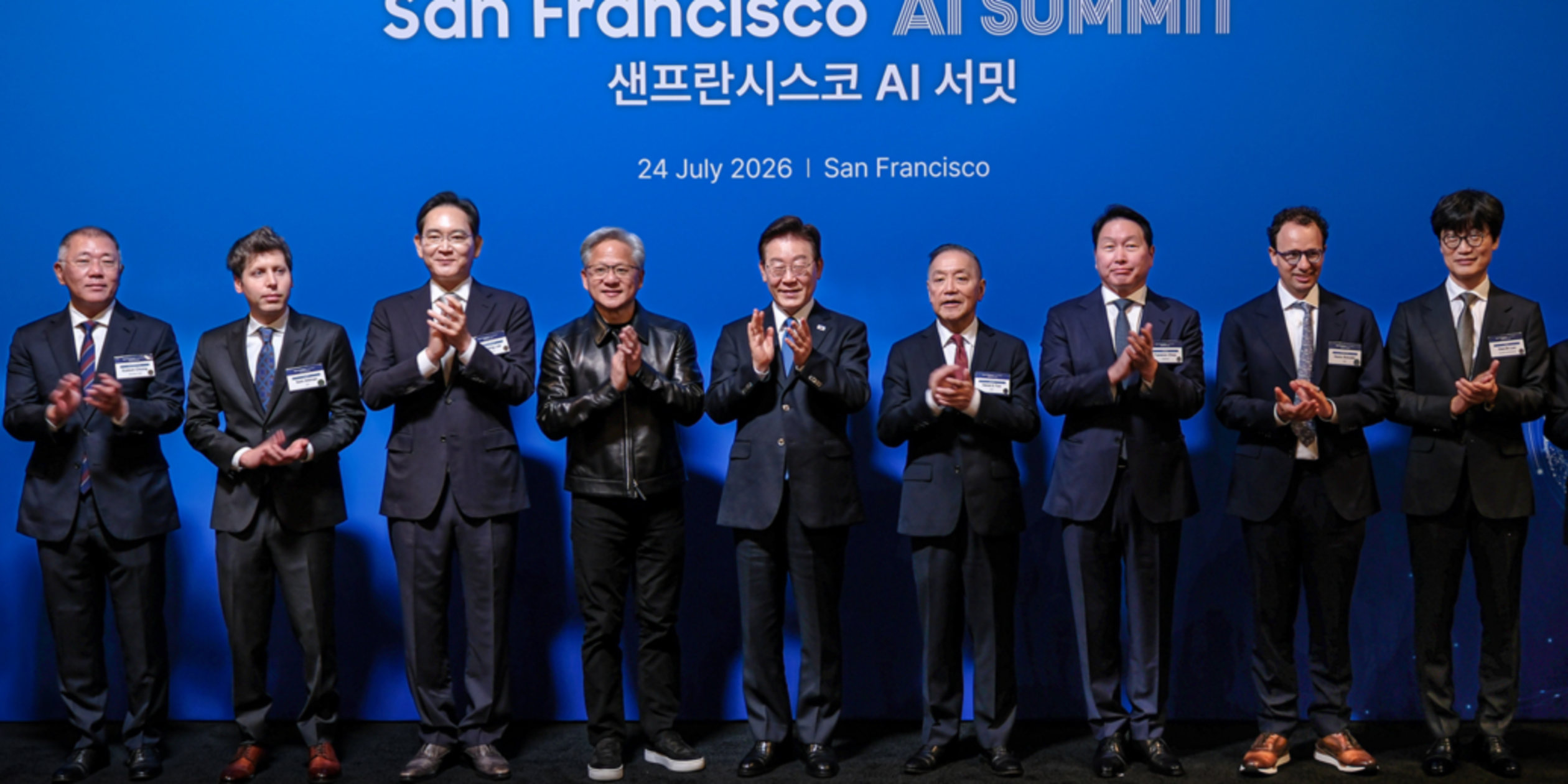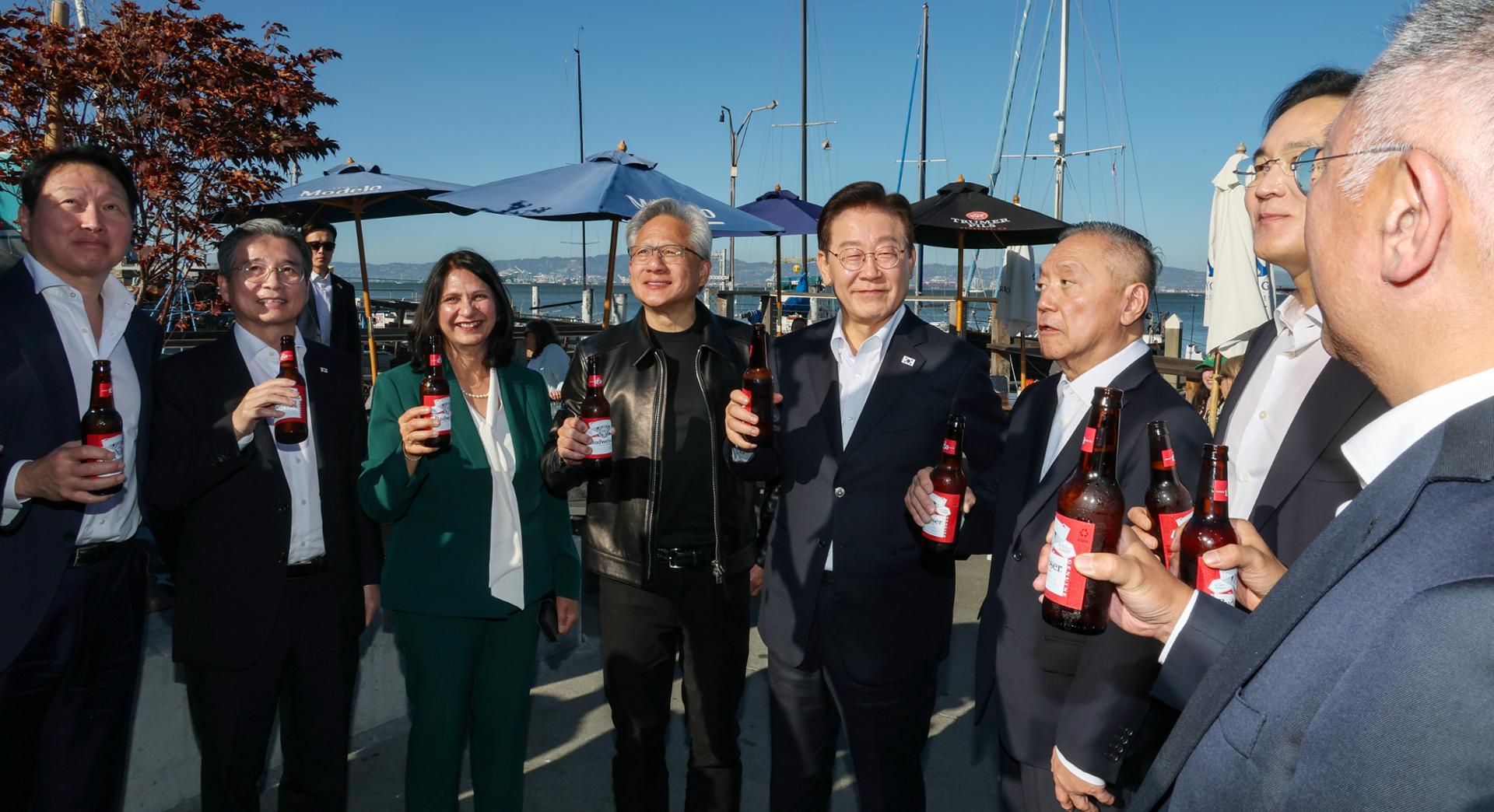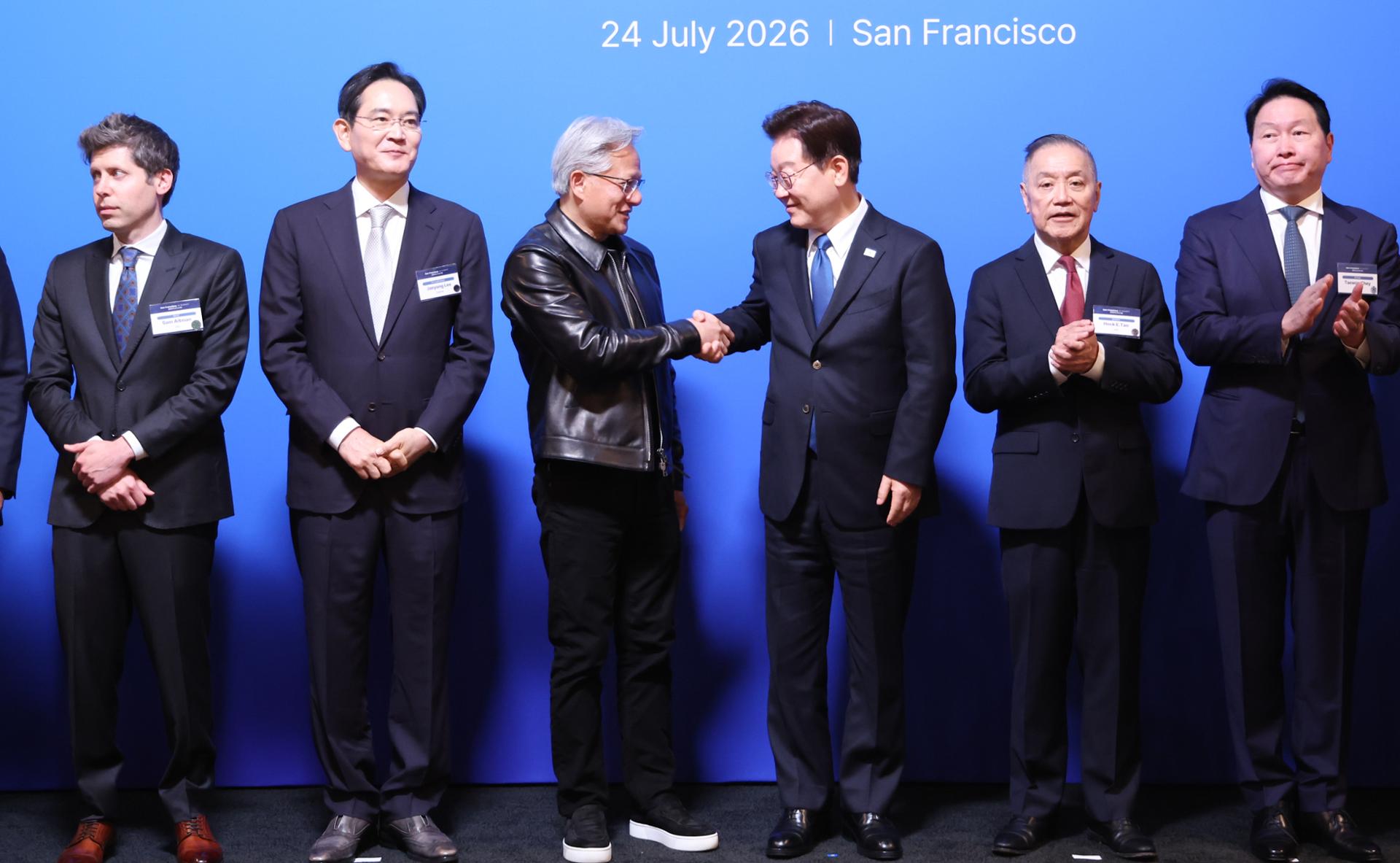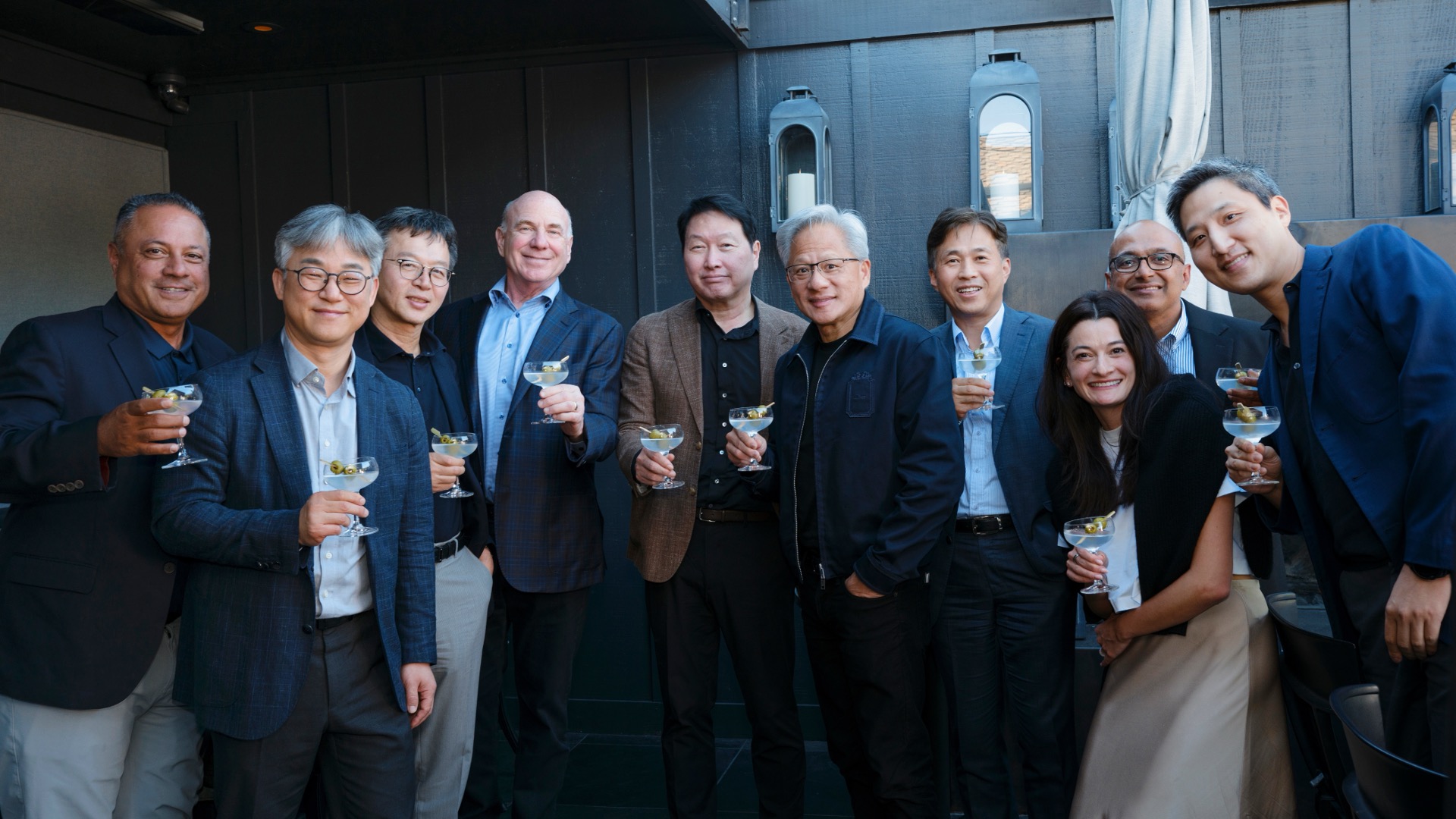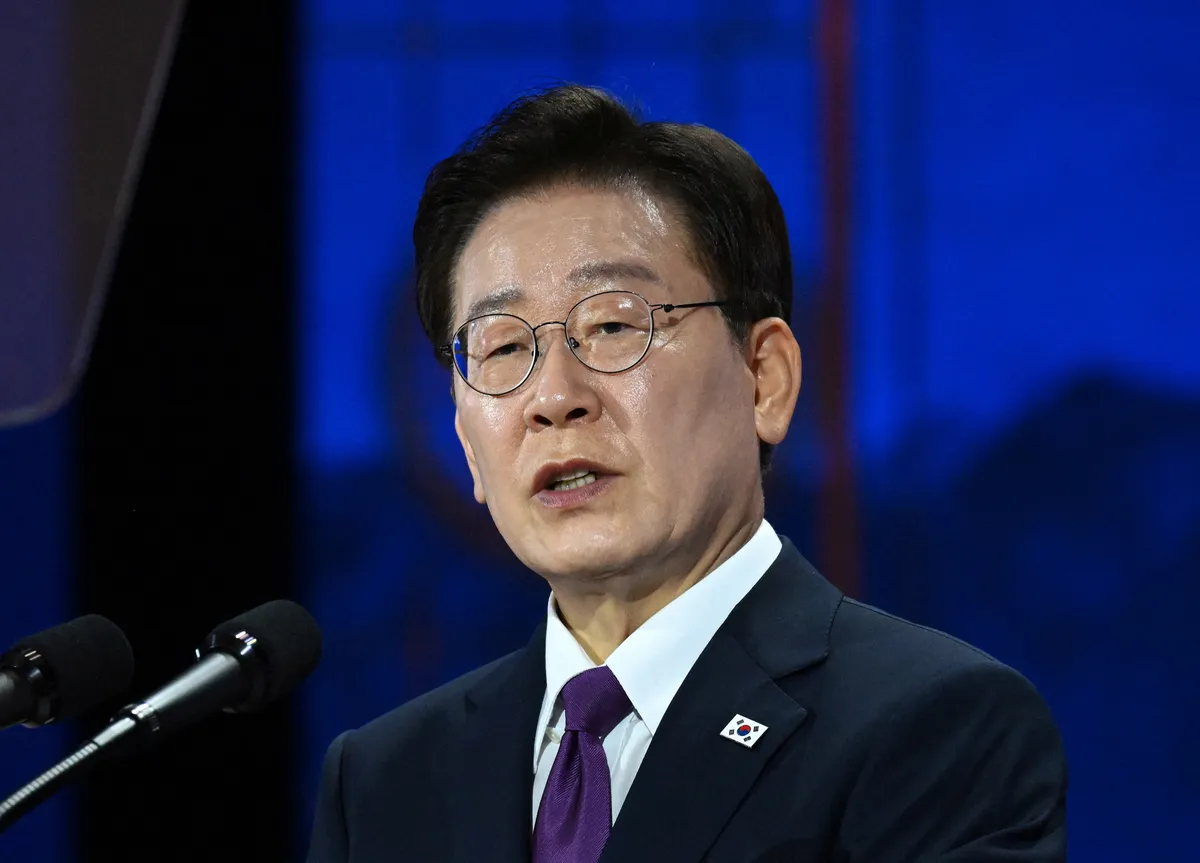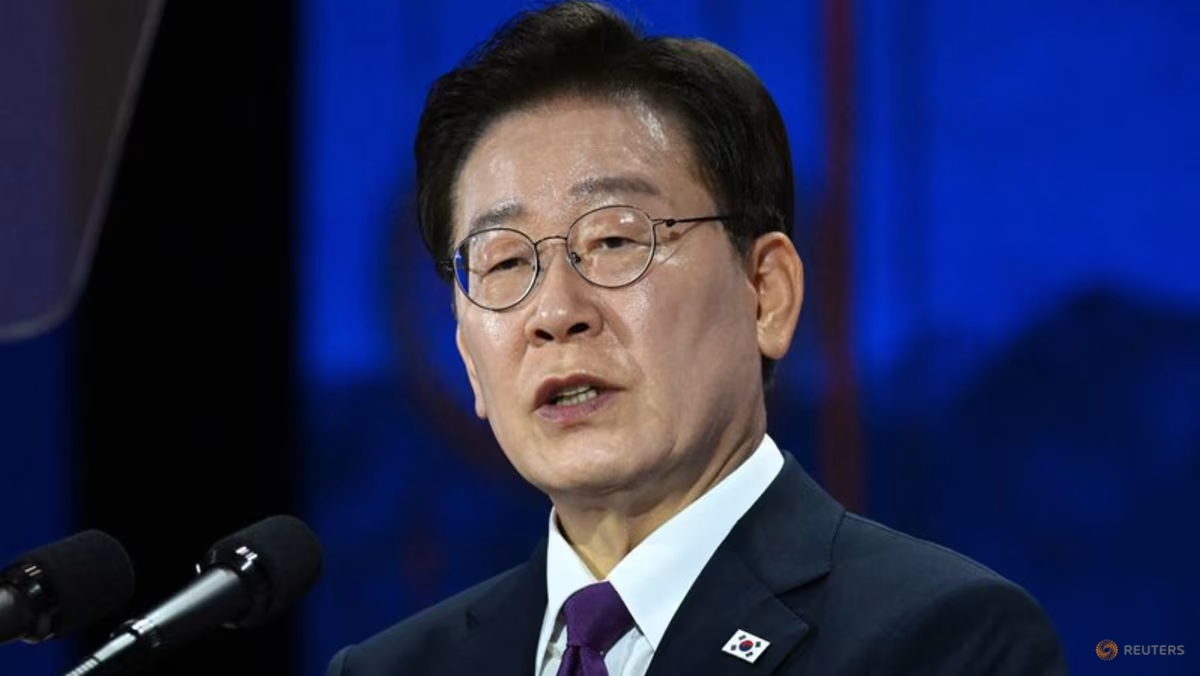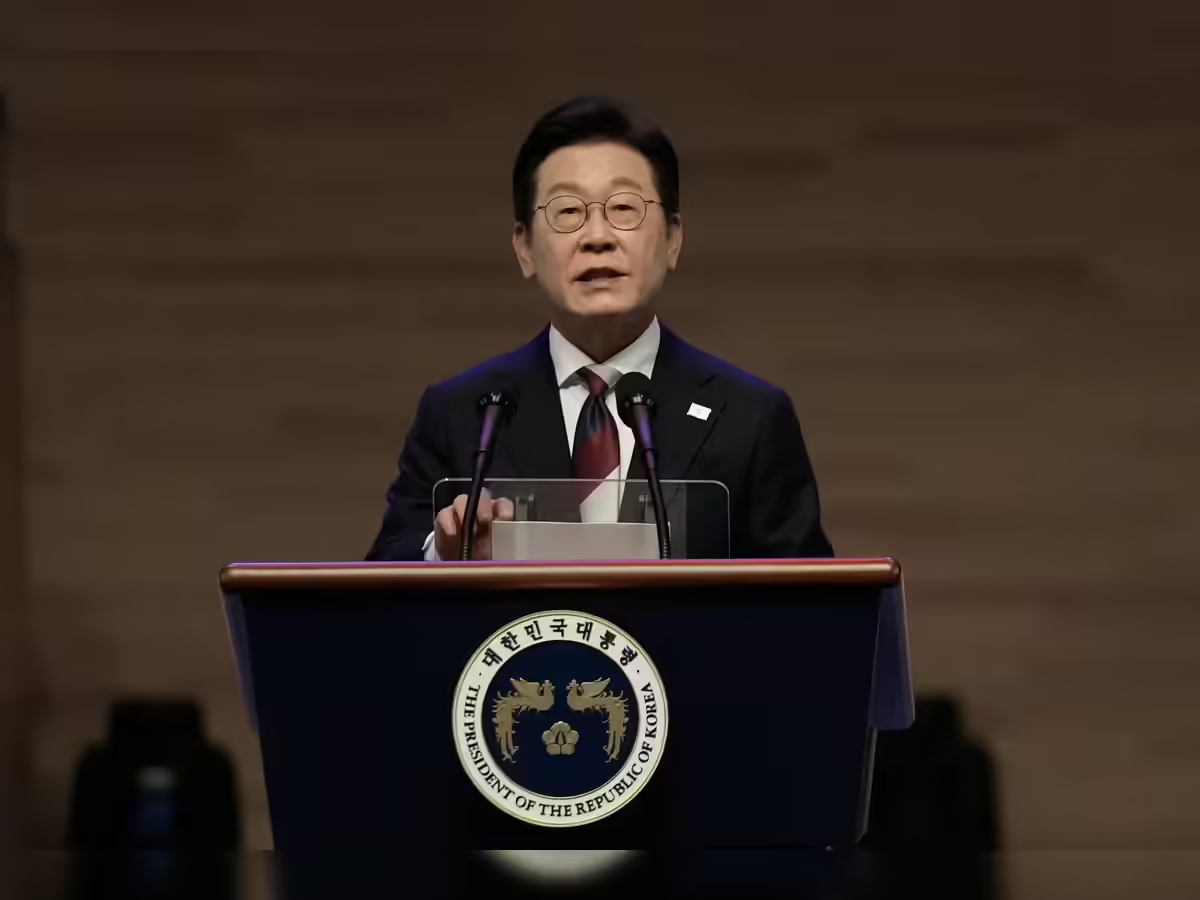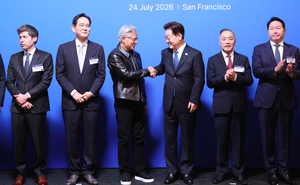
Partnerships with Broadcom, Nvidia and other US tech leaders underscore Seoul's ambition to become global AI infrastructure hub President Lee Jae Myung (center right) shakes hands with Nvidia CEO Jensen Huang (center left) during the San Francisco AI Summit at The Midway in San Francisco on Thursday. Also pictured are (from left) OpenAI CEO Sam Altman, Samsung Electronics Chairman Lee Jae-yong, Broadcom CEO Hock Tan and SK Group Chairman Chey Tae-won. (Yonhap) South Korea moved to cement its role in the global artificial intelligence supply chain Friday as Samsung Electronics and SK Group unveiled massive AI infrastructure partnerships with leading US technology companies under President Lee Jae Myung's "San Francisco AI Declaration."The initiatives, announced at the San Francisco AI Summit, form part of nearly $950 billion (about 1,390 trillion won) in planned cooperation spanning semiconductors, AI infrastructure, robotics and autonomous driving. The projects include AI data centers backed by about 5 gigawatts of power capacity and computing infrastructure equivalent to 2 million GPUs.The summit brought together Samsung Electronics Chairman Lee Jae-yong, SK Group Chairman Chey Tae-won, Hyundai Motor Group Executive Chair Chung Euisun, Naver Chair Lee Hae-jin, Nvidia CEO Jensen Huang, Broadcom CEO Hock Tan, OpenAI CEO Sam Altman and Anthropic CEO Dario Amodei.Samsung deepens AI chip alliance with BroadcomSamsung signed a strategic agreement with Broadcom to expand cooperation across memory, foundry and advanced packaging, leveraging what it describes as the industry's only integrated AI semiconductor manufacturing platform.The companies plan to pursue more than $200 billion in cooperation through 2030.Samsung will supply next-generation memory, including HBM4 and HBM4E, to support Broadcom's AI accelerators while applying its 2-nanometer foundry process and advanced packaging technologies to future networking and AI chips.The partnership combines Broadcom's strength in custom AI accelerators with Samsung's semiconductor manufacturing capabilities as hyperscale cloud providers increasingly develop their own AI chips."Integrated semiconductor solutions combining memory, logic and advanced packaging will be essential in the AI era," Samsung Device Solutions chief Jun Young-hyun said.SK expands Nvidia-led AI infrastructure pushSK Group announced more than $500 billion in planned AI infrastructure cooperation with Nvidia, centered on building Korea's next-generation AI computing ecosystem.SK Telecom plans to develop up to 2 gigawatts of AI factories using Nvidia's next-generation GPU platform and AI Factory architecture beginning in 2027, while SK hynix will deepen its long-term partnership with Nvidia to jointly develop and optimize next-generation HBM products.SK hynix separately agreed to pursue long-term AI memory supply cooperation with Microsoft for future data centers, while SK Telecom signed an agreement with Anthropic to cooperate on gigawatt-scale AI data centers in Korea. The company also agreed with Amazon Web Services to expand collaboration beyond their joint AI data center project in Ulsan."The competitiveness of the AI era depends not only on using AI well, but on creating more intelligence," SK Chairman Chey Tae-won said. "Together with Nvidia, we aim to build world-class AI factories and help Korea become a global AI hub."Beyond AI modelsThe agreements reflect a broader shift in the global AI competition, from developing foundation models to securing the semiconductors, computing power, energy and manufacturing capacity needed to deploy them at scale.Industry officials say Korea's dominance in high-bandwidth memory chips and growing AI infrastructure investment have made it an increasingly important partner for global technology companies.“The US visit and AI Summit were significant because they brought the Korean government and companies face to face with key players in the global AI ecosystem, creating concrete opportunities for cooperation,” an industry official said.“As AI competition expands beyond individual companies into a national race for industrial competitiveness and securing supply chains, the government’s role in connecting Korean chipmakers with global tech companies and opening new business opportunities for the private sector will become increasingly important.”
Samsung, SK cement Korea's AI supply-chain role
South Korea moved to cement its role in the global artificial intelligence supply chain Friday as Samsung Electronics and SK Group unveiled massive AI infrastru
TL;DRAI
Samsung e SK Group annunciano partnership da quasi $1T con Nvidia, Broadcom, Anthropic, AWS e Microsoft per semiconduttori AI (HBM4/4E), data center e foundry 2nm. La competizione AI globale si sposta dal software al controllo della supply chain: chi domina HBM memory, manufacturing nanometrica e gigawatt-scale capacity vince.
617 words~3 min read