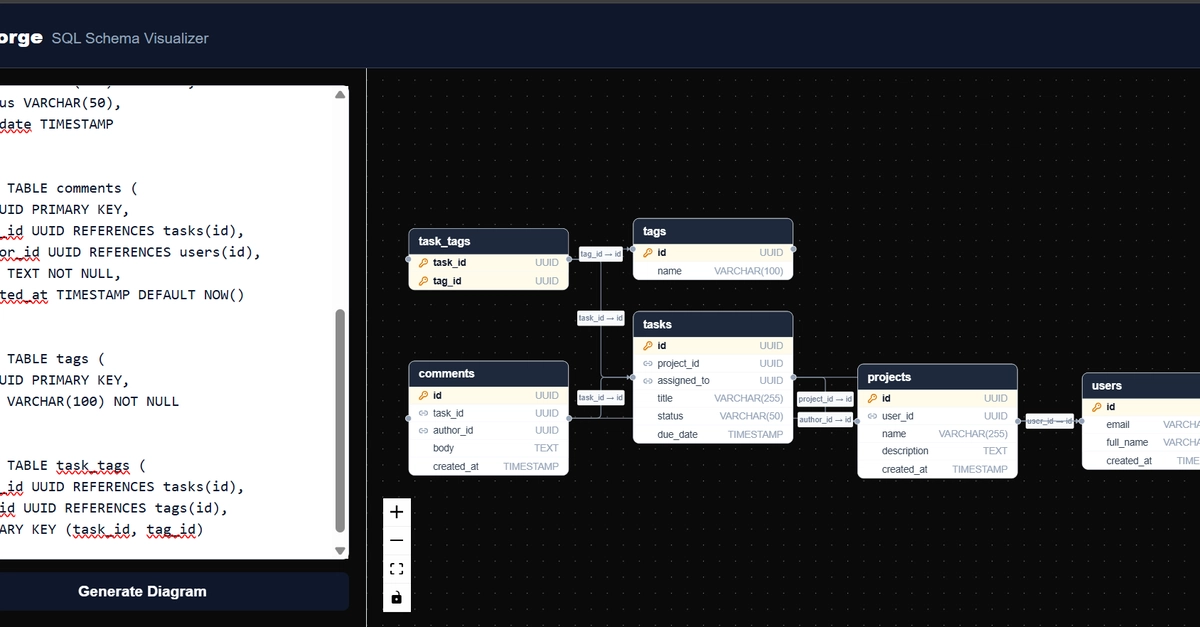
Disclosure: I build Schemity, a desktop ERD tool - this post is from our blog and uses it for the examples.
TL;DR: Lucidchart draws entity relationship diagrams on a general-purpose canvas, so the schema has to be carried in by hand: run a query, export a CSV, upload it, then drag tables onto the canvas one at a time. Schemity is the offline desktop alternative that connects to PostgreSQL, Supabase, MySQL, MariaDB, SQL Server or SQLite directly, reverse engineers the whole schema with its relationships intact, and stores every diagram as a plain JSON file in your Git repo for $129 once.
If you want an ERD tool that reads your database instead of a file you exported from it, Lucidchart is the wrong shape of tool and Schemity is a direct answer: a native desktop app that opens a real connection, pulls the schema, and draws the diagram with foreign keys already wired. Lucidchart can absolutely render an ERD - but every path into it starts with you doing the extraction by hand.
That is not a bug in Lucidchart. It is what happens when a database diagram is one shape library inside a general-purpose diagramming canvas that also draws org charts, flowcharts, and network topologies. The canvas is excellent. It just does not know what a foreign key is until you tell it, and it has no way to go and ask.