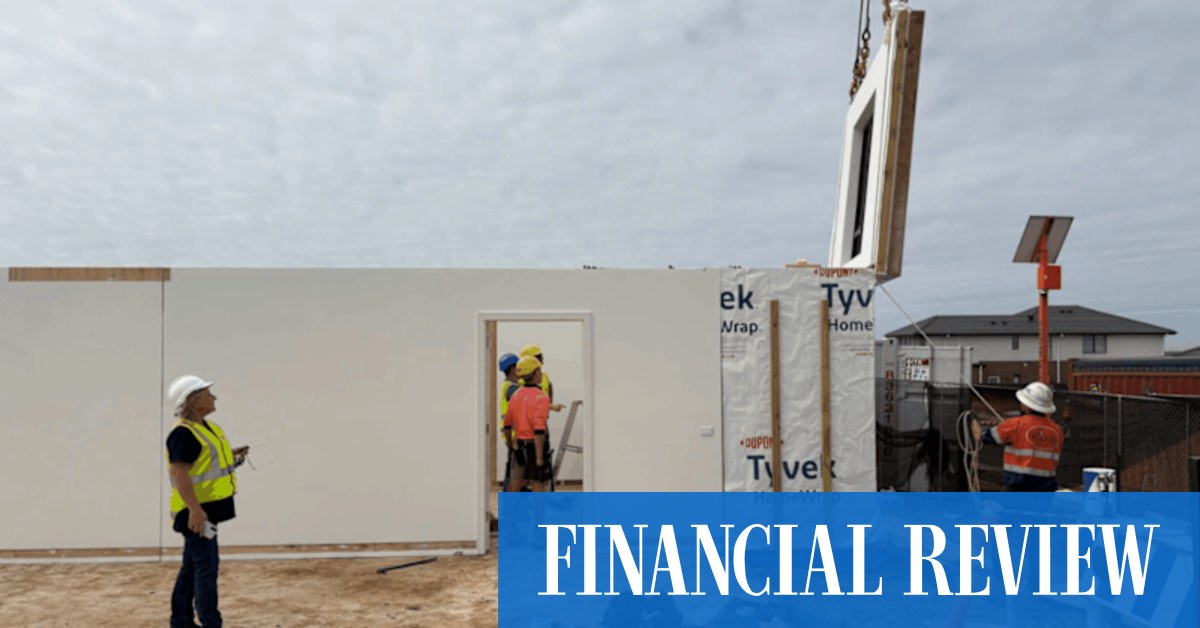
Australia could build more homes, in a radically faster way, to solve its housing crisis, a new report argues.Putting the ambitious national strategy into action would also help Australia to rebuild its industrial base in a once-in-a-generation opportunity to reverse decades of deindustrialisation, it says.The John Curtin Research Centre (JCRC), a Labor-aligned think tank, has released a new report, Manufacturing Homes: A National Strategy for Solving Australia's Housing Crisis.Federal Housing Minister Clare O'Neil has launched the report at Labor's National Conference in Adelaide today.The report warns that Australia has become the least manufacturing self-sufficient country in the Organisation for Economic Co-operation and Development (OECD), which has left critical sectors of the economy, including housing, exposed to supply chain shocks and cost volatility.But it says if policymakers made Australian manufactured housing (AMH) a central pillar of Australia's housing system, it would offer Australia a pathway to re-industrialise while solving its housing crisis at the same time.It says Australia's housing crisis is a consequence of how slowly and inefficiently we build houses, and the system needs overhauling."Australia's housing crisis is not only a shortage of dwellings. It is a crisis in how Australia builds," the report argues."While right-populists blame immigrants for the current housing shortage, the fact is Australia saw far higher immigration and population growth in the 1950s and 1960s — during which housing was cheap and abundant."One of the reasons Australia was able to deliver abundant and affordable housing throughout the biggest population boom in our history was because we used prefab housing and had a high-productivity housing sector."The current housing shortage is fundamentally a productivity problem," it says.A new industrial strategy and a solution to the housing crisisThe 84-page report was written by the JCRC's chief economist, Lachlan Kerwood-McCall, and executive director, Nick Dyrenfurth. It says manufactured housing, delivered with Modern Methods of Construction (MMC) and industrialised building systems, would provide an Australian-made, productivity-driven pathway out of our housing crisis.At the moment, only around 5 to 8 per cent of total construction activity in Australia incorporates modular or manufactured methods, compared with vastly higher adoption rates in countries like Sweden, Germany, Japan and Singapore.And to help Australia's MMC sector transition from early-stage adoption to a scaling phase, it will require collaboration between government, industry, and finance, the report says.It says the Australian government should set a 10-year target of lifting the Australian manufactured housing (AMH) industry's share of total new housing construction to 35 per cent by 2036-37, with a longer-term target of 50 per cent. "Achieving such a share would position AMH as a mainstream delivery model across multiple housing typologies and procurement streams," it says.See the graph below from the report.It also argues that by making manufactured housing a central pillar of Australia's housing system, it could be used as an industrial strategy to rebuild Australia's manufacturing industry after decades of deindustrialisation."The closure of Australia's automotive industry and the decline of complex manufacturing removed the very industrial ecosystems, precision engineering, systems integration, advanced materials, that typically underpin modern manufactured housing sectors," it says."[But] the pandemic, geopolitical tensions, and supply chain disruptions have exposed the risks of over-reliance on offshore production."Reindustrialisation is ultimately a choice about the kind of country Australia wants to be," it says.Clare O'Neil launched the John Curtin Research Centre's manufactured housing report at Labor's National Conference on Saturday. (ABC News: Callum Flinn)Recommendations to achieve a home building revolutionThe report makes 12 recommendations, structured around five key pillars.A National Strategy for Solving Australia's Housing Crisis, by Lachlan Kerwood-McCall and Nick Dyrenfurth (July 2026)First, it says governments should help the MMC and AMH sector create economies of scale."Unlike traditional on-site methods of construction, where higher output involves higher costs and requires higher prices, manufactured housing becomes cheaper the more we build," it says."Public sector demand does not push up prices and crowd out private sector demand; it pushes down prices and crowds in private sector demand. "Aligning government procurement and social housing policies to the MMC industry lowers costs and prices for private sector buyers, as well as getting Housing Accord and Housing Australia Future Fund (HAFF) home-building targets back on track thanks to higher productivity."It says policy levers could include procurement, HAFF reform, and reforms to Defence Housing Australia.Second, it says an Australian manufactured housing industry should not be overly dependent on imports.Rather, it says, it could be underpinned by Australia's substantial timber plantations, wood processing and emerging engineered wood product manufacturing sectors."Reforms must ensure that the domestic industry can rapidly scale up to meet substantially higher demand long-term without supply-side bottlenecks and cost pressures emerging," it says."Policy levers include local content requirements and reforms to the National Reconstruction Fund."Third, it says Australia's entire housing system has been designed and built around the assumption that houses are built on-site, but that is extremely costly and inefficient.It says a change of national building culture will require system-wide change using policy levers like planning, certification, and finance.Fourth, it says an AMH industry would need an abundant supply of young workers to prevent skills and labour shortages."Policy levers include expanding and building on trade and apprentice pathways and aligning the TAFE, VET and broader training system and the Australian government’s Key Apprenticeships Program (particularly the Housing Construction Apprenticeship stream) with MMC industry requirements," it says.Fifth, it says demo projects and regional manufacturing hubs would be essential to prove the model at scale, build public confidence, and anchor industrial capability in the regions that stand to benefit most.
Factory-built homes could help Australia reindustrialise, report says
Factory-built homes could solve Australia's housing crisis and drive reindustrialisation, a Labor think tank report says.
909 words~4 min read