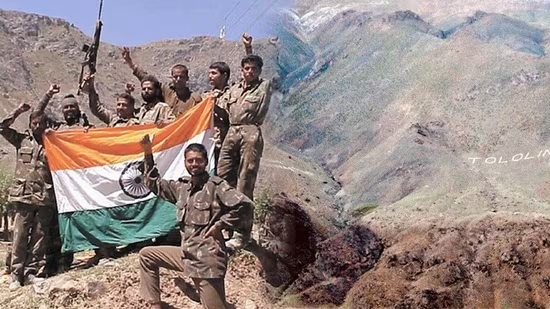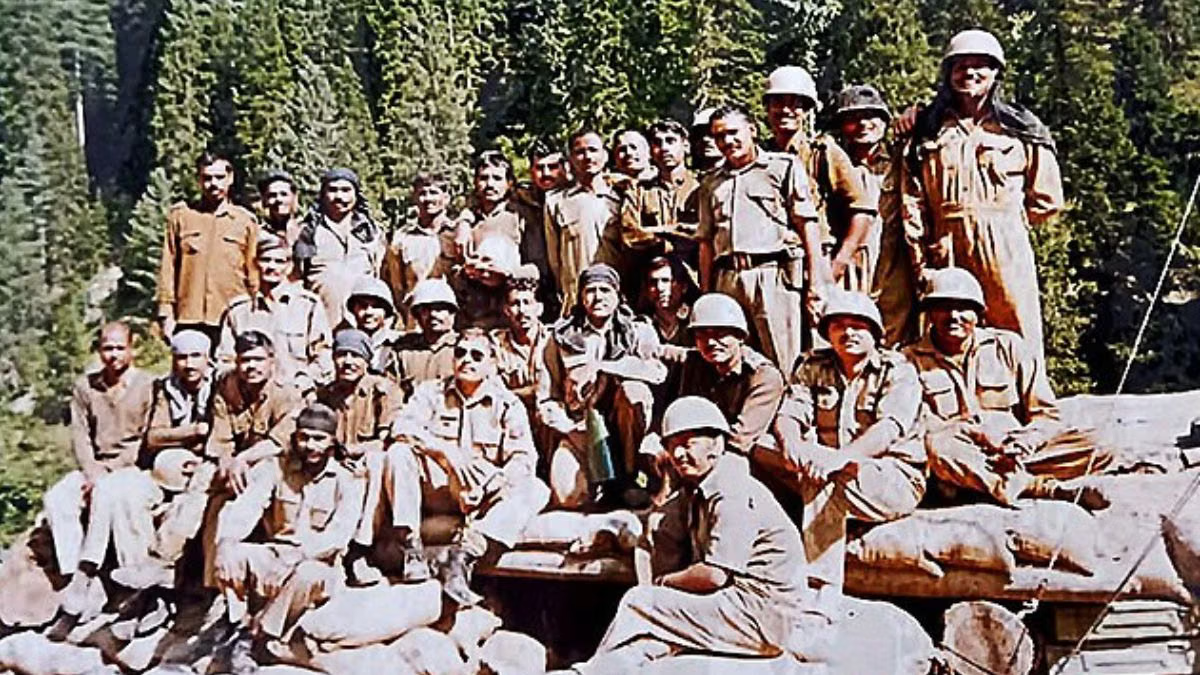
That remains Kargil’s unfinished lesson, which I will turn to in a bit, but first let’s revisit the valorous summer of 1999.Victory with restraint
India entered the conflict with Pakistan barely a year after the Pokhran-II nuclear tests. American sanctions under the Glenn Amendment prohibited foreign military sales, financing and licences for items on the US Munitions List, while restricting certain dual-use exports.
While India was not without friends or equipment, the episode exposed how quickly peacetime dependencies turned into wartime vulnerabilities.The solution came through improvisation and diversified partnerships. Star-performer Swedish Bofors 155-mm guns delivered devastating fire at extreme elevations. South Africa’s Denel Corporation provided thousands of 155 mm shells under emergency procurement. In the air, French Mirage-2000Hs were rapidly upgraded with Israeli-made Litening targeting pods and American Paveway-II laser-guided bombs. By June 12, they were ready for precision operations and on June 24, Mirages struck Pakistani command-and-control bunkers on Tiger Hill. Operation Safed Sagar became an unprecedented air operation that re-wrote high altitude air warfare in the subcontinent.Benjamin Lambeth, the American air-power scholar, later called Kargil a “milestone event in Indian military history” and a prototype for India’s likely future combat challenges. In the years after Kargil, dozens of books and hundreds of analyses have drawn lessons from moving accounts.Indian diplomacy played its part, while reinforcing military restraint. India chose not to cross the Line of Control (LoC) even when that made operations harder. Pakistan’s attempt to disguise regular troops as irregulars eventually collapsed. When Nawaz Sharif reached Washington on July 4, then US President Bill Clinton insisted that Pakistan unconditionally withdraw its forces to its side of the LoC. American security expert Bruce Riedel, present in the room, recalled that Sharif “very reluctantly agreed to withdraw.” Kargil was won on the heights, but India’s conduct ensured Pakistan also lost the diplomatic face. As luck would have it, the two countries embarked on different political reckonings. India held general elections, prime minister Atal Bihari Vajpayee returned for a third term and publicly investigated the failures that led to the war. Whereas in Pakistan, the blame game between prime minister Nawaz Sharif and then army chief Pervez Musharraf culminated in the famous military coup of October 12, 1999.India proved its strength not by claiming infallibility, but by examining error—a lesson that remains relevant to this day.