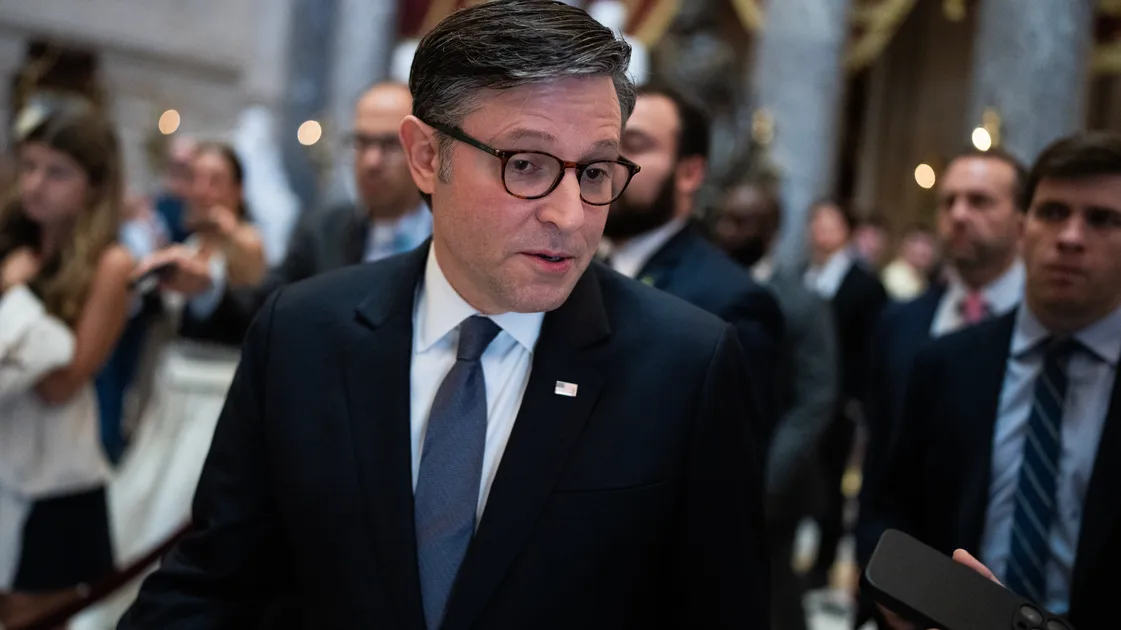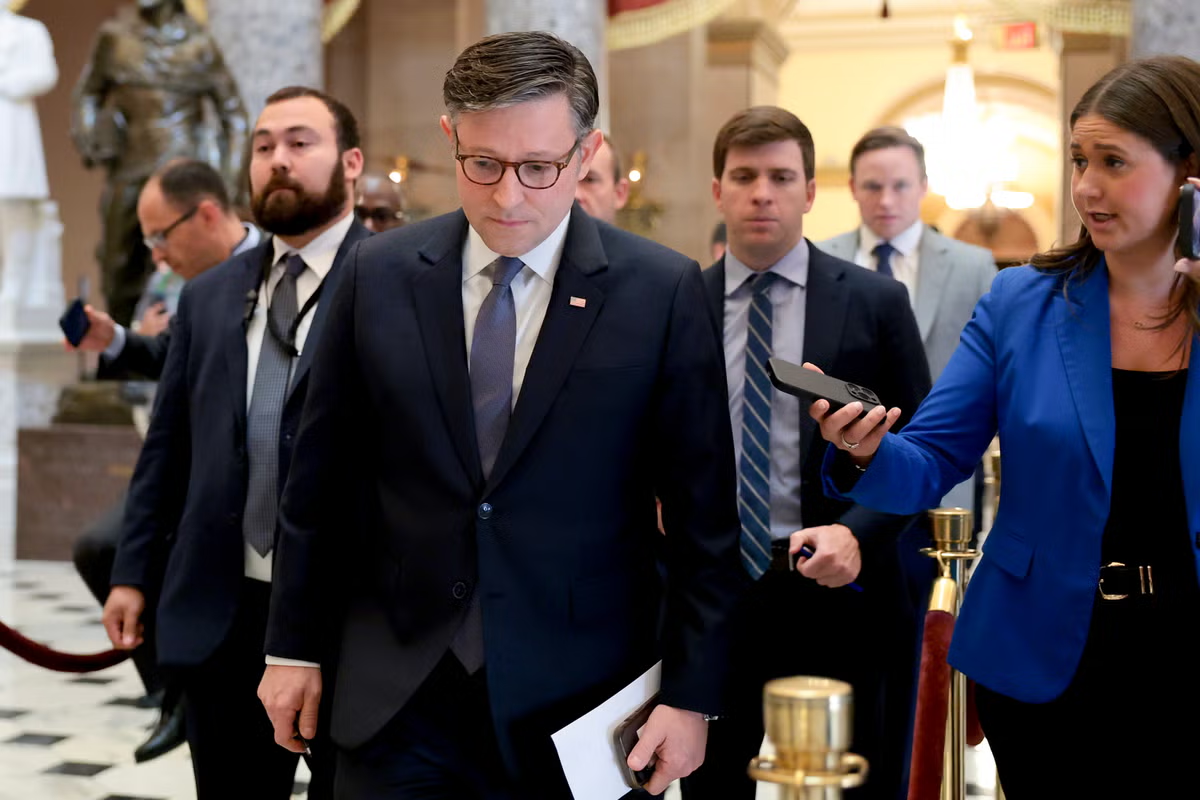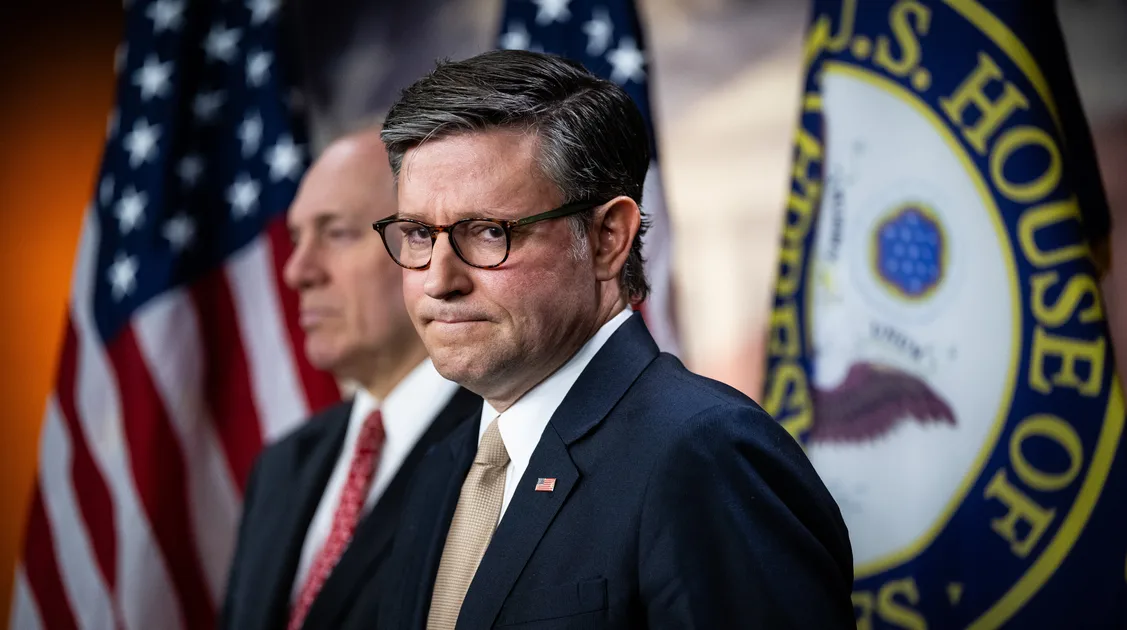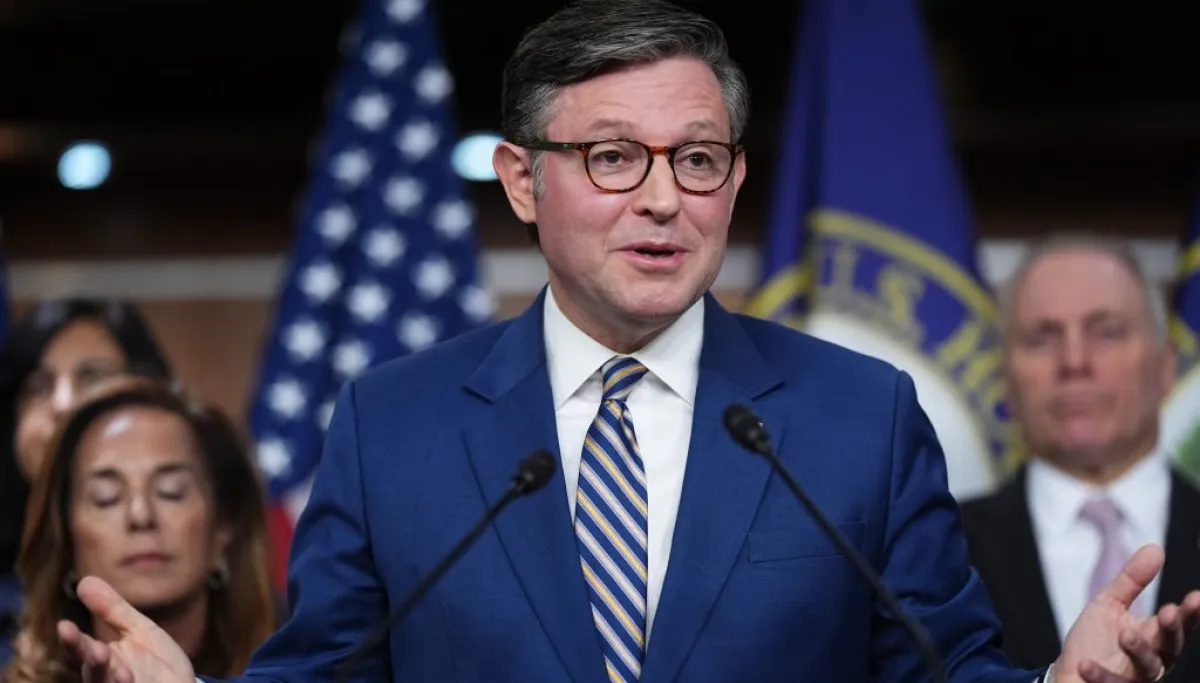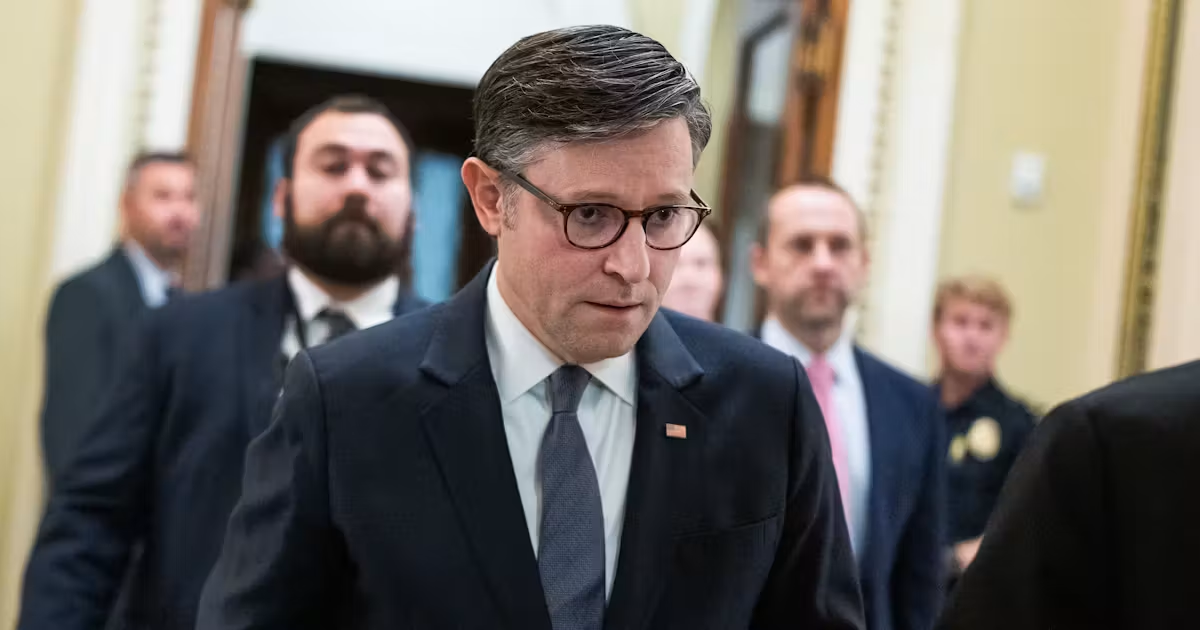
House Speaker Mike Johnson is fed up with the chaos boiling in his own caucus.The Louisiana lawmaker invited a handful of Republicans into his “ceremonial room” last week to salvage a bipartisan veterans bill, a party priority that had been threatened by a few unruly Republicans.Representative Anna Paulina Luna was in that room. She had opposed the massive military benefits package, arguing against veterans’ pay bumps over concerns that it could cut down disability claims. She started yelling at Iowa Representative Zach Nunn, who supported the measure, before turning her ire toward Johnson.And that’s when the soft-spoken speaker lost it.“I’m sick of this shit,” Johnson snapped, according to multiple sources in the room that spoke to NOTUS.The outburst was out of character for Johnson, who proceeded not only to apologize to Luna but also kneeled before the elementary-school-age son of Representative Gabe Evans to express his regret for cursing in front of him. Ultimately, Johnson was forced to return to a strategy that has practically become normal due to the seemingly insurmountable disagreements from a small faction within his party: He pulled the bill.A small band of conservatives have repeatedly disrupted the Republican agenda, refusing to be team players and making governing impossible, according to several lawmakers that spoke with NOTUS.“It creates anger and resentment,” retiring Nebraska Representative Don Bacon told the digital news outlet. “We want to get things done, and dysfunction’s not good.”A collection of far-right lawmakers have learned that they can effectively hold their votes on important measures hostage in order to get what they want—a tactic that has not only worked, as Johnson placates them to win over his party’s razor-thin majority, but has also endlessly frustrated other Republicans.“The Republican conference is a diverse gathering of people, some of whom are really effective at getting things done and others who are more interested in knocking things down,” South Dakota Representative Dusty Johnson told NOTUS.But the disruptive blueprint is nothing new—at least not in recent history. In 2023, a band of eight Republicans—led by disgraced former Florida Representative Matt Gaetz—used the same strategy to oust Kevin McCarthy after the former House speaker failed to rein the group in. Johnson had better watch out that his party doesn’t do the same.Read more about Johnson:President Trump’s justification for his latest round of tariffs has angered foreign leaders. The White House on Friday instituted tariffs between 10 and 12.5 percent on 60 countries around the world by citing Section 301 of the Trade Act of 1974, which allows import duties to be placed on countries that use forced labor. But U.S. trading partners have slammed the move, with Australian Trade Minister Don Farrell calling them “completely unjustified.”“We believe that amongst all of the countries in the world Australia does take the issue of slavery, modern slavery, seriously, and will continue to do that,” Farrell said.New Zealand Prime Minister Christopher Luxon called the tariffs “extremely disappointing,” and said that the U.S. did not have the evidence to say that his country uses slave labor.“Tariffs are not the way—they drive up costs and uncertainty for businesses,” he wrote in a post on X.European Union foreign policy chief Kaja Kallas took offense to the allegations of forced labor, saying that their labor laws are better for workers than those of the U.S. “If you compare our labor laws to the ones of the United States, I mean we have, people have paid vacations, we have very good conditions, labor conditions for our employees, so it’s not really grounded,” Kallas said.Japan’s Chief Cabinet Secretary Minoru Kihara said, “It is regrettable that the measure imposes tariffs on the grounds of non-existence of measures banning imports of goods made by forced labor, even though Japan’s industry and trade are in line with international rules.”It’s pretty clear that the Trump administration is simply trying to use any legal justification for its tariffs that will avoid being overturned by the courts this time, unlike the president’s last attempt. Forced labor is still a problem internationally, but Trump has not presented any specific evidence of any business in these 60 countries having a slavery problem. Editor’s Pick:The U.S. president is on the fritz over his inability to end the Iran war.Donald Trump was overheard roaring and cursing inside the Oval Office, “unleashing a series of expletives” while referring to Iran’s leadership as “scumbags” and “lunatics,” an insider told The Wall Street Journal late Thursday.The war that Trump initially claimed would last just a few weeks is now entering its fifth month, with no end in sight. That reality has haunted Trump, according to the Journal, as advisers fear that the conflict could consume the final years of his presidency.Trump effectively threw up his hands when the preliminary peace deal signed by both countries collapsed weeks ago, claiming that he couldn’t—and wouldn’t—negotiate with Tehran.“I don’t want to deal with them anymore,” Trump bitterly announced during a NATO summit presser in Ankara, Turkey, earlier this month. “As far as I’m concerned, it’s just a waste of time dealing with them.”At the time of the memorandum of understanding signing, Trump reportedly ignored his Republican allies who told him that Tehran would never stick to the terms of the deal, overeager to put the war behind him, according to a senior administration official that spoke with the Journal.Trump, apparently, is only now learning that he cannot run the White House “like a business,” and that U.S. foreign policy requires a finer touch than lording around the military’s pointy stick. In just his second term, Trump has displayed a penchant for abusing America’s might, attacking Yemen, Somalia, Syria, Iran, Iraq, Nigeria, and Venezuela. Earlier this week, he reportedly mulled intervening in another foreign conflict in Mali.The unending Iran war has deeply frustrated Trump, according to administration officials that spoke with the Journal. Trump has tried to find an off-ramp from the conflict in the months since he threatened to obliterate Iran’s “entire civilization,” but he has been repeatedly unsuccessful in doing so.Some of Trump’s advisers are reportedly concerned that the ongoing hostilities could harm Republican election odds in November, a failure that could transform his final two years in office. Trump pursued war against Iran following an unusual Situation Room meeting with Israeli Prime Minister Benjamin Netanyahu. Trump then went to war without congressional approval, and without formally addressing the American public regarding his intent.Americans, meanwhile, have suffered. The war has killed at least 18 U.S. service members and taken an enormous toll on daily life in the U.S., inflaming the cost of practically everything as shipping companies contend with rising oil prices.Read more about the war:The Department of Defense has changed the official number of U.S. military service members killed in the war with Iran from 18 to 14—and couldn’t explain why. Three military officials told The New York Times Thursday that one reason the death toll had been altered was because four of the deaths occurred last week, after President Donald Trump’s ceasefire fell apart. The Trump administration has previously tried to insist that there are two separate phases in the war effort.Meanwhile, Joel Valdez, the acting press secretary for the Pentagon, told the outlet that the change resulted from “temporary data disruptions” and would soon be fixed.The DOD has argued that it is bound by law to report on deaths, but not injuries. But here, the Pentagon’s shady actions highlight the startling lack of transparency as Trump continues to prosecute his wildly unpopular war with Iran. The Pentagon has been slow to release information about U.S. service members’ conditions, and has downplayed the extent of their injuries.The DOD also withheld information about three Iranian strikes last week that injured dozens of U.S. service members and damaged several helicopters, U.S. officials told the Times. Earlier this year, Defense Secretary Pete Hegseth referred to an Iranian drone strike on a makeshift tactical operations center in Kuwait as a “squirter.” But dozens of U.S. service members suffered from injuries including burns, shrapnel wounds, and brain trauma. The Pentagon, however, did not release information about how many were hurt in the strike, and U.S. Central Command initially claimed that just five were seriously wounded.Read more about the war:The Trump administration is taking over the Penn Station renaming process, with the Transportation Department revealing that a new name for New York City’s iconic transportation hub is a top priority.The New York Daily News reported Thursday that Transportation Secretary Sean Duffy sent a letter to multiple Senate committees outlining his department’s decision to “direct Amtrak to rename New York Penn Station.” While the new name has not been confirmed, Duffy suggested last August that “Trump Station” had “a nice ring to it.” And three months before that, Gothamist obtained redesign renderings of the station with Trump’s name on it, and gold flourishes everywhere.It’s no secret that Trump wants to see his name on as many stations and landmarks as possible before he goes. In February, he held infrastructure funding in New York hostage unless Democrats agreed to rename Penn Station and Washington, D.C.’s Dulles International Airport after him. Then there was the “Trump-Kennedy Center” saga, which ended in his name being removed from the cultural institution. And just this month, he got Florida’s Palm Beach International Airport named after him, as well.Read The TNR Blue Book, our new newsletter on the Democratic Party:
“Sick of This Sh*t”: Mike Johnson Snaps Over Republican Dysfunction
Johnson then immediately apologized for his outburst.
1,556 words~7 min read