Although basic metals and metal products had the largest outstanding bank credit of ₹5.22 lakh crore, the sector recorded a comparatively lower growth rate of 10.3 per cent
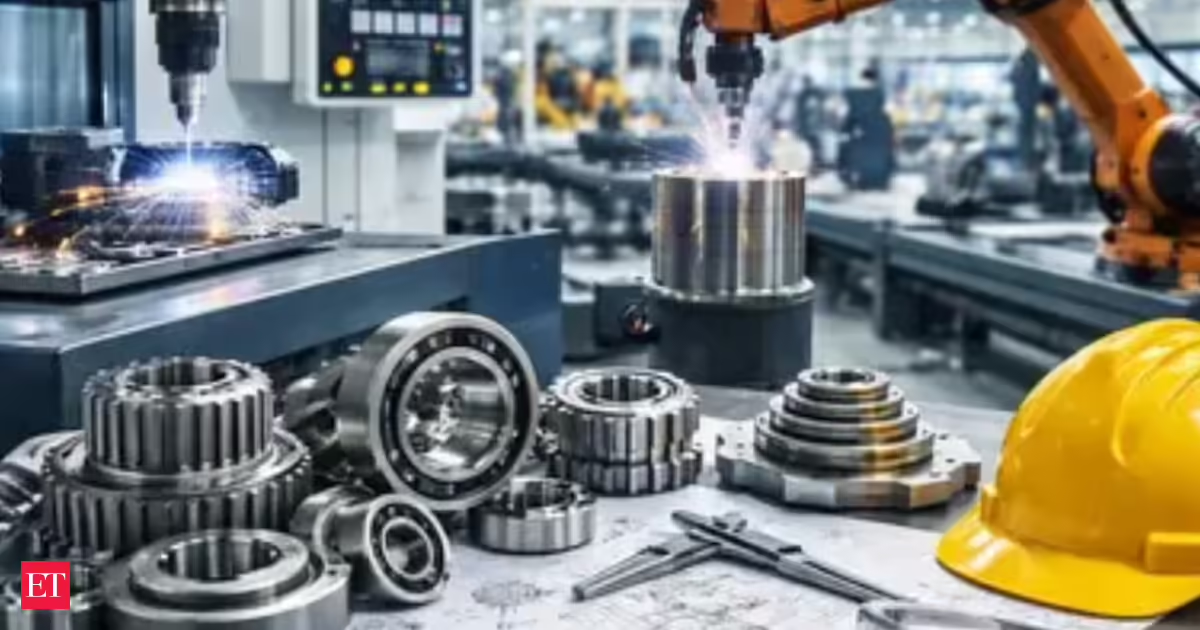
Engineering has recorded the fastest growth in industry-wise deployment of bank credit over the past three years, reflecting India’s infrastructure push and rising capital expenditure, according to the latest RBI monthly bulletin. Outstanding bank credit to the engineering sector stood at ₹3.24 lakh crore as of May 31, 2026, recording a 17.6 per cent compound annual growth rate (CAGR) over the past three years. This was followed by gems and jewellery (12.4 per cent), petroleum, coal products and nuclear fuels (11.5 per cent) and other industries (11.4 per cent).Although basic metals and metal products had the largest outstanding bank credit of ₹5.22 lakh crore, the sector recorded a comparatively lower growth rate of 10.3 per cent.“The engineering sector growth is driven by the massive government push on infrastructure spending towards developing a Viksit Bharat. Bank credit is aligned to this theme,” said Vivek Iyer, Partner and Financial Services Risk Leader, Grant Thornton Bharat.According to Madan Sabnavis, Chief Economist, Bank of Baroda, the trend reflects credit demand from industries, rather than banks actively directing lending. “It is essentially a case of demand for credit. The capital goods and engineering sector has performed well, and that performance is driving the demand for bank credit,” he said.The momentum is also visible across sub-industries. The ‘others’ category recorded the highest three-year credit growth at 18.6 per cent, followed by edible oils and vanaspati (15.5 per cent), electronics (14.1 per cent) and ports (13.9 per cent). However, experts mentioned that the ‘others’ category is largely a balancing item comprising industries that cannot be classified under specific sectors, making it difficult to draw meaningful conclusions from its growth.PLI schemeSabnavis attributed the rise in electronics lending to higher investment under the government’s Production Linked Incentive (PLI) scheme. “Electronics production has gone up with the incentive, leading to expansion plans and higher demand for credit, particularly in mobile phone manufacturing,” he said.Iyer added that rising consumption beyond metropolitan centres is also supporting lending in sectors such as electronics and edible oils. “Growth in these industries is primarily driven by increasing per capita incomes in India’s hinterlands,” he said.Looking ahead, both experts expect infrastructure-linked credit demand to remain resilient. While consumer-facing sectors could see uneven growth, domestic investment and stronger regional partnerships are likely to support continued lending momentum despite subdued global demand.Published on July 24, 2026