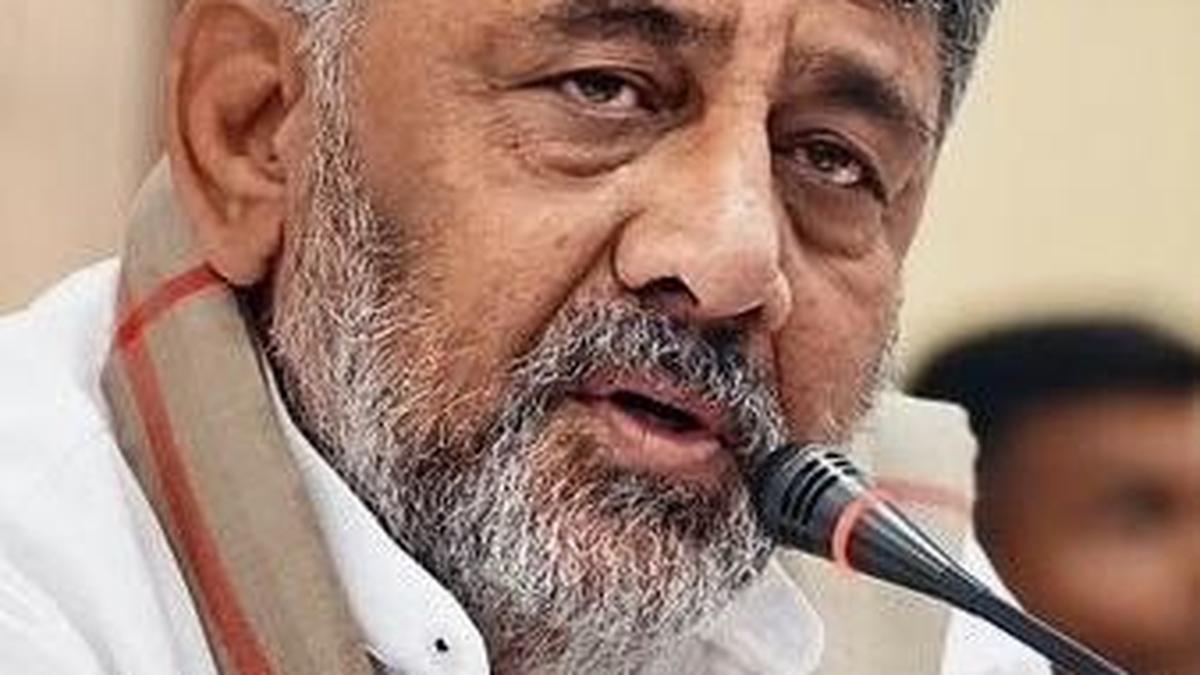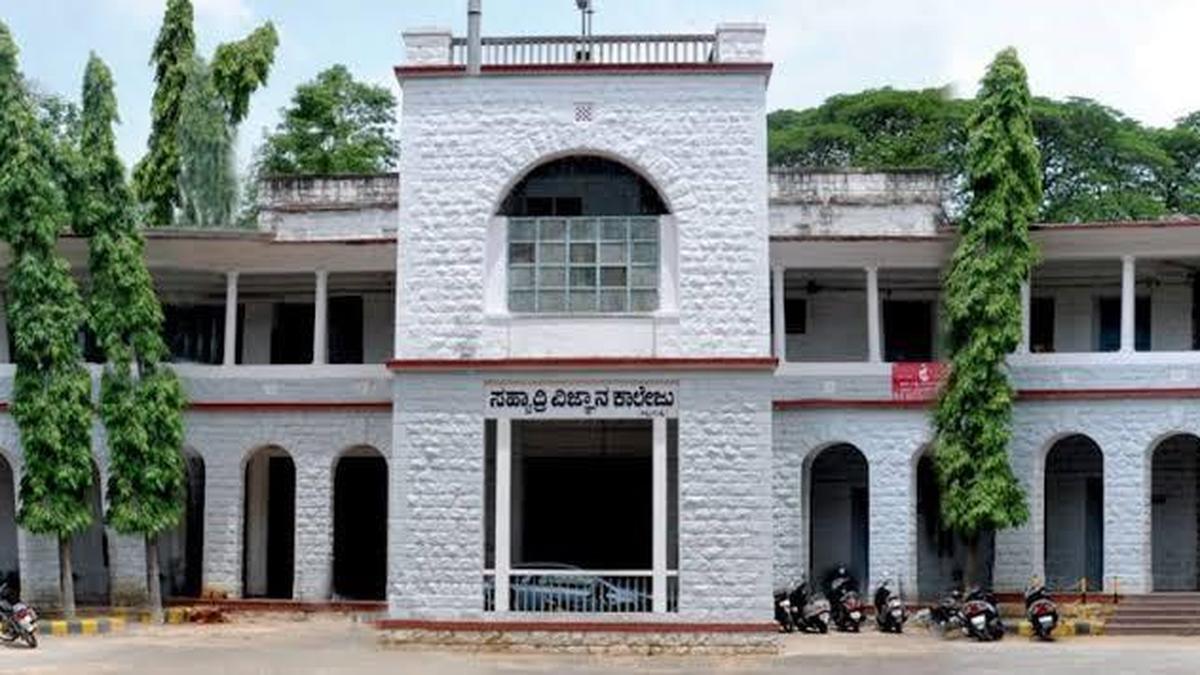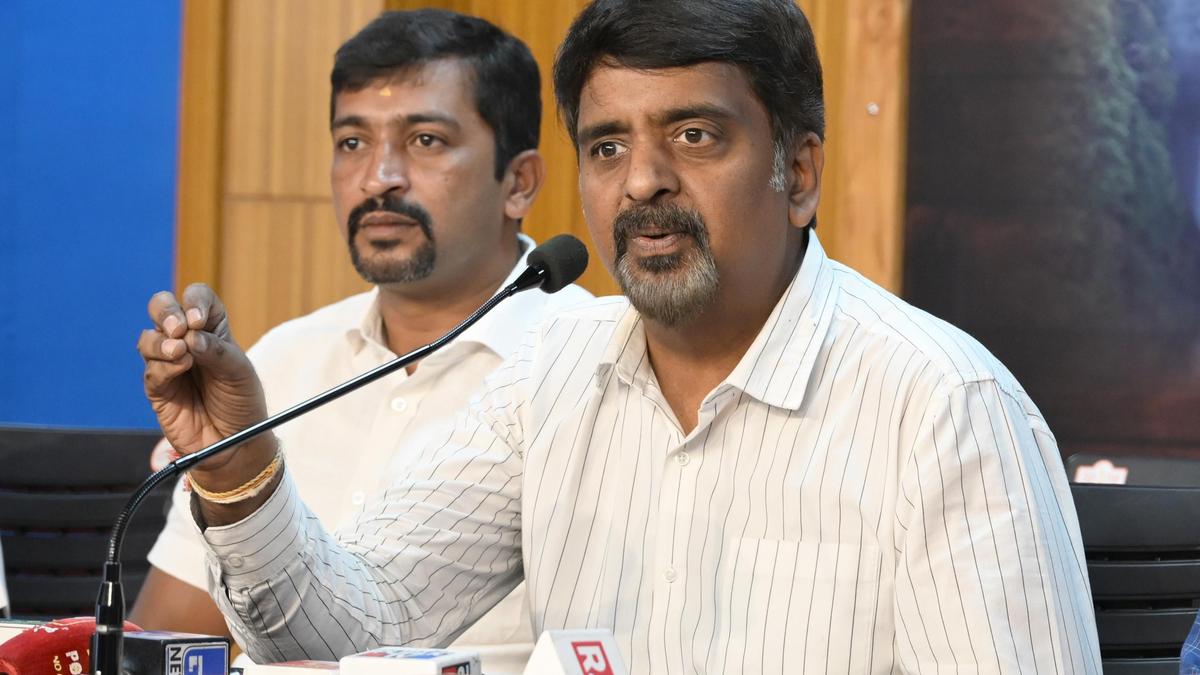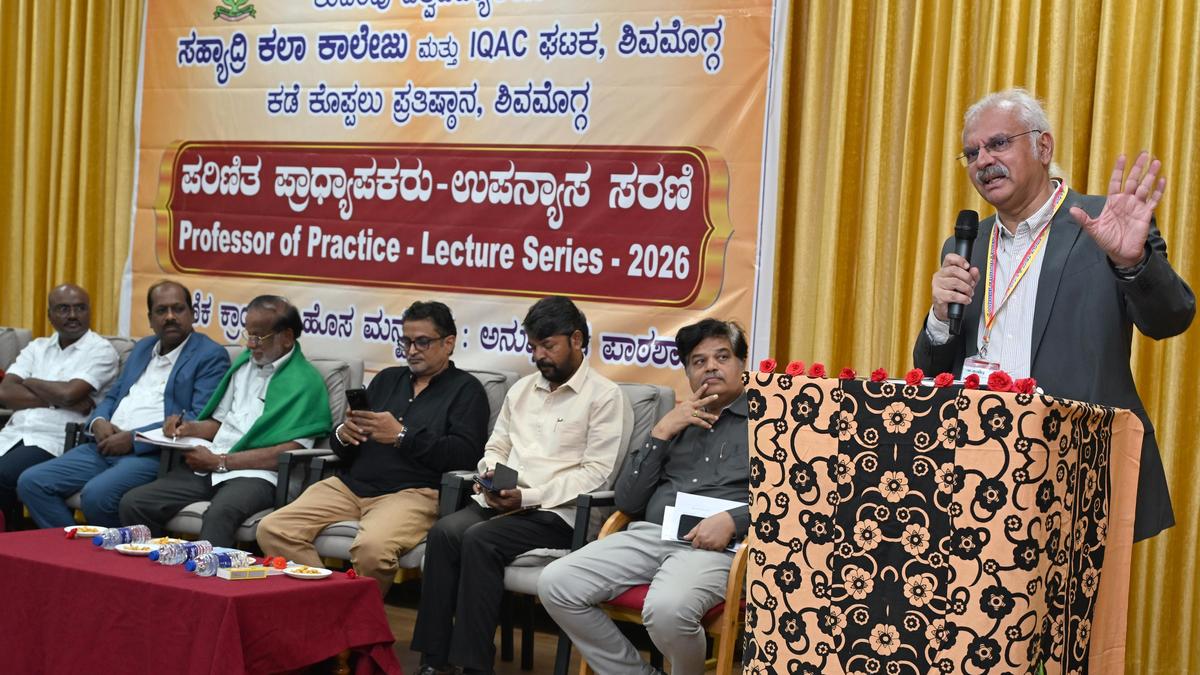
Prof. Sharath Ananthamurthy, Vice-Chancellor of Kuvempu University, addressing the audience after inaugurating a lecture series at Sahyadri Arts College in Shivamogga on Friday.
| Photo Credit: S.K. Dinesh
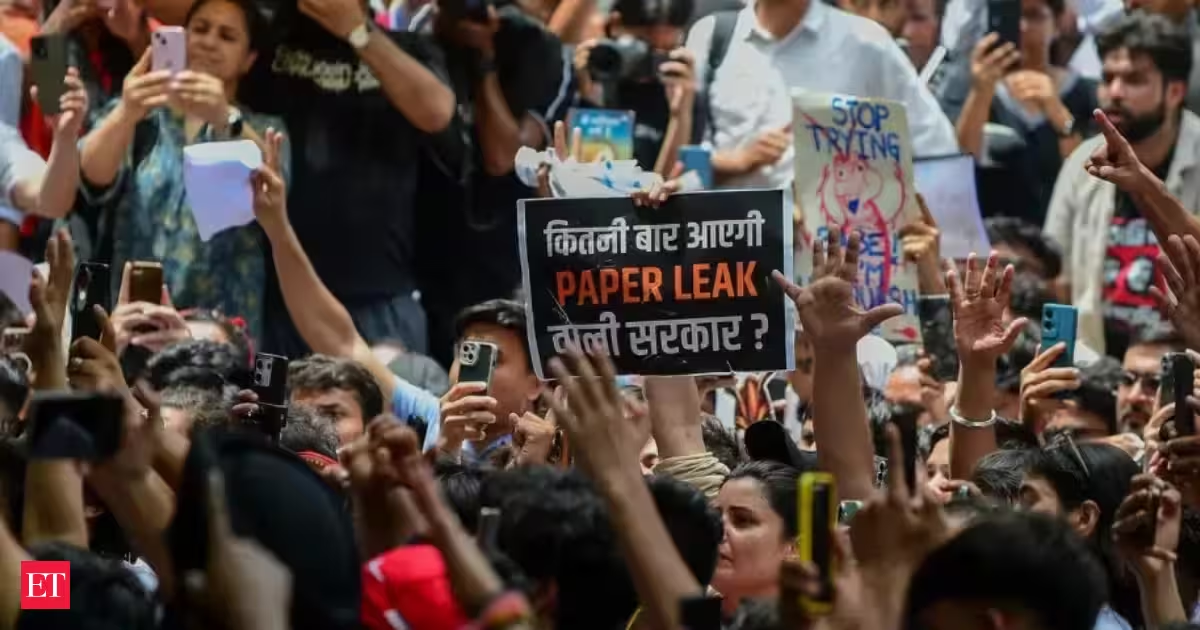
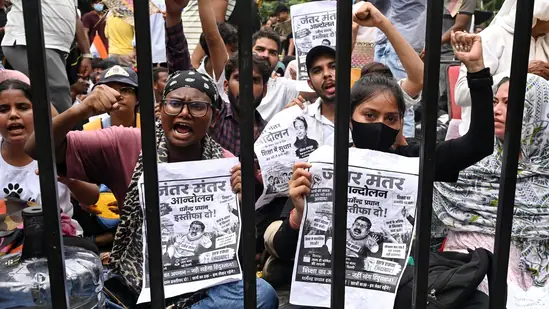
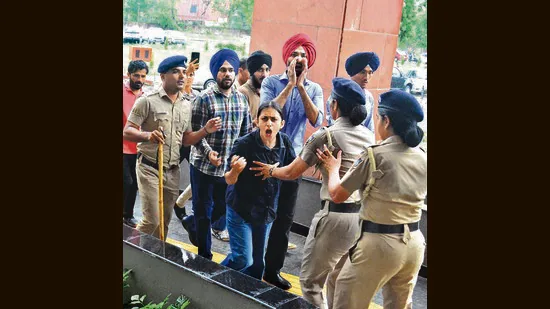
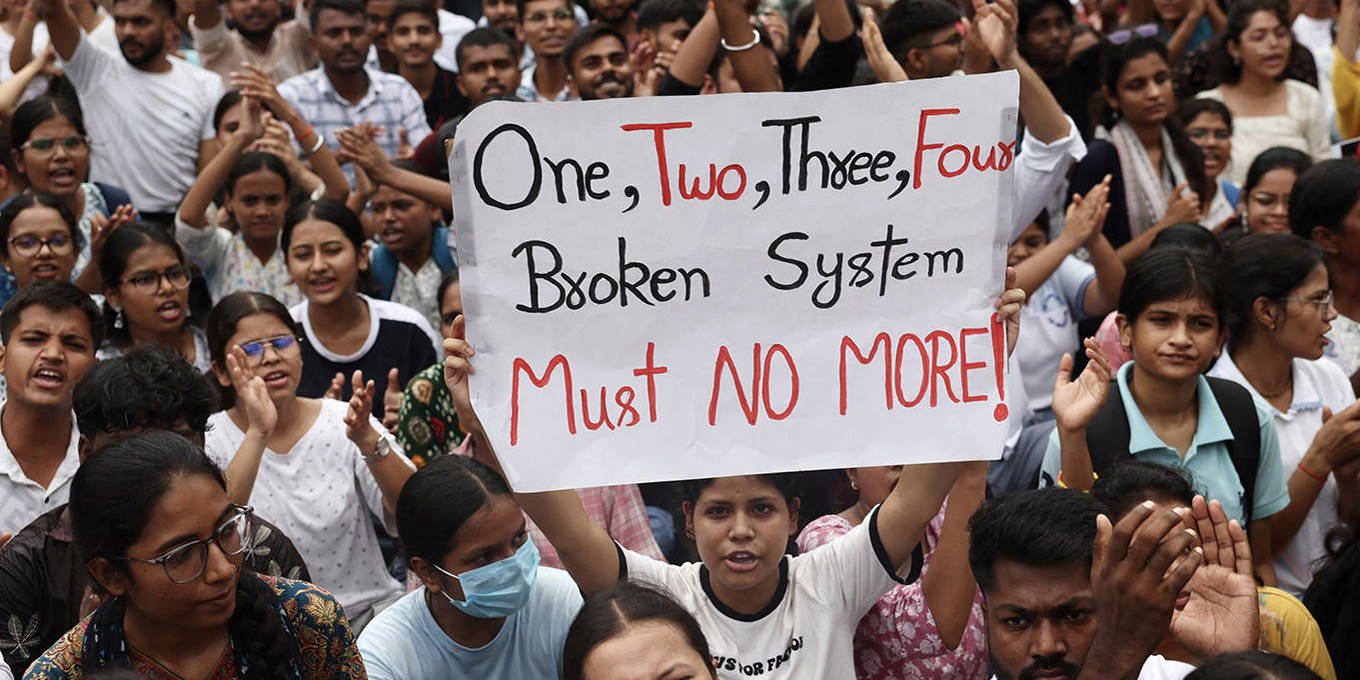
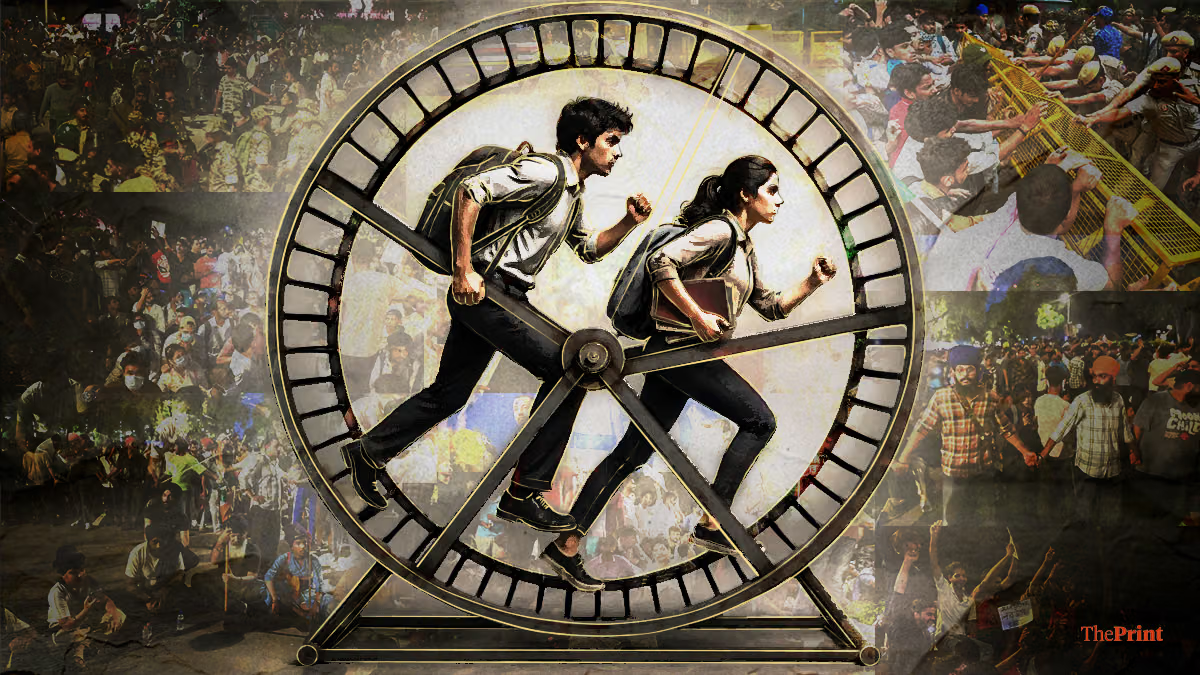
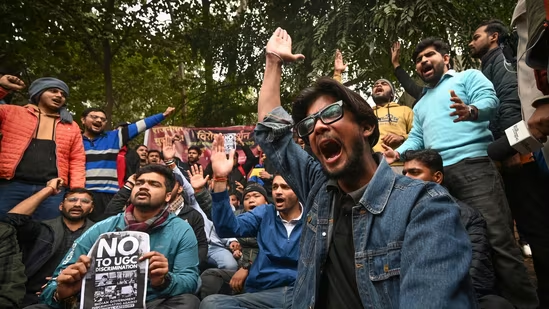
Referring to the ongoing students’ protests, Kuvempu University Vice-Chancellor Prof. Sharath Ananthamurthy said that the protests were pointing towards deeper problems in the education system, besides prompting teachers to introspect.He spoke after inaugurating a series of lectures at Sahyadri Arts College, a constituent college of Kuvempu University, in Shivamogga on Friday.“The students’ protests are not limited to the NEET paper leak, students’ suicides or even the resignation of the Union Education Minister. They are questioning a system that has pushed education without understanding the true meaning of modernity,” he said.The Vice-Chancellor said teachers too needed to introspect and accept that the questions being raised by students were directed at them as well. “These children are pointing fingers at us too. We cannot wash our hands off by saying that politicians are responsible. We are giving them nothing in the name of education,” he said.Closure of schools in dangerThe capitalist system, he said, had “captured everything” and was treating education as a commodity. Nearly 90% of students depended on public universities, while only about 10% went to private universities. However, governments and politicians were giving disproportionate importance to the latter.“Public education is not a concern for any government. Schools are in a bad state. Schools with three or four children are being closed. Even schools with three or four students should not be closed. Even as a symbol, it is dangerous,” he said. Instead of shutting down public institutions, there was a need to think about how public education could be strengthened, he said.He warned against the neoliberal approach of replacing knowledge with skills, terming it dangerous. “Of course, we are not well-versed in skills either. What is a skill? That itself is a question,” he said. A skill taught by someone working in a factory today could become extinct tomorrow, he pointed out, asking whether education should therefore be confined entirely to teaching skills.“We need to think about the foundation we provide for our children. Thinking and reasoning abilities are primary and important. The foundational skills should be embedded in knowledge,” he said. He stressed the need for an interdisciplinary approach to education. If economics was being taught, the course should address the crisis faced by the agrarian community instead of remaining abstract. The issue should also find a place in sociology classes. Similarly, a physics teacher should be able to explain the consequences of atomic energy, he added.NEP-SEPOn the National Education Policy (NEP), the Vice-Chancellor said its true objective was to bring the entire education system under a neoliberal framework. However, he said he found some of its structural aspects acceptable, particularly the scope for an interdisciplinary approach. “A child could go from one subject to another stream easily. A student could easily go to another university with the knowledge acquired in the previous institution. These are some of the good things,” he said. The problem, he said, lay in the distortion of content, particularly history, and an attempt to project one particular community as an enemy. “Keeping aside all that, we could have retained that structure,” he said.“In Karnataka, as if in a running race, we wanted to be the first to implement it. We hurriedly introduced and implemented it without allowing criticism. We spoilt it,” he said. Referring to the State Education Policy (SEP), he said he had been a member of the committee and had arguments with Prof. Sukhadeo Thorat, who headed the committee, on several issues. “What we have brought in again is the same old system. This will not work, and it has not worked. That is why students are not coming and joining us," he said. Published - July 24, 2026 07:58 pm IST