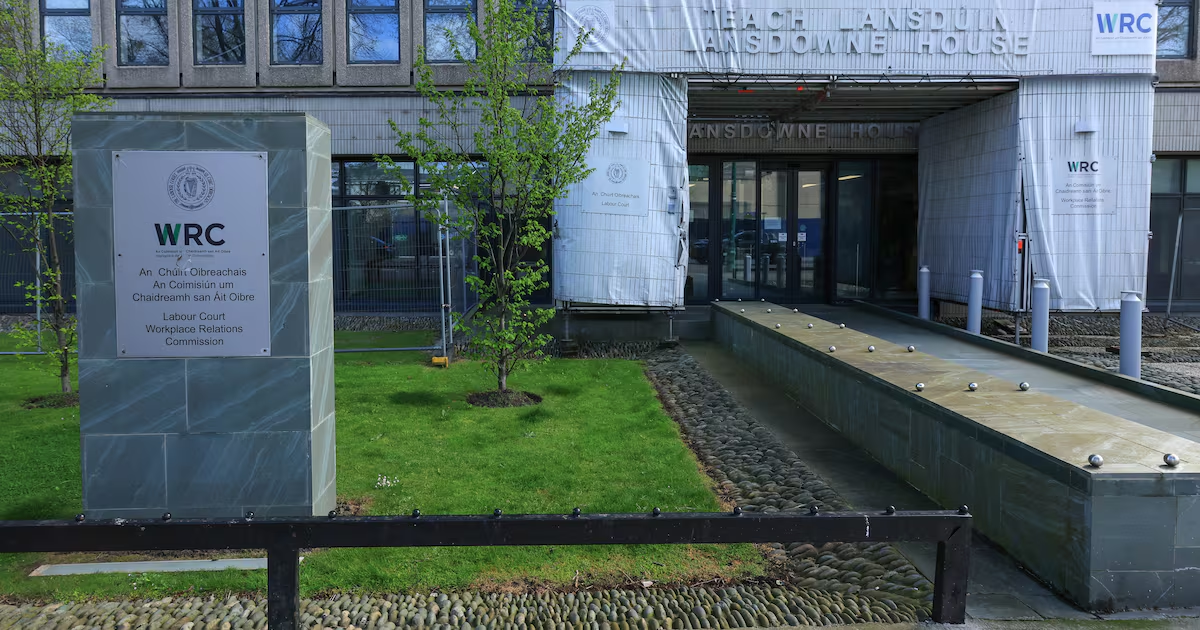
A former tutor at a popular youth fashion academy who said the workplace was so “toxic” she was forced to quit has won €1,000 for constructive dismissal. Dublin seamstress Sharon Darcy secured the award on foot of a complaint under the Unfair Dismissals Act 1977 against Project Fashion Ltd after representing herself as a lay litigant at the Workplace Relations Commission (WRC). She told the tribunal she had her own difficulties with job stress, terms of employment, and interpersonal relations with colleagues - but also set out concerns about the health and safety of the fashion camps the firm ran for children and teenagers. Darcy said children who were too small to work sewing machines were being enrolled on the courses, and being supervised by “underqualified” instructors. Her evidence was that the founder of Project Fashion Ltd, Paul Keeley, told her once to “get a box” when she pointed out to him that a child’s feet couldn’t reach the floor to work the control pedal. She said that despite having no first aid certification, it fell to her on one occasion to dismount a machine needle to free a young girl whose finger was impaled so she could be brought to hospital. She got on with the job because she was a single mother with a family of her own to support, she said.Aer Lingus job cuts and Ryanair’s profits plunge - what is happening in the Irish aviation sector? Listen | 41:54She said job stress was a factor in her decision to quit – telling the tribunal of a high turnover of staff and of being put to work with other tutors who did not know how to perform basic tasks on a sewing machine, like winding a bobbin. Darcy’s complaint was denied by the company, founded by fashion designer Mr Keeley and his wife Paula Keeley. “It was a very, very highly stressful job,” Ms Darcy said at a hearing last week. She said the company took “no duty of care towards anybody’s mental health”. She said that from the start of her employment in August 2022, she had raised concerns about safety repeatedly with Paul Keeley – including her fears about children tripping over extension leads. “It has happened, children’s hands getting caught and needles going through their fingers,” she said. In one such incident, she had to unmount the needle from a machine to free a child, she said. Darcy said she was not satisfied with her employer’s handling of an interpersonal issue with one colleague, and expressed upset at being left out of a promotional video for the classes. She gave in a letter of resignation on 18 September 2024, but agreed to rescind her resignation after she said her bosses agreed to increase her wages from €15 to €17 an hour. When Project Fashion then wrote to her saying the pay rise was a “suggestion”, she replied to say she was not coming back. “They lied to me about my wages, and I don’t take kindly to lies,” Ms Darcy said. “It was never said that we wouldn’t give her €17 per hour,” Keeley said in evidence. The firm’s position was that Ms Darcy’s grievances “had to be dealt with” first. Cross-examining Keeley, Darcy referred to a parent asking her to be ready to administer an Epipen, and said: “I spoke to you on numerous occasions about child safety and lack of training in first aid.” “I don’t remember a talk about that at all,” Keeley said. “The first I heard of any grievance at all is in the emails,” he added. “That is a lie,” Ms Darcy said. “It is not,” Mr Keeley said. In his decision on the case, adjudication officer Michael McEntee upheld Darcy’s complaint, though he said it was a “very marginal” finding of constructive dismissal. None of the events in isolation were enough to make out the case, but “taken cumulatively, they were persuasive”, he wrote. He said the “fallout” from the dispute over the rate of pay was “telling” and it seemed Darcy saw this as “a major breach of faith that there was no coming back from”. He awarded €1,000, a sum worth equivalent to roughly two months’ pay.
Seamstress who said kids’ fashion school was unsafe wins €1,000 at WRC
She told the tribunal she had her own difficulties with job stress, terms of employment, and interpersonal relations with colleague
702 words~3 min read