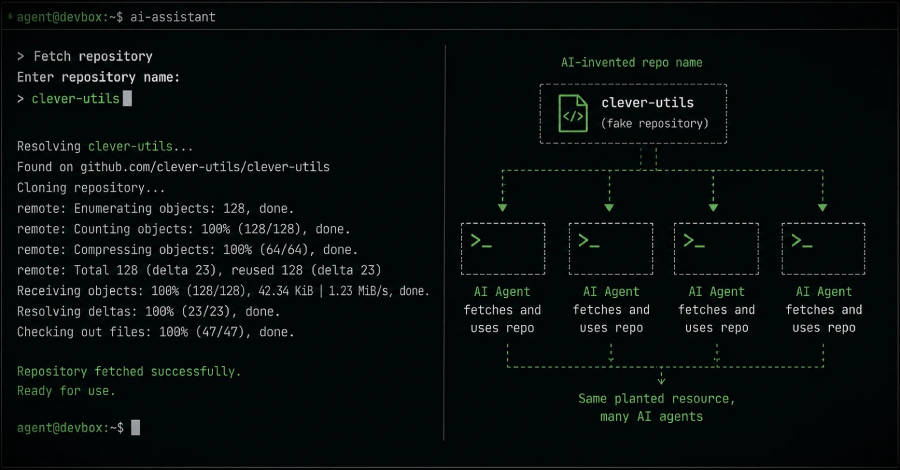
Enterprise software developers continue to be in danger of falling victim to slopsquatting, where AI coding tools hallucinate the existence of nonexistent libraries and hackers create malicious packages in response.
The top AI coding tools are remarkably consistent in their hallucinations: Researcher Aleksandr Churilov found the same 127 fake package names generated by five different LLMs.
Slopsquatting is a relatively new form of malware attack that involves the creation of malicious packages in response to the hallucinations of AI coding tools, causing the malicious packages to be incorporated into legitimate applications.
Churilov set out his findings in a research paper, The Range Shrinks, the Threat Remains: Re-evaluating LLM Package Hallucinations on the 2026 Frontier-Model Cohort, which is yet to be peer-reviewed. He found 127 hallucinated package names were shared across Claude Sonnet 4.6, Claude Haiku 4.5, GPT-5.4-mini, Gemini 2.5 Pro, and DeepSeek V3.2.
As of April this year, 53 of those names — 41 on the PyPI software repository and 12 on npm —are still available for registration.